Why Landscape Painting Gained Prestige in the 17th and 18th Centuries
Landscape painting has not always held the high status it enjoys today. In fact, for much of art history, landscapes were considered minor, decorative subjects, secondary to grand religious narratives, royal portraiture, or mythological epics. Yet by the 17th and 18th centuries, this humble genre transformed into one of the most celebrated and respected categories of European art. Paintings of fields, rivers, skies, and mountains found their way into elite homes, prestigious collections, and royal palaces. Artists who once struggled for recognition became cultural icons, and the landscape itself, long taken for granted as mere setting, emerged as a protagonist worthy of artistic reverence.
This 2400-word article explores why landscape painting gained prestige in the 17th and 18th centuries, examining the cultural, scientific, philosophical, and economic shifts that powered its ascent. From Dutch Golden Age realism to Enlightenment naturalism, we will explore how landscapes became a powerful visual language that reflected society’s changing relationship with nature, science, and national identity, and why collectors today continue to prize works from this pivotal era.
From Decorative Background to Artistic Centerpiece: Landscapes Before the 17th Century
To understand why landscape painting rose in importance, one must first recognize how low it stood on the artistic hierarchy for centuries. In the medieval and early Renaissance periods, landscape was rarely the primary subject of a painting. Instead, it served as a backdrop for biblical stories, mythological figures, or portraits of powerful patrons. The landscape’s purpose was symbolic, spiritual, or atmospheric, but seldom the primary focus.
This bias was reinforced by the academic hierarchy formalized by institutions like the French Academy, where history painting, depicting gods, heroes, and moral narratives, was ranked the most prestigious genre. Below it were portraits, genre scenes, and still life. At the bottom was landscape.
Why was it ranked so low? Because landscape had no inherent moral lesson, no heroic action, no divine figure. It represented the natural world, and the natural world, unchanged by human hands, was considered intellectually inferior. Artists might paint landscapes for pleasure or as exercises in atmospheric perspective, but they could not expect serious acclaim for them.
This would change dramatically beginning in the 17th century, driven by economic expansion, scientific revolution, philosophical transformations, and shifting patronage.
The Dutch Golden Age: Where Landscapes Became Cultural Identity
The first major breakthrough in elevating the genre occurred in the Dutch Republic during the 17th century. Unlike Catholic southern Europe, where Church patronage dominated artistic production, the Protestant Dutch Republic fostered an entirely different model: a free market for art driven by private buyers, merchants, and middle-class collectors.
Middle-Class Buyers Wanted Real Scenes, Not Mythology
Because Dutch society was less interested in grand religious imagery, artists catered to a new audience with new tastes. Landscapes, familiar scenes of rivers, farms, windmills, and city views, resonated deeply with Dutch buyers who took pride in their growing nation, its reclaimed lands, and its mercantile prosperity.
This democratization of art collecting was revolutionary. Artists no longer depended solely on aristocratic or clerical commissions. They could paint daily life, and landscapes sold extremely well.
The Landscape as National Pride
The Dutch had literally shaped their environment through engineering, dredging, and land reclamation. As a result, paintings of flat horizons, stormy skies, and orderly farmlands became visual expressions of collective identity. Landscapes symbolized stability, resilience, independence, and economic triumph. Artists like Jacob van Ruisdael, Aelbert Cuyp, and Meindert Hobbema created atmospheric masterpieces that captured the spirit of Dutch life.
Scientific Realism and Weather Studies
Another reason landscape gained prestige in the Netherlands was its connection to scientific observation. The Dutch Golden Age was a period of empirical study, in cartography, meteorology, optics, and botany. Artists mirrored this intellectual enthusiasm by painting skies and weather patterns with astonishing precision.
Cloud studies, light effects, and naturalistic textures brought landscapes closer to truth. For the Dutch public, this realism was not only beautiful but trustworthy, a scientific record of the world they knew.
The result was a profound shift: landscape painting became a serious, respected art form connected to national pride, scientific accuracy, and personal identity.
Italy and the Classical Ideal: The Rise of the Arcadian Landscape
While the Dutch celebrated realistic depictions of their homeland, Italian and French artists in the 17th century approached landscape differently, through the lens of ideal beauty and classical harmony.
Claude Lorrain and Nicolas Poussin: Architects of the Ideal Landscape
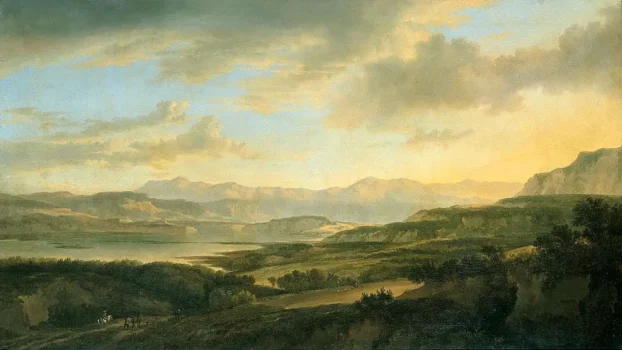
Artists such as Claude Lorrain and Nicolas Poussin crafted idyllic scenes filled with golden light, balanced compositions, classical ruins, and pastoral tranquility. Their landscapes were not tied to national identity but to a timeless vision of nature perfected.
These “ideal landscapes” blended mythological elements with a poetic, harmonious natural world, offering viewers escape, contemplation, and serenity.
The Role of the Grand Tour
By the 18th century, wealthy young Europeans embarked on the Grand Tour, gathering classical knowledge, antiquities, and art. They wanted souvenirs that captured Italy’s beauty and ancient past. Landscapes filled this demand perfectly.
Collectors purchased large numbers of Italian landscapes, especially those by Canaletto, Guardi, and Panini, whose luminous cityscapes and architectural vistas became cultural trophies.
Landscapes as Intellectual Exercises
The classical landscape’s prestige was also reinforced by academic theory. Because artists like Poussin infused moral meaning, historical allusion, and classical references into their works, landscapes began to edge closer to history painting in intellectual significance. They were no longer merely representations of nature, they were scenes of cultural refinement.
Nature as a Source of Knowledge
The 17th and 18th centuries were marked by the Scientific Revolution, a period when the natural world became a subject of intense curiosity. Observation, measurement, and classification transformed how Europeans understood the environment.
Nature as a Rational System
As thinkers like Descartes and Newton advanced new ideas about the universe, artists mirrored this shift by representing nature more analytically: studying geology, atmospheric perspective, and the behavior of light.
Landscape painters positioned themselves as observers of truth, aligning with the scientific method.
Botanical Expeditions and Global Exploration
The rise of global trade and exploration brought new plants, animals, and geographical knowledge to Europe. Naturalists illustrated exotic landscapes, and artistic curiosity expanded beyond the familiar.
This scientific excitement elevated the genre’s intellectual value, making landscape painting a respected form of empirical observation.
Philosophical Transformations: Nature, Emotion, and the Human Spirit
Parallel to scientific inquiry, philosophical ideas about nature underwent a transformation.
Rousseau and the Virtue of Nature
Jean-Jacques Rousseau argued that nature represented purity, morality, and human authenticity, a counterpoint to the corruption of cities and courts. His ideas profoundly shaped European culture.
Landscape painting became a vehicle through which viewers could contemplate simplicity, freedom, and emotional truth.
The Sublime and the Picturesque
Philosophers like Edmund Burke introduced concepts that reshaped artistic taste:
The Sublime celebrated awe, power, terror, and vastness, seen in stormy seas, mountains, and dramatic skies.
The Picturesque embraced irregularity, rustic beauty, and textured landscapes.
These theories elevated landscape painting by giving it emotional and intellectual depth. Artists were no longer depicting simple scenery, they were exploring the human condition.
The Moral Landscape
Landscape became a stage for philosophical reflection. Whether representing harmony, divine order, or emotional intensity, landscapes allowed artists and viewers to engage with the world beyond the physical. Nature became a metaphor for life, morality, and the human soul.
From Aristocratic Power to Cultural Taste
By the late 17th and early 18th centuries, changes in patronage played a crucial role in landscape painting’s rise.
Decline of Religious Commissions
As Europe secularized, Church commissions decreased. This reduction in demand for religious narratives opened the artistic market to new genres, and landscape benefited significantly.
Rise of Secular Collectors
Aristocrats, merchants, scholars, and travelers collected art to express taste, education, and sophistication. Landscapes became symbols of refinement.
Royal Patronage and Landscape Gardens
Kings and nobles, especially in France and England, invested heavily in landscape gardens designed to reflect philosophical ideals. The taste for cultivated nature translated into a taste for painted landscapes that echoed these ideals.
British Landscape Traditions: From Topography to Poetic Nature
Britain played a major role in landscape painting’s 18th-century prestige.
The Picturesque and Landscape Gardens
British estates embraced naturalistic garden design, influenced by Burke’s ideas. This movement strengthened interest in landscape aesthetics.
Topographical Painting and National Pride
Artists such as J.M.W. Turner’s predecessors documented castles, rivers, and countryside scenes. These works fostered national identity and patriotic sentiment, similar to the Dutch example.
Emergence of Turner and Constable
By the late 18th and early 19th centuries, Turner and Constable propelled landscape to the highest artistic heights. Their innovations were rooted in the philosophical and scientific foundations laid in the previous century.
Urban Growth and the Desire for Nature
As Europe industrialized and cities expanded, nature became something to be missed. Landscapes offered psychological escape and nostalgia.
Nature as Luxury
For elite collectors, landscape paintings symbolized tranquility amid the pressures of modern life. They created private worlds of calm within urban interiors.
Collecting as Social Status
Owning a landscape by a major master conveyed intellectual sophistication, cultural literacy, and connection to philosophical trends.
Increasing Art Literacy
Art academies, salons, and publications taught the public how to “read” landscapes. As appreciation deepened, so did demand.
How Landscape Painting Achieved Lasting Prestige
By the end of the 18th century, landscape painting had fully escaped its minor-genre status.
It Satisfied Both Reason and Emotion
Landscape painting uniquely balanced:
Empirical observation
Philosophical depth
Emotional expression
National identity
No other genre combined these intellectual and sensory elements so harmoniously.
It Reflected Changing Worldviews
As Europeans shifted from religious to secular identities, from monarchy to enlightenment, from superstition to science, landscapes provided a visual language for modern thinking.
It Became Universal
Unlike religious or mythological scenes, landscapes required no cultural or linguistic knowledge. Anyone could appreciate them. This universality made them enduringly popular.
Why Collectors Today Still Prize 17th- and 18th-Century Landscapes
Modern collectors remain captivated by this period’s landscapes for several reasons.
Historical Significance
These works represent a turning point in art history and reflect social, scientific, and philosophical revolutions.
Technical Mastery
Artists like Ruisdael, Lorrain, Cuyp, Canaletto, and Hobbema achieved exceptional atmospheric realism, optical sophistication, and compositional balance.
Cross-Market Appeal
Landscapes fit seamlessly into both historical and contemporary interiors, expanding their desirability across demographics.
Investment Stability
Old Master landscapes remain strong performers on the art market due to their historical importance and steady demand among collectors.
Emotional and Aesthetic Timelessness
The calming nature of landscape imagery makes it perpetually relevant. Collectors prize these works because they evoke serenity, contemplation, and connection to the natural world.
A Genre Transformed Forever
The prestige of landscape painting in the 17th and 18th centuries was not a sudden change but the result of many intertwined forces. From the rise of the Dutch merchant class to the philosophical musings of Enlightenment thinkers; from scientific discoveries to global exploration; from the decline of religious patronage to the rise of personal collecting, the landscape became a mirror of European society’s evolution.
What began as mere background grew into a respected genre that captured reality, imagination, philosophy, and national identity. For today’s collectors, these works offer more than visual pleasure, they provide a window into one of the most influential eras of artistic transformation.
Landscape painting became great not simply because artists wanted it to be, but because society itself changed. Nature became knowledge, beauty, escape, identity, and emotion. And in the hands of 17th- and 18th-century masters, the landscape became art’s grandest stage, one that still captivates collectors and historians centuries later.