12 Legendary Collectors Who Changed the Art World
Why Legendary Collectors Matter More Than We Think
Art history is often written through the lens of artists, but another equally powerful group shapes the narrative behind the scenes: collectors. Their choices, what they buy, support, preserve, or publicize, can determine the survival of entire artistic movements. They influence market values, help define institutional tastes, and sometimes rescue masterpieces from obscurity or destruction.
These 12 legendary collectors did more than accumulate beautiful objects. They championed radical ideas during moments of resistance, invested in artists who lacked support, built museums that transformed cities, and helped create the cultural ecosystems we now take for granted.
Below is an expanded exploration of the 12 Legendary Collectors Who Changed the Art World, their vision, their histories, and their enduring influence.
1. Peggy Guggenheim : The Patron Saint of Modern Art
Expanded Description & History
Peggy Guggenheim (1898:1979), heiress to the Guggenheim mining fortune, became one of the most influential figures in the development of modern art. After moving to Paris in the 1920s, she fell into the orbit of André Breton, Marcel Duchamp, Max Ernst, and other avant-garde thinkers who sparked her passion for collecting.
During World War II, Peggy undertook one of the most heroic collecting operations in history. As fascism spread, she purchased works by artists like Kandinsky, Miró, Mondrian, and Ernst at a pace of “one a day,” partly to preserve artistic heritage from destruction. She arranged visas for endangered artists, helping several escape Europe.
Her New York gallery, Art of This Century (opened 1942), became the launchpad for American Abstract Expressionism. Peggy was instrumental in supporting a young Jackson Pollock, even paying him a monthly stipend so he could create full-time.
In 1948 she showcased her collection at the Venice Biennale, an unprecedented move that introduced groundbreaking American art to Europe. Her Venice palazzo, now the Peggy Guggenheim Collection, remains one of the world’s top modern art museums.
2. Gertrude Stein : The Mother of Modernism
Expanded Description & History
Gertrude Stein (1874:1946), together with her brother Leo, created one of the earliest and most important private collections of modern art in Paris. The Stein family arrived in Paris in the early 1900s, just as a wave of revolutionary creative energy broke across the city.
Their apartment at 27 rue de Fleurus became a legendary salon. Every Saturday night, avant-garde artists, writers, and intellectuals gathered to see the Steins’ acquisitions, Cézannes stacked two deep, early Picassos, radical works by Henri Matisse, and more.
Stein wasn’t merely a collector: she was a cultural catalyst. She recognized Picasso’s genius before the art world did, becoming both his patron and close confidant. She supported Matisse even when critics dismissed his bold color experiments. Her writing, dense, experimental, and modernist, further cemented her role as a key influencer in the formation of modern culture.
Stein’s early patronage provided artists with visibility, financial stability, and social networks. Without her, the trajectory of modern art in Paris may have looked very different.
3. Isabella Stewart Gardner : The American Original Who Built a Living Museum
Expanded Description & History
Isabella Stewart Gardner (1840:1924) was a Boston socialite turned global art adventurer. After inheriting a fortune, she traveled extensively through Europe, the Middle East, and Asia, collecting everything from Venetian paintings to rare manuscripts, medieval textiles, and Asian ceramics.
Unlike traditional collectors, Gardner believed that art should be experienced emotionally. When she returned to Boston with an extraordinary collection of Old Masters, including works by Titian, Rembrandt, Botticelli, and Vermeer, she didn’t store them away. Instead, she built a Venetian-style palace called Fenway Court, designing every room based on her personal, intuitive aesthetic.
She curated the museum as a complete artwork, arranging objects in spiritual harmony rather than by academic categories. After her death, she left strict instructions: the museum layout could never be altered.
This unconventional vision has made the Isabella Stewart Gardner Museum one of the most atmospheric and influential museums in the world. Even the infamous 1990 art heist, still unsolved, has become part of her enduring legacy.
4. Charles Saatchi : The Contemporary Disruptor
Expanded Description & History
Charles Saatchi (born 1943) is perhaps the most powerful art collector of the late 20th and early 21st centuries. After achieving massive success as co-founder of the Saatchi & Saatchi advertising empire, he turned his marketing instincts toward art.
Saatchi’s collecting style broke all the traditional rules. He bought big, bought bold, and was unafraid of controversy. In the late 1980s and early 1990s, he began acquiring works from emerging British artists, many fresh out of art school.
His 1992 exhibition “Young British Artists” and the subsequent “Sensation” show (1997) launched the careers of:
Damien Hirst
Tracey Emin
Sarah Lucas
Rachel Whiteread
Chris Ofili
Saatchi didn’t just collect; he shaped the narrative. His willingness to use shock, media attention, and spectacle helped propel contemporary British art onto the global stage.
His institution, Saatchi Gallery, continues to champion new movements, demonstrating how a single collector can influence cultural identity on a national scale.
5. François Pinault : The Global Museum Builder
Expanded Description & History
François Pinault (born 1936), founder of the Kering luxury group (Gucci, Balenciaga, Saint Laurent), is one of the most influential art collectors alive today. Pinault began collecting in the 1970s but expanded aggressively in the 1990s with a focus on contemporary art.
What makes Pinault exceptional is scale, taste, and infrastructure. He built not one but several museums to house his holdings:
Palazzo Grassi in Venice
Punta della Dogana in Venice
Bourse de Commerce : Pinault Collection in Paris
These institutions show rotating exhibitions drawn from his 10,000-piece collection, including giants like Jeff Koons, Cindy Sherman, Kerry James Marshall, Rudolf Stingel, and Maurizio Cattelan.
Pinault’s role in revitalizing Venice as a contemporary art hub, alongside the Venice Biennale, cannot be overstated. His commitment demonstrates how private collectors can transform global cultural ecosystems.
6. Solomon R. Guggenheim : The Industrialist Who Fell in Love with Abstraction
Expanded Description & History
Solomon R. Guggenheim (1861:1949) was a mining magnate who, late in life, developed a fascination for abstract art. Guided by artist and curator Hilla von Rebay, Guggenheim embraced “non-objective” art, works emphasizing form, color, and spirituality over representation.
In an era when abstract art was misunderstood and dismissed, Guggenheim invested heavily in artists such as:
Wassily Kandinsky
Paul Klee
László Moholy-Nagy
Piet Mondrian
He founded the Museum of Non-Objective Painting in 1939, the precursor to today’s iconic Solomon R. Guggenheim Museum. Frank Lloyd Wright’s revolutionary venue opened in 1959, ten years after Guggenheim’s death, and became an international symbol of modernism.
His collection and vision set the foundation for the global Guggenheim network spanning Bilbao, Venice, and Abu Dhabi.
7. Paul Durand-Ruel : The Dealer Who Saved the Impressionists
Expanded Description & History
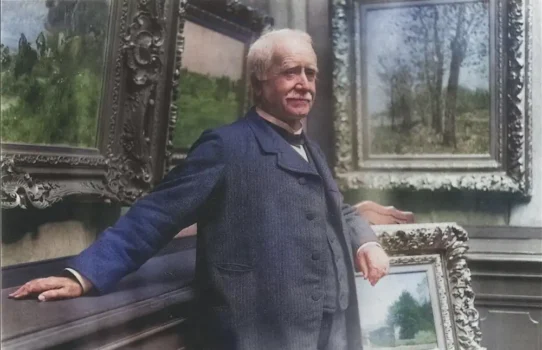
Paul Durand-Ruel (1831:1922) was not only a collector but a daring art dealer whose commitment saved the Impressionists from poverty and obscurity. He discovered them in the 1870s, Monet, Renoir, Pissarro, Sisley, at a time when critics mocked their style.
Durand-Ruel purchased thousands of their works, often during periods when the artists had no income. His financial support kept entire movements alive.
He also pioneered modern methods of exhibition marketing, organizing touring shows across Europe and the United States. His successful exhibitions in the U.S. in the 1880s and 1890s dramatically changed public perception, turning Impressionism into a beloved global movement.
Monet later said:
“We would have died of hunger without Durand-Ruel.”
8. J. Paul Getty : The Reluctant Collector Who Created a Cultural Empire
Expanded Description & History
J. Paul Getty (1892:1976), once called “the richest man in America,” developed an interest in antiquities early in life. Though known for his frugality in business, Getty splurged on rare books, European paintings, Greek and Roman sculpture, and decorative arts.
He built the Getty Villa in Malibu, modeled after a Roman villa buried by Vesuvius. After his death, the Getty Trust used his enormous endowment to expand into:
The Getty Center
Getty Conservation Institute
Getty Research Institute
Getty Foundation
Today, the Getty is one of the wealthiest cultural organizations in the world, funding global preservation projects and supporting scholarship in art history and conservation.
Getty’s legacy extends well beyond collecting, he helped professionalize cultural preservation on a global scale.
9. Dominique de Menil : The Humanist Collector
Expanded Description & History
Dominique de Menil (1908:1997), along with her husband John, built a profoundly thoughtful art collection defined by spirituality, intellectualism, and cross-cultural dialogue.
Originally from France, the couple relocated to Houston, where they became passionate advocates for modern and contemporary art. Dominique’s vision led to the creation of:
The Menil Collection
Rothko Chapel
Byzantine Fresco Chapel
Her collecting taste was broad and empathetic, African art, Surrealism, Catholic icons, Abstract Expressionism. She had deep relationships with artists like Cy Twombly, Max Ernst, Mark Rothko, and Dan Flavin.
The Rothko Chapel, with its meditative atmosphere and monochrome paintings, remains one of the most spiritually significant art environments in the world.
10. Eli Broad : The Collector Who Rebuilt Los Angeles’ Art Landscape
Expanded Description & History
Eli Broad (1933:2021) was a self-made billionaire whose philanthropic vision transformed Los Angeles into a world art capital. Broad began collecting in the 1970s, focusing on postwar and contemporary art.
His collection includes works by:
Jeff Koons
Jasper Johns
Jean-Michel Basquiat
Cindy Sherman
Broad co-founded the Museum of Contemporary Art (MOCA) in 1979, helping stabilize its finances for decades. In 2015, he opened The Broad, a major free-admission museum in downtown L.A., showcasing 2,000+ works.
Broad’s philanthropic mission was clear: make art accessible to the public. His investments reshaped downtown Los Angeles and helped cultivate an arts ecosystem rivaling New York.
11. Sergei Shchukin : The Russian Industrialist Who Brought Modernism East
Expanded Description & History
Sergei Shchukin (1854:1936) was a Moscow-based textile magnate who built one of the most forward-thinking collections of modern French art. Shchukin had an uncanny ability to identify genius. Starting with Monet and Gauguin, he moved toward more daring works by Picasso and Matisse.
At a time when many Europeans rejected the avant-garde, Shchukin bought more than 40 Picassos and commissioned major works from Matisse, including “The Dance” and “The Music.”
His Moscow mansion became a private museum, open to students and the public. After the Russian Revolution, his collection was nationalized and divided between the Hermitage Museum and the Pushkin Museum.
Shchukin’s patronage brought radical modernism to Russia decades before it was widely accepted.
12. Baron Hans Heinrich Thyssen-Bornemisza : The Man With the “Collection of Collections”
Expanded Description & History
Baron Hans Heinrich Thyssen-Bornemisza (1921:2002) inherited a significant part of the Thyssen family collection and expanded it into one of the largest private art collections in the world.
His holdings spanned 700 years of art history:
Italian Renaissance
Dutch Golden Age
Impressionism
German Expressionism
20th-century modernism
In the late 1980s, he negotiated with Spain to establish the Museo Nacional Thyssen-Bornemisza in Madrid, which opened in 1992. The museum filled gaps in Spain’s national collections, creating a perfect triad with the Prado and Reina Sofía.
Thyssen’s inclusive vision, mixing Old Masters with modernism, reshaped museum presentation standards worldwide.
How These Collectors Changed the World of Art Forever
These 12 legendary collectors left monumental legacies by:
championing avant-garde artists
creating daring museums
defining aesthetics of entire eras
influencing markets and institutions
protecting cultural heritage
Their stories remind us that the power of collecting lies not just in acquiring art, but in preserving culture, enabling innovation, and sharing beauty with the world.