The 12 Most Exclusive Art Auctions Ever Held
A Collector’s Guide to Legendary Sales, High-Stakes Drama, and the Masterpieces That Shaped the Market
In the world of fine art collecting, there are auctions, and then there are the seismic, culture-shifting events that redefine the market, rewrite auction records, and, sometimes, alter the perceived value of entire artistic periods. These are the sales whispered about in collector circles, studied by economists, and remembered by auction house veterans as the moments when the art market proved its capacity for spectacle, excess, and breathtaking ambition.
Below is an in-depth journey through the twelve most exclusive art auctions of all time. Each section explores where it happened, when it took place, what was sold, how the bidding played out, and why the auction became legendary. For collectors, each sale offers a lesson, about timing, provenance, global wealth trends, and the addictive thrill of acquiring a masterpiece with a story as powerful as the work itself.
The Rockefeller Collection Sale – Christie’s, New York (2018)
A philanthropic triumph and the most valuable auction in history.
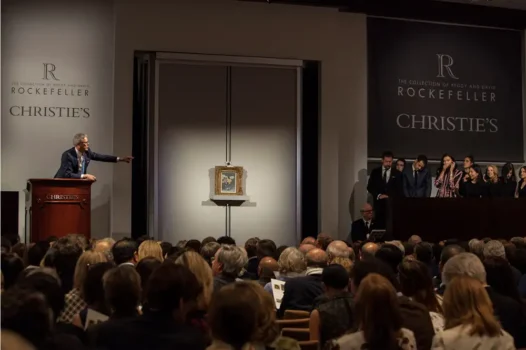
The 2018 Rockefeller auction at Christie’s was not just an event, it was a cultural phenomenon. Held across several days in New York, the sale liquidated the storied private collection of David and Peggy Rockefeller, heirs to one of America’s most historically influential families. Christie’s spent nearly a year preparing the auction, transforming it into a global tour spanning London, Shanghai, Los Angeles, and Paris.
The collection included Impressionist icons, porcelain, rare furniture, and decorative arts. What made it extraordinary was not merely the quality of the works but the sheer scale of philanthropy: every dollar, more than $835 million, went to charity.
The star of the sale was Picasso’s “Young Girl with a Flower Basket”, which soared to $115 million. Works by Monet, Matisse, and Gauguin triggered bidding wars that broke genre records.
Collectors viewed this auction as both a once-in-a-lifetime buying opportunity and a chance to participate in a cultural legacy. For many, the Rockefeller name represented a type of American cultural stewardship that will likely never be replicated.
Salvator Mundi – Christie’s, New York (2017)
The most expensive painting ever sold, and the most controversial.
When Leonardo da Vinci’s “Salvator Mundi” appeared at Christie’s Post-War and Contemporary sale in 2017, the art world was stunned. It was an odd choice: the work was placed among Basquiats and Warhols rather than Old Masters. But Christie’s understood spectacle and engineered an atmosphere that made history possible.
The painting, rediscovered and restored in the early 2000s, had traveled from obscurity to attribution debates, to Russian oligarch ownership, and finally to the auction stage. As bidding opened, the price quickly shot past expectations. A final phone bid, later revealed to be on behalf of Saudi Crown Prince Mohammed bin Salman, pushed the price to $450.3 million, shattering all previous world records.
The sale’s significance lies not only in the cost but in its lingering questions: Is the work fully autograph Leonardo? Where exactly is it now? And did its astronomical price reset expectations for Old Masters in the 21st century?
Collectors saw the auction as a cautionary tale about attribution, restoration, and the market’s appetite for mythmaking.
Yves Saint Laurent & Pierre Bergé Collection – Christie’s, Paris (2009)
The auction that revived Paris as a market center.
Known simply as the “Sale of the Century,” this three-day auction liquidated the private collection of fashion designer Yves Saint Laurent and his partner Pierre Bergé. Held inside the Grand Palais, a fittingly theatrical setting, it became a cultural event rather than a mere sale.
The collection was breathtaking: Old Masters, Modernist masterpieces, Chinese bronzes, rare furniture, sculpture, and objets d’art. The auction achieved $483 million, a staggering sum during the global financial crisis.
The emotional highlight came when a bronze Chinese zodiac head became embroiled in cultural and political controversy, with China demanding its return. A bidder later refused to pay on ethical grounds, deepening the drama.
Collectors still study this sale as the blueprint for curated, narrative-driven auctions where personality, provenance, and myth combine to create explosive bidding.
The Collection of Peggy and David Rockefeller – Online Segment (2018)
The first major online sale to break records, and a new era of digital bidding.
Separate from the live Rockefeller auction, Christie’s hosted an online segment featuring smaller works, decorative pieces, and personal memorabilia. Though expected to earn modest sums, the sale surpassed $106 million, proving that digital platforms could handle high-value art with ease.
This online event changed collector behavior permanently. It demonstrated that provenance could elevate even modest objects, like silverware or travel mementos, into coveted collectibles.
For collectors today, the Rockefeller online sale remains a landmark in understanding how prestige can elevate categories beyond painting and sculpture.
The Elizabeth Taylor Jewelry Auction – Christie’s, New York (2011)
When glamour met record-setting jewelry bids.
In December 2011, Christie’s unveiled one of the most visually stunning auctions ever held: the personal jewelry collection of actress Elizabeth Taylor. The sale featured pieces gifted by Richard Burton, rare diamonds, Bulgari sets, and historical jewels.
The highlight was Taylor’s 33-carat diamond, which fetched $8.8 million. By the end, the auction exceeded $115 million, setting a new world record for a private jewelry collection.
Collectors still talk about the atmosphere of the sale, one part Hollywood nostalgia, one part feverish bidding. It also marked a shift in the market where celebrity provenance began competing with artistic provenance in creating value.
The Drue Heinz Collection – Sotheby’s, London (2019)
An American literary icon’s taste unveiled.
Drue Heinz, widow of Henry John Heinz II and a noted literary philanthropist, quietly amassed a refined collection of British art and sculpture. Sotheby’s presented it in 2019, highlighting works by Freud, Bacon, Auerbach, and Moore.
The sale’s exclusivity lay in its quality and discretion, Heinz seldom loaned works, making the reveal of her collection an event in itself. The auction totaled £15.2 million, with Bacon’s studies leading the sale.
Collectors viewed this auction as a study in impeccable, personal curation rather than blockbuster pricing.
Alberto Giacometti’s “L’Homme qui Marche I” – Sotheby’s, London (2010)
A single sculpture sale that shocked the market.
During an otherwise restrained global economy, Giacometti’s bronze “Walking Man I” reached £65 million, breaking all sculpture records.
What made the sale extraordinary was its timing: buyers demonstrated that iconic modernist sculpture could command prices once reserved only for paintings. The auction was swift, electrifying, and a turning point for the 20th-century sculpture market.
Collectors use this sale to mark the moment sculpture achieved absolute parity with painting on the global stage.
Pablo Picasso’s “Les Femmes d’Alger (Version O)” – Christie’s, New York (2015)
The Picasso that broke the internet, and the auction record.
Sold in May 2015 for $179.4 million, this painting set a world record for any work of art at auction at the time. Christie’s staged a specially curated “Looking Forward to the Past” sale, blending modern and contemporary masterworks.
The Picasso became the star not only because of its quality but because of its art-historical importance, it is part of a 15-painting series riffing on Delacroix’s harems. Bidding was fast, theatrical, and international.
Collectors remember this sale as the moment global wealth, particularly from Asia and the Middle East, became highly visible in the modern art sector.
The Taubman Collection – Sotheby’s, New York (2015)
The most expensive estate ever handled by Sotheby’s.
A. Alfred Taubman, former Sotheby’s chairman, left a vast and diverse estate. Sotheby’s devoted multiple sales to the collection, totaling over $500 million.
The centerpiece was a magnificent Modigliani nude, which sold for $170.4 million. The auction was overshadowed slightly by Taubman’s former legal issues during his tenure at Sotheby’s, adding an unusual undercurrent of complexity to the sale.
Collectors value this sale as a blueprint for estate liquidation at the highest tier.
Jean-Michel Basquiat’s Untitled Skull – Sotheby’s, New York (2017)
The sale that crowned Basquiat as the king of contemporary art.
In 2017, a massive Basquiat skull painting sold for $110.5 million, purchased by Japanese billionaire Yusaku Maezawa. The bidding was explosive, and the final result stunned even veteran market analysts.
This sale marked the moment contemporary art, not Impressionism, not Modernism, commanded the highest cultural and financial capital among younger collectors.
It remains a symbol of how demand, rarity, and generational taste can realign the market almost overnight.
The Ganz Collection – Christie’s, New York (1997)
The auction that defined the modern era of collecting.
Victor and Sally Ganz purchased many modern masterpieces directly from artists and dealers long before they became market giants. When their collection went to auction, bidders recognized not only the quality but the impeccable provenance of nearly every work.
The auction realized $206 million, an astronomical figure at the time. Picasso, Rauschenberg, and Frankenthaler dominated the sale.
Collectors today credit the Ganz sale with establishing the modern belief that provenance is nearly as important as the artwork itself.
The Barnes Foundation Sales (Various, early 20th century)
The controversial dispersal of one of America’s most important collections.
While not a single auction but a series of highly controlled sales, the Barnes Foundation’s occasional deaccessioning of works became legendary due to the institution’s unique legal restrictions and its founder Albert Barnes’ eccentricities.
The foundation originally prohibited selling any works, but financial pressures forced exceptions. Whenever a piece from the incomparable collection entered the market, it caused international waves.
Collectors treat these rare appearances as once-per-generation opportunities. The exclusivity came not from price alone, but from near-mythic rarity.
What These Twelve Auctions Teach Collectors Today
Studying these extraordinary auctions offers valuable lessons for emerging and established collectors alike:
1. Provenance is power.
Collections with personal narratives, Rockefeller, Saint Laurent, Taylor, command premiums no single artwork could achieve alone.
2. Rarity drives the highest prices.
Whether a Leonardo or a Basquiat, the market rewards scarcity above all.
3. Global wealth shapes the art market.
Buyers from Asia and the Middle East now dominate the highest tiers.
4. Auctions are theatre.
Christie’s and Sotheby’s understand that atmosphere can unleash bidding frenzy.
5. Iconic works transcend economic cycles.
Giacometti’s and Picasso’s records prove that masterpieces remain recession-resistant.
6. Online auctions have matured.
The Rockefeller online sale demonstrated that prestige translates seamlessly to digital platforms.
The Future of Exclusive Art Auctions
As wealth globalizes and digital platforms accelerate access, the definition of “exclusive” is slowly shifting. Yet one thing remains constant: the world’s greatest auctions blend storytelling, rarity, and the irresistible human desire to own a piece of history.
For collectors, understanding these twelve landmark auctions is not simply an exercise in nostalgia, it is a roadmap for recognizing future seismic sales before they happen. image/ christies