The World’s Greatest Art Treasures Owned by Royal Families
The Masterpieces, the Dynasties, and the Wealth That Preserves Them
For centuries, royal families around the world have been among the most powerful patrons of the arts. Long before museums became public institutions, monarchs commissioned masterpieces, collected treasures from around the world, and filled their palaces with works created by the greatest artists in history. Today, these royal art collections represent not only extraordinary cultural wealth but also the legacies of dynasties that shaped world history.
From the British Royal Collection to the treasures of the Thai, Saudi, and Monegasque royals, the world’s monarchies still control some of the largest and most valuable art holdings on Earth. This article explores the most famous royal masterpieces, examines who truly owns them, and even tackles a question that fascinates many: Which royal family is a trillionaire?
A Global Look at Royal Art Collections
Royal art collections differ from private collections because they are often tied to the monarchy itself rather than any one person. Many of them are not legally owned by the ruling king or queen but held in trust for the nation, while others are the personal property of reigning dynasties.
Here are the world’s most important and historically influential royal art collections:
The British Royal Collection – one of the largest and most important art collections on Earth, with over one million objects.
The Royal Palace of Madrid (Patrimonio Nacional) – masterpieces associated with the former Spanish Empire.
The Royal Thai Collection – fine Buddhist art, royal portraits, and historical regalia.
The Qatari and Saudi Royal Collections – modern billion-dollar acquisitions and cultural investments.
The House of Grimaldi (Monaco) – centuries of portraits, sculptures, and royal heirlooms.
The Dutch Royal Collection (House of Orange-Nassau) – Rembrandt drawings, royal portraits, and rare manuscripts.
Each collection reflects the history, culture, and political identity of the monarchy that amassed it.
The British Royal Collection: The World’s Most Famous Royal Art Treasure
When people talk about “royal art,” the first institution that comes to mind is almost always the British Royal Collection. It is one of the greatest and most diverse art holdings on the planet, rivaling major museums such as the Louvre or the Hermitage.
Size and Scope of the Collection
The British Royal Collection includes:
Over 7,600 paintings
More than 180,000 prints
Over 2,000 miniatures
Hundreds of thousands of decorative arts
Historic manuscripts, jewels, furniture, sculptures, tapestries, and armor
The collection is displayed across royal residences including:
Buckingham Palace
Windsor Castle
The Palace of Holyroodhouse
Royal museums and galleries across the UK
This immense wealth of art has been accumulated over centuries of British monarchy, beginning with the Tudors and expanding dramatically under Charles I, George III, Queen Victoria, and Elizabeth II.
What Are the Royal Collection’s Most Famous Pieces?
The Royal Collection includes masterpieces by some of the greatest artists in history. Below are the most iconic treasures.
1. Leonardo da Vinci’s Drawings
Perhaps the crown jewel of the collection is its extraordinary group of 600 Leonardo da Vinci drawings, one of the largest and most important Leonardo holdings in the world. These include anatomical studies, engineering sketches, scientific observations, and preparatory drawings for major paintings.
2. Rembrandt’s Portraits
The collection contains several works by Rembrandt van Rijn, including masterpieces of portraiture that showcase the Dutch Golden Age at its height.
3. Vermeer’s “The Music Lesson”
One of the only 34 surviving paintings by Johannes Vermeer, The Music Lesson is among the most valuable paintings in the world. Its presence in the Royal Collection adds enormous prestige.
4. Canaletto’s Venetian Views
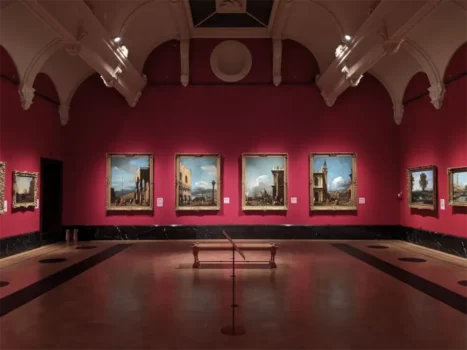
George III acquired an incredible series of Canaletto’s panoramic views of Venice, considered among the finest the artist ever produced.
5. Fabergé Eggs and Russian Imperial Masterpieces
The British Royal Collection includes one of the largest collections of Fabergé works outside Russia, including:
Miniature hardstone animals
Imperial-style eggs
Rare jewelry pieces
These objects are a favorite among modern visitors because of their craftsmanship and royal connections.
6. Holbein’s Tudor Portraits
Hans Holbein the Younger painted many portraits of Henry VIII’s court, and several of these iconic images survive in the Royal Collection.
7. The Crown Jewels (Held Separately)
Though not part of the Royal Collection, the British Crown Jewels are often mistaken as part of it. They are housed in the Tower of London and include:
The Imperial State Crown
The Sovereign’s Sceptre
The Cullinan Diamonds
The Koh-i-Noor Diamond (subject to international debate)
Who Owns the Royal Art Collection?
This is one of the most common and misunderstood questions.
The British Royal Collection Is NOT Owned by the King Personally
The British Royal Collection is legally held by the reigning monarch in trust for the nation. This means:
The art cannot be sold.
It cannot be inherited privately.
It is not owned by King Charles III as personal property.
It belongs to the institution of the monarchy.
Essentially, the monarch is the custodian, not the owner.
What Does the King Actually Own Personally?
While the Royal Collection is not personal property, King Charles III does own:
Sandringham House
Balmoral Castle
Selected personal artworks
Some private family heirlooms
But the vast majority of royal art remains institutional.
Other Important Royal Art Collections Around the World
The Spanish Royal Collection (Patrimonio Nacional)
Spain’s royal art collection rivals Britain’s in scale and significance. It includes:
Works by Velázquez, including portraits of Philip IV’s court
Masterpieces from Goya
Flemish tapestries
Rare medieval manuscripts
Treasures connected to the Habsburg and Bourbon dynasties
Many of these are housed in the Royal Palace of Madrid and the El Escorial.
The Thai Royal Collection
Thailand’s collection includes:
Royal regalia
Buddhist religious statues
Historical manuscripts
Portraits from the Chakri dynasty
These treasures are central to Thai cultural identity, especially items associated with King Rama V and the modern golden age of Thailand.
The Saudi and Qatari Royal Collections
In the last two decades, Gulf monarchies have become major buyers in the global art market.
The Qatar Royal Family
The Al Thani family is one of the world’s most influential art collectors, investing billions in:
Islamic art
Western masterpieces
Rare jewels
Qatar famously purchased Paul Cézanne’s “The Card Players” for over $250 million, one of the highest prices ever paid for a painting.
The Saudi Royal Family
Members of the Saudi royal family have privately acquired:
Leonardo da Vinci’s “Salvator Mundi” (sold for $450.3 million, a world record)
Modern art
Rare antiques and manuscripts
These purchases represent a shift in global cultural power.
The Dutch Royal Collection (House of Orange-Nassau)
The Netherlands maintains a distinguished royal collection that includes:
Rembrandt drawings
Royal portraits
Historic clothing
Ornaments used during coronations
Period furniture and palace decorations
Much of it is displayed in the Royal Palace Amsterdam and the Het Loo Palace Museum.
The Monegasque Royal Collection (House of Grimaldi)
Monaco’s princely family, famous for Princess Grace Kelly, owns:
Royal portraits dating back to the 13th century
Silver, tapestries, and sculptures
Historic weapons
Personal memorabilia from Grace Kelly
Monaco’s collection is smaller but uniquely glamorous.
Which Royal Family Is a Trillionaire?
This is a trending question, especially online, and the answer is clear.
The World’s Only “Trillionaire” Royal Family: The House of Saud (Saudi Royal Family)
While no official financial statement exists, reliable global wealth estimates place the net worth of the entire Saudi royal family (House of Saud) at:
Over $1 trillion USD
This figure includes:
Oil revenues
Land ownership
Investments
Private corporations
Luxury assets and art
The extended family network (thousands of royal princes)
Important Clarification:
The Saudi royal family as a whole is trillionaire, not an individual king or prince.
Individual members such as Mohammed bin Salman (MBS) reportedly manage personal fortunes in the billions, but not trillions alone.
This makes the House of Saud the wealthiest royal dynasty in the world, far surpassing:
The British Royal Family
The Thai Royal Family
The Qatari Royal Family
The Brunei Royal Family
The Emirati Royal Families
The Wealth of Other Royal Families (for Comparison)
The British Royal Family
Estimated combined wealth: $28–$40 billion
This includes the Crown Estate (not the King’s private property) and personal assets.
The Thai Royal Family
Estimated wealth: $30–$70+ billion
The Crown Property Bureau controls vast land and investments.
The Qatari Royal Family
Estimated wealth: $335 billion
They also own some of the world’s most expensive modern artworks.
The Emirati (Dubai/Abu Dhabi) Royal Families
Estimated wealth: $180–$300 billion
Why Royal Art Collections Matter
Royal art collections are not simply valuable, they are essential to world cultural heritage. These collections:
Preserve human history
Inspire new generations of artists
Attract millions of tourists
Provide national identity
Reflect international cultural exchange
Showcase centuries of craftsmanship
Royal collections represent a bridge between past and present.
How Royal Art Collections Are Preserved Today
Most royal collections, even when privately owned, operate similarly to museums. They involve:
1. Expert Curatorial Staff
Professional teams care for, catalog, and research each item.
2. Temperature- and Light-Controlled Palace Galleries
Precious artworks require stable environments for preservation.
3. Digitization Projects
Thousands of artworks are now available online through high-resolution imaging.
4. Public Exhibitions
The British Royal Collection holds rotating exhibitions at Buckingham Palace, Holyroodhouse, and Windsor Castle.
5. Conservation Laboratories
Art restorers use scientific methods to preserve paintings, manuscripts, metals, and textiles.
The Influence of Royal Art Collections on Culture and Tourism
Royal collections play a key role in:
Global Tourism
Millions visit royal palaces every year.
Buckingham Palace alone attracts over 500,000 annual visitors during its summer opening.
Cultural Diplomacy
Royal artworks are occasionally loaned to world museums, strengthening international relationships.
National Branding
The art a monarchy displays becomes part of a country’s identity.
For example:
Britain = Renaissance drawings + royal portraits
Spain = Golden Age masterpieces
Thailand = sacred Buddhist treasures
Saudi/Qatar = modern acquisitions and Islamic art
The Art Market
Royal interest in the arts can elevate the value of entire categories.
For example:
Fabergé prices skyrocketed after royal exhibitions
Leonardo drawings gained prominence through royal ownership
Why Some Royal Families Spend Billions on Art
Art remains a form of:
Soft power
Prestige
Cultural leadership
National symbolism
Long-term investment
Gulf monarchies in particular use art to expand international influence and diversify their economies.
Controversies Surrounding Royal Art Collections
1. Debates Over Ownership
Some items were acquired during colonial eras, including:
Art from India
African objects
Middle Eastern artifacts
There have been ongoing discussions about restitution.
2. The Koh-i-Noor Controversy
The famous diamond set into the British Crown has been claimed by:
India
Pakistan
Afghanistan
Iran
The British government argues that it was legally acquired at the time, but the debate continues.
3. Transparency of Private Royal Collections
Some monarchies keep their personal art holdings completely private, so the true scale of their collections is unknown.
The Future of Royal Art Collections
As monarchies modernize, royal art collections are becoming:
More Accessible
Digital platforms and exhibitions allow global audiences to view rare works.
More Researched
Royal archives are increasingly open to historians and scholars.
More Connected
Collections are now loaned internationally for special exhibitions.
More Preserved
State-of-the-art conservation ensures these treasures survive for generations.
Royal art collections will continue to shape global culture, tourism, and scholarship in the 21st century.
Summary
Here are the key takeaways about the world’s greatest royal art treasures:
Most Famous Royal Art Collection:
The British Royal Collection, with masterpieces by Leonardo, Vermeer, Rembrandt, and Canaletto.
Most Famous Artworks in the Royal Collection:
Leonardo da Vinci’s drawings
Vermeer’s The Music Lesson
Rembrandt portraits
Holbein Tudor portraits
Fabergé treasures
Who Owns the Royal Art Collection?
It is owned in trust for the nation, not personally by the king.
Which Royal Family Is a Trillionaire?
The Saudi Royal Family (House of Saud), with an estimated net worth exceeding $1 trillion.
Royal families have shaped the world’s artistic landscapes for centuries, and their collections remain among humanity’s most valuable cultural treasures.