An In-Depth Look at The Good Shepherd by Bartolomé Esteban Murillo
Bartolomé Esteban Murillo’s The Good Shepherd is one of the most tender and emotionally resonant religious images of the Spanish Baroque. Portraying Christ as a youthful shepherd radiating compassion and serenity, the painting reflects Murillo’s unique ability to merge spiritual symbolism with human warmth, making sacred themes accessible and deeply moving for viewers across centuries.
Bartolomé Esteban Murillo (1617–1682) was one of the most celebrated painters of Spain’s Golden Age, renowned for his soft naturalism, luminous color, and profound emotional sensitivity. Among his many religious works, The Good Shepherd stands out as a quintessential expression of his artistic and spiritual vision. Created during the mid-17th century, the painting captures Christ not as a distant divine ruler, but as a gentle, caring presence intimately connected to humanity. This approach reflects both Murillo’s personal style and the broader aims of Counter-Reformation art in Spain, which sought to inspire devotion through empathy, clarity, and emotional engagement.
The subject of the Good Shepherd originates from the Gospel of John, where Christ declares, “I am the good shepherd. The good shepherd lays down his life for the sheep.” In Christian theology, the image symbolizes Christ’s sacrificial love, guidance, and protection of his followers. Murillo’s interpretation emphasizes these qualities through a youthful depiction of Jesus, often shown seated in a pastoral landscape, tenderly watching over a small flock of sheep. Rather than dramatizing suffering or martyrdom, Murillo focuses on quiet reassurance and spiritual intimacy, making the theological message approachable and deeply humane.
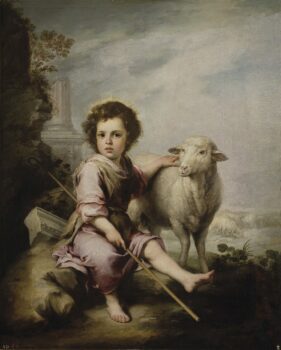
One of the most striking aspects of The Good Shepherd is Murillo’s portrayal of Christ as a child or adolescent. This choice is both unusual and deliberate. By depicting Jesus as young, Murillo underscores innocence, purity, and gentle authority. Christ’s expression is calm and contemplative, his gaze often directed either toward the viewer or downward toward the sheep, suggesting both divine awareness and personal care. This youthful Christ embodies protection without severity, reinforcing the idea of a loving savior rather than a fearsome judge.
Murillo’s mastery of light and color plays a crucial role in shaping the painting’s emotional tone. Soft, golden light bathes the figure of Christ, creating a subtle halo-like effect without overt symbolism. The transitions between light and shadow are smooth and delicate, enhancing the painting’s sense of tranquility. Murillo’s palette favors warm earth tones, gentle blues, and creamy whites, which contribute to the overall harmony of the composition. This softness, often described as Murillo’s hallmark, distinguishes his work from the harsher realism of some contemporaries and aligns perfectly with the painting’s theme of compassion.
The sheep in The Good Shepherd are not merely decorative elements; they are central to the painting’s symbolic language. Rendered with care and naturalism, they cluster close to Christ, reinforcing his role as protector and guide. Their calm demeanor mirrors the serenity of the shepherd himself, suggesting a world ordered by trust and divine care. In Christian iconography, sheep represent the faithful, vulnerable yet safe under Christ’s watchful presence. Murillo’s ability to infuse these animals with quiet life and individuality enhances the painting’s emotional credibility.
Compositionally, Murillo achieves balance and intimacy through simplicity. Christ is typically placed centrally, anchoring the scene, while the surrounding landscape recedes gently into the background. There is no dramatic architectural setting or complex narrative action; instead, the viewer is invited into a peaceful pastoral moment. This compositional restraint ensures that attention remains focused on the relationship between Christ and his flock, reinforcing the painting’s devotional purpose.
The Good Shepherd must also be understood within the religious and cultural context of 17th-century Spain. The Counter-Reformation placed great emphasis on art as a tool for spiritual instruction and emotional persuasion. Murillo excelled in creating images that were theologically sound yet emotionally accessible, appealing to both learned theologians and ordinary worshippers. His paintings were often commissioned for churches, monasteries, and private devotion, where they served as aids to prayer and contemplation. The Good Shepherd, with its gentle imagery and clear symbolism, perfectly fulfills this role.
The enduring appeal of Murillo’s The Good Shepherd lies in its universal message of care, guidance, and unconditional love. While deeply rooted in Christian theology, the painting transcends its religious origins by speaking to fundamental human experiences: the desire for protection, the comfort of trust, and the reassurance of being watched over. Murillo’s genius lies in his ability to convey these themes without grand gestures or dramatic tension, relying instead on subtle emotion and visual harmony.
Today, The Good Shepherd remains a powerful example of Murillo’s contribution to Baroque art and religious painting. It exemplifies his unique blend of realism and idealization, his sensitivity to human emotion, and his unwavering commitment to making the divine feel close and compassionate. In a world often marked by uncertainty and conflict, Murillo’s serene vision of Christ as the Good Shepherd continues to offer a timeless image of peace, hope, and gentle authority.
Meaning of The Good Shepherd Painting by Bartolome Murillo
In the peaceful glow of a softly lit museum, nestled within the Prado Museum in Madrid, a painting captures the hearts of visitors with its tender imagery and profound spiritual message. The work is “The Good Shepherd” by Bartolomé Esteban Murillo, one of the most celebrated Spanish painters of the Baroque period. With his delicate brushwork, serene compositions, and spiritual sensitivity, Murillo brings to life a vision of Christ not as a distant, suffering figure, but as a gentle protector and guide , the Good Shepherd.
This painting is more than just an artwork; it is a theological statement, a cultural artifact, and a timeless meditation on mercy, care, and divine love. But to fully appreciate The Good Shepherd, we must delve deep into its creation, symbolism, historical context, and enduring relevance.
Who Was Bartolomé Esteban Murillo?
Bartolomé Esteban Murillo (1617–1682) was born in Seville, Spain, a city that at the time was one of the richest and most influential in Europe due to trade with the Americas. Murillo emerged during the Spanish Golden Age of painting, standing alongside greats like Diego Velázquez, Francisco de Zurbarán, and José de Ribera. However, while his contemporaries often focused on realism or intense chiaroscuro, Murillo became renowned for his gentleness, compassion, and a unique warmth in his works.
Murillo was a devout Catholic, and much of his work reflects religious themes, especially the Virgin Mary, the Christ child, and scenes from the life of Jesus. He was also beloved for his depictions of street children and everyday life, often infused with empathy and moral undertones. His paintings were highly sought after, not just in Spain but across Europe.
When and How Was The Good Shepherd Painted?
The Good Shepherd was painted around 1660, during the mature period of Murillo’s career. By this time, he had fully developed his signature style: a soft, luminous realism characterized by delicate brushwork, subtle colors, and a palpable sense of intimacy.
Though the exact commission details of this painting are unknown, it is believed that Murillo created several versions or variations of The Good Shepherd, often for religious institutions or private devotion. The version currently housed in the Museo del Prado in Madrid is one of the most famous and well-preserved examples.
Murillo likely used oil on canvas, a medium that allowed for his signature soft blending and fine detail. His studio in Seville was highly active, and though he had pupils, this particular painting bears all the hallmarks of his personal hand.
What Is The Good Shepherd Painting All About?
At first glance, the painting appears simple: a young boy sits on a rock, cradling a lamb in his arms. But a closer look reveals a much deeper narrative. The boy is none other than Jesus Christ, depicted as a child , the Infant Christ , yet in the role of the Good Shepherd, a title he gives himself in the Gospel of John:
“I am the good shepherd. The good shepherd lays down his life for the sheep.” , John 10:11
The scene is pastoral, almost idyllic. The child Jesus wears a humble tunic, barefoot, surrounded by sheep. He gazes out, calm yet purposeful. In his arms, the lamb represents the lost soul he has saved and now holds safely. The entire composition radiates tenderness, humility, and divine care.
This image is not meant to show theological complexity or grandeur, but rather accessible spirituality. Murillo, in line with the Counter-Reformation ideals of the time, aimed to create religious art that would move the faithful emotionally and bring them closer to the divine.
Symbolism and Deeper Meaning in The Good Shepherd
Murillo’s The Good Shepherd is rich in Christian symbolism, much of it drawn directly from the Bible and long-standing iconographic traditions.
1. The Lamb
The lamb is one of the most powerful and recurring symbols in Christian art. It represents:
Innocence and purity
The souls of the faithful
Jesus himself, as the sacrificial “Lamb of God”
In this painting, the lamb nestled in the arms of Christ likely symbolizes the soul that was lost but is now found, referencing the parable of the lost sheep (Luke 15:3–7). It is a representation of divine mercy and salvation.
2. The Staff
Though not always immediately visible, in many versions of this painting or similar themes by Murillo, Jesus carries or is near a shepherd’s crook or staff. The crook is a tool used to guide and protect sheep , in this context, it represents divine guidance and authority.
3. Bare Feet
Christ’s bare feet reflect his humility and connection to the earth. He is not a distant ruler but a present, empathetic guide who walks among his people.
4. The Setting
The pastoral background , soft greenery, natural light , reinforces the theme of peace and care. It is an idealized Edenic space, symbolizing the paradise offered to those who follow the Good Shepherd.
5. Childlike Innocence
Depicting Christ as a child enhances the viewer’s emotional response. It connects the viewer with innocence, purity, and vulnerability, and yet this child carries the burden of divine care and responsibility.
What Is Happening in the Painting?
In The Good Shepherd, the story is quiet but profound. Christ is seated, not walking or preaching. His focus is inward, contemplative. He holds the lamb , perhaps one that has wandered and now has been retrieved. The lamb, calm and trustful, nuzzles into his arms. There is no drama, no miracles being performed , just the quiet, powerful act of being present and offering protection.
This stillness invites the viewer to reflect. Murillo’s genius lies in capturing this moment of pause , of deep connection between savior and soul. It’s not only a depiction of an event, but an invitation to enter into a spiritual relationship with Christ.
What Type of Art Is The Good Shepherd?
Murillo’s The Good Shepherd belongs to the Baroque period, which dominated European art in the 17th century. However, Murillo’s interpretation of the Baroque was distinctively soft and spiritual, diverging from the dramatic intensity often associated with artists like Caravaggio.
His version of Baroque art emphasizes:
Gentle realism
Emotional warmth
Spiritual clarity
Idealized forms
His color palette , warm earth tones, gentle whites, soft blues , enhances the meditative quality of the painting. His figures are realistic but idealized, glowing with an inner light. This made his work deeply appealing to religious patrons, particularly in the post-Council of Trent era when the Catholic Church sought emotionally engaging art that instructed and uplifted.
Murillo’s religious paintings were often used for private devotion, making them accessible and deeply personal.
The Value of The Good Shepherd Painting
As with many classical masterpieces, The Good Shepherd by Murillo is priceless in terms of cultural and historical value. Since it is part of a national museum’s collection , Museo del Prado in Madrid , it is not for sale and thus does not carry a market price.
However, should a work of this caliber by Murillo ever go to auction , which is exceedingly rare , it could command millions of dollars. For example, Murillo’s paintings have sold for anywhere between $1 million to $10 million, depending on the subject, condition, and provenance.
But beyond monetary value, The Good Shepherd is a spiritual and emotional treasure , part of the collective religious and artistic heritage of humanity.
Where Is The Good Shepherd Located Today?
The most famous version of The Good Shepherd by Murillo is housed in the Museo Nacional del Prado, in Madrid, Spain. The Prado is one of the most important art museums in the world, home to masterpieces by Velázquez, Goya, El Greco, and Titian.
The museum acquired the painting to help preserve Spain’s Baroque religious heritage and to showcase the compassionate vision Murillo brought to sacred themes.
In addition to the Prado version, other similar Murillo paintings depicting Christ as the Good Shepherd or similar subjects exist in various collections:
The Hermitage Museum in St. Petersburg
The Seville Cathedral
The Museo de Bellas Artes in Seville
These versions may vary slightly in composition but retain the same tender spirit.
Murillo’s Legacy and Enduring Impact
Murillo’s The Good Shepherd has left a lasting imprint not just on art history but also on religious imagination. His soft rendering of divine themes influenced generations of Spanish and Latin American artists. His portrayals of Christ, the Virgin, and saints shaped Catholic devotional imagery well into the 18th and 19th centuries.
In an age where art often shocks, provokes, or critiques, Murillo’s work offers something increasingly rare: consolation. It whispers rather than shouts. It invites rather than commands.
For modern viewers , religious or not , The Good Shepherd remains a moving depiction of what it means to care, to protect, to be present for others in their vulnerability.
A Vision of Divine Tenderness
In The Good Shepherd, Bartolomé Esteban Murillo created more than just a painting. He painted a vision of Christ that is approachable, loving, and gentle , a reflection of the divine that is deeply human. The image continues to inspire awe and spiritual reflection centuries after its creation.
In an age of chaos and uncertainty, Murillo’s soft Christ still holds out his arms , not to judge or to condemn, but simply to welcome.