Venus at Her Mirror: Diego Velázquez’s Enigmatic Vision of Beauty and Reality
Diego Velázquez’s Venus at Her Mirror (c. 1647–1651) is the only surviving female nude by the Spanish master and one of the most remarkable paintings of the Baroque era. Painted during Velázquez’s mature period, likely while he was in Italy or shortly after his return to Spain, the work occupies a singular position in both his career and the broader history of European art. At a time when religious conservatism and the Spanish Inquisition strictly limited depictions of the nude, Velázquez produced a painting that is sensuous yet restrained, intimate yet intellectually complex.
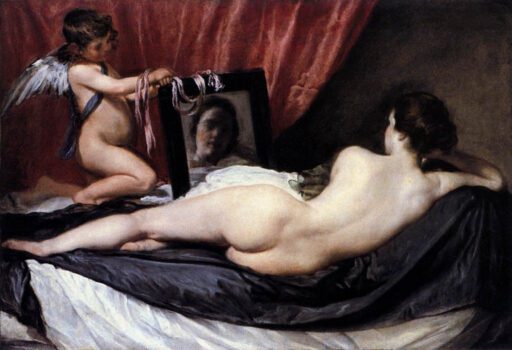
The painting depicts Venus, the Roman goddess of love and beauty, reclining on a bed with her back turned to the viewer. Her body is rendered with soft, naturalistic tones, lying diagonally across the canvas. She gazes into a mirror held by her son Cupid, who appears almost secondary, his presence subdued rather than symbolic. The mirror reflects Venus’s face, though the reflection is blurred and ambiguous, offering no clear idealized portrait. This subtle distortion is central to the painting’s enduring fascination.
Unlike many Renaissance and Baroque representations of Venus, Velázquez avoids overt mythological drama or decorative excess. There are no lush landscapes, elaborate jewels, or theatrical gestures. Instead, the setting is spare: muted gray and brown draperies, a soft bed covering, and the gentle play of light on flesh. The emphasis is on form, tone, and atmosphere rather than narrative. This quiet simplicity gives the painting an almost modern sensibility, focusing attention on the act of seeing rather than the myth itself.
One of the most striking aspects of Venus at Her Mirror is the reversal of the traditional gaze. Typically, female nudes in Western art are presented frontally for male viewing pleasure. Velázquez, however, turns Venus away from us. The viewer encounters her body first, not her face, and only sees her expression indirectly through the mirror. Even then, the reflection is elusive. Her face appears slightly out of focus, challenging the idea that beauty can be fully captured or possessed. This ambiguity invites interpretation: is Venus looking at herself, at the viewer, or at something beyond both?
The mirror plays a crucial symbolic role. In art history, mirrors often represent vanity or self-knowledge, but Velázquez complicates these meanings. The reflection does not offer clarity or narcissism; instead, it suggests uncertainty and mediation. Beauty here is not fixed or absolute but subjective and dependent on perspective. By blurring Venus’s reflected face, Velázquez undermines idealization and hints at the tension between reality and illusion, a theme that runs throughout his oeuvre, most famously in Las Meninas.
Stylistically, the painting demonstrates Velázquez’s mastery of brushwork and tonal harmony. The transitions between light and shadow are subtle and fluid, creating a lifelike softness that avoids rigid outlines. The flesh tones are warm and natural, contrasting gently with the cool grays and silvers of the background. This painterly approach reflects Velázquez’s engagement with Venetian art, particularly the influence of Titian, whose sensuous nudes were widely admired across Europe. Yet Velázquez’s Venus is quieter, more introspective, and less overtly idealized than her Venetian counterparts.
The historical context of the painting adds another layer of significance. In seventeenth-century Spain, nude paintings were rare and often confined to private collections of the elite. Venus at Her Mirror was likely commissioned for such a private setting, allowing Velázquez greater freedom than public or religious works would permit. Even so, the painting’s restraint suggests a careful negotiation between artistic ambition and cultural constraint.
Over time, Venus at Her Mirror has become a touchstone for discussions about gender, gaze, and modernity in art. Its influence can be traced in later explorations of the nude, from Manet to modern photographers and painters who question how bodies are represented and viewed. The painting’s enduring power lies not in spectacle but in subtlety, its ability to provoke reflection rather than provide answers.
Today, Venus at Her Mirror is widely regarded as one of Velázquez’s greatest achievements. It encapsulates his genius for observation, his philosophical depth, and his capacity to transform a classical subject into something profoundly original. More than a depiction of a goddess, the painting is a meditation on beauty itself, fleeting, elusive, and forever shaped by the way we look at it.
Meaning of Venus at her Mirror Painting by Diego Velázquez
“Venus at her Mirror,” also known as the “Rokeby Venus,” stands as one of the most enigmatic and captivating works in the canon of Western art. Painted by the Spanish Baroque master Diego Velázquez between 1647 and 1651, this painting is a rare representation of the female dressless in Spanish art. Despite its graceful aesthetic and minimalist palette, the artwork is densely packed with symbolism, historical context, and interpretative potential. Today, it continues to provoke admiration and scholarly debate, not only for its sensual allure but also for its philosophical and cultural implications.
In this comprehensive story post, we will explore the origins of the painting, its visual composition, artistic techniques, historical context, symbolism, interpretation, and modern-day significance. We will also examine its current location, estimated value, and the drama it has inspired over centuries.
Who Painted Venus at her Mirror and When?
The artist behind Venus at her Mirror is Diego Rodríguez de Silva y Velázquez (1599–1660), the leading painter of the Spanish Golden Age. Velázquez served as the court painter to King Philip IV of Spain and is best known for his masterful portraits, religious works, and genre paintings, most famously Las Meninas (1656).
Velázquez painted Venus at her Mirror during his second trip to Italy, likely between 1647 and 1651. Italy, the epicenter of Renaissance art and classical humanism, had a profound impact on Velázquez. During this period, he studied works by Titian, Tintoretto, and other Venetian masters. Titian’s sensual depictions of Venus, particularly his Venus of Urbino, influenced Velázquez’s approach to the painting.
It is believed that Velázquez painted Venus at her Mirror while he was in Rome. Unlike many of his other commissions, this work may not have been created for a royal or religious patron but instead for a private collector, perhaps a liberal-minded aristocrat or intellectual appreciative of classical mythology and the female form.
What is Venus at her Mirror All About?
The painting depicts the Roman goddess Venus, reclining dressless with her back to the viewer, gazing at her reflection in a mirror held by her son Cupid. Her body is elongated across soft fabrics and a bed or chaise, her skin luminous against a dark and restrained background.
This scene is at once intimate and introspective. Venus’s is not flaunted but partially concealed by the angle of her pose and the flowing drapery. She is seen from behind, with her face only partially visible in the mirror, an unusual composition that adds mystery and complexity to the work.
Rather than presenting Venus as an object of desire in a conventional sense, Velázquez invites viewers into a moment of private reflection. Is Venus admiring her own beauty, contemplating love, or lost in a divine reverie? The ambiguity is precisely what makes the painting so powerful and enduring.
The Symbolism and Meaning of the Painting
Venus at her Mirror is rich in symbolic layers that go beyond a mere depiction of mythological beauty. Several elements in the painting contribute to its depth:
1. The Mirror
The mirror is a central symbol in the painting. Traditionally associated with vanity, the mirror here seems to serve a more introspective or philosophical purpose. Venus’s face is not clearly rendered in the reflection; it is blurred, indistinct. This could suggest the elusiveness of true self-knowledge, the distortion of self-perception, or the ephemeral nature of beauty.
The mirror could also represent a dialogue between art and reality. In painting, mirrors often symbolize the act of seeing and being seen, a meta-commentary on the artist’s role as an observer of the world.
2. Cupid
Cupid, the god of desire and affection, holds the mirror up for Venus. This act can be seen as a symbolic gesture, love presenting beauty to itself. Cupid’s subdued posture and serious expression also subvert typical depictions of him as mischievous or playful. Here, he takes on a more solemn role, perhaps suggesting the spiritual or philosophical dimensions of love.
3. Venus’s Pose and Back View
By showing Venus from behind, Velázquez departs from the frontal ideal that characterized many Renaissance paintings. The back view adds an air of restraint and anonymity. The viewer is not invited to meet Venus’s gaze directly; instead, the encounter becomes one of contemplation rather than seduction.
The sinuous curvature of her body, the soft play of light across her skin, and the gentle blending of forms all contribute to a sense of organic beauty, natural, yet idealized.
4. The Dark Drapery and Color Palette
Velázquez employs a subdued, earthy palette of browns, blacks, grays, and muted pinks. This lends the work a sense of understated elegance. The contrast between the luminous flesh of Venus and the dark background emphasizes her divinity and centrality.
The drapery frames her body like a theatrical curtain, enhancing the visual focus on her figure and subtly referencing the idea of revelation and concealment, both physical and metaphorical.
What is Happening in the Painting?
On the surface, Venus is reclining in a moment of repose, gazing into a mirror held by Cupid. But on a deeper level, the painting captures an existential moment, one of self-examination, introspection, and possibly melancholy.
The ambiguity of her facial expression in the mirror, the softness of her body’s lines, and the quiet demeanor of Cupid all point toward a scene suspended in time. There is no narrative action, only the silent interplay of sight, identity, and myth.
This moment may symbolize the act of love gazing at itself, or beauty contemplating its impermanence. It could also serve as an allegory of the soul reflecting on its nature through the lens of mythological archetypes.
The Artistic Style and Techniques Used
Venus at her Mirror exemplifies the Baroque style but with notable restraint. Unlike the exuberant dynamism of Caravaggio or Rubens, Velázquez opts for subtlety and naturalism.
Characteristics of the Style:
Baroque Composition: The composition balances sensuality with sobriety. The use of chiaroscuro (light and dark) helps to sculpt the body and convey depth.
Loose Brushwork: Velázquez’s handling of paint is fluid and masterful. The textures of skin, fabric, and hair are rendered with minimal yet expressive strokes.
Classical Influence: The reclining pose echoes ancient Roman sculpture and Renaissance painting, but Velázquez adds a psychological depth that feels modern.
Naturalism: Despite the mythological subject, the figures feel real. The proportions, skin tones, and even the details of the mirror are grounded in observation.
This combination of realism with idealism marks Velázquez as a precursor to modern masters like Manet, who famously admired and emulated his work.
The History and Journey of the Painting
The painting earned the nickname “Rokeby Venus” after it entered the collection of Rokeby Park in Yorkshire, England, in the 19th century. Before that, its early provenance remains somewhat unclear, though it likely remained in private hands for over a century due to the erotic nature of the subject.
In 1813, the painting was acquired by John Morritt, an English gentleman, who housed it in Rokeby Park. From there, it gained fame in Britain, both for its artistry and its daring subject matter.
Attack by Suffragette
One of the most dramatic episodes in the painting’s modern history occurred in 1914 when Mary Richardson, a suffragette and member of the Women’s Social and Political Union (WSPU), attacked the painting with a meat cleaver at the National Gallery in London. She slashed the canvas in protest against the arrest of Emmeline Pankhurst, the movement’s leader.
Richardson later said she was protesting the objectification of women and the societal hypocrisy that venerated female beauty in art while oppressing real women. The painting was meticulously restored, but the event remains a powerful moment in the history of feminist art criticism.
Current Location and Value
Today, Venus at her Mirror resides in the National Gallery in London, where it remains one of the most beloved and frequently discussed works in the museum’s collection. It is displayed with great care, accompanied by contextual information and security due to its historical importance and vulnerability to past attacks.
Estimated Value
While the painting is not for sale, its estimated value would likely be in the hundreds of millions of dollars if ever brought to auction, though priceless in cultural terms. As a unique painting by Velázquez and a cornerstone of European art history, its monetary value is nearly incalculable.
Legacy of Velázquez’s Venus at her Mirror Painting
Velázquez’s Venus at her Mirror has inspired countless interpretations across disciplines, art history, philosophy, gender studies, and psychoanalysis.
Some see the painting as a defense of the female dressless in art, a testament to beauty as a form of divine expression. Others interpret it as a subtle critique of vanity or a reflection on the act of seeing itself. Feminist scholars have both criticized and reclaimed the painting, examining the balance between sensuality and autonomy.
It has also inspired many modern artists, including Édouard Manet, whose Olympia (1863) references Velázquez’s composition but confronts the viewer more directly and provocatively.
In literature and poetry, the painting often symbolizes the paradoxes of love, beauty, and perception. Its influence ripples through contemporary discourse about the gaze, who looks, who is seen, and what power dynamics are embedded in visual culture.
Venus at her Mirror by Diego Velázquez is much more than a sensual mythological portrait; it is a meditation on beauty, identity, perception, and artistic mastery. Painted during a time when the female dressless was rare in Spanish art, Velázquez broke boundaries by combining classical ideals with psychological depth.
The painting challenges viewers to consider not only what they see but how they see, and why. Venus does not look directly at us; she looks into a mirror, perhaps seeking herself. We, the observers, are left wondering whether we are witnessing her introspection or becoming part of it.
From its creation in 17th-century Rome to its revered place in London’s National Gallery, Venus at her Mirror continues to captivate, provoke, and inspire. It remains a cornerstone of Velázquez’s legacy and a masterpiece that bridges the mythological past with timeless human questions.
Key Facts Recap
Artist: Diego Velázquez
Title: Venus at her Mirror (aka Rokeby Venus)
Date: c. 1647–1651
Medium: Oil on canvas
Style: Spanish Baroque with Classical and Naturalistic elements
Dimensions: Approximately 122 cm × 177 cm
Current Location: National Gallery, London
Estimated Value: Incalculable (likely over $200 million if ever sold)
Symbolism: Love, beauty, self-reflection, perception, the gaze
Historical Significance: Rare Spanish painting; subject of feminist protest in 1914