Harmony and Ambiguity: Understanding The Concert by Titian
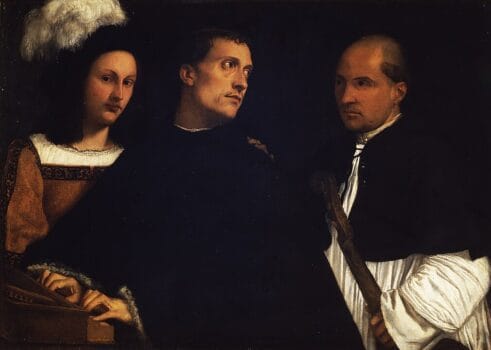
Titian’s The Concert stands as one of the most quietly compelling paintings of the Venetian Renaissance, a work whose apparent simplicity conceals deep artistic and intellectual complexity. Painted around 1510–1511, The Concert depicts three young men absorbed in music-making while a fourth, older figure, traditionally interpreted as a monk, listens attentively. The scene unfolds in a shadowed interior, intimate and contemplative, inviting the viewer into a private world where sound, thought, and visual harmony merge. Though long attributed to Giorgione, modern scholarship generally credits Titian, making the painting central not only to Titian’s early career but also to debates about authorship in early sixteenth-century Venice.
The Concert appears to be a genre scene: musicians casually gathered, instruments in hand, seemingly unaware of the viewer. Yet Renaissance audiences would have understood this image as far more than a snapshot of daily life. Music, in humanist thought, was associated with cosmic order, intellectual refinement, and the harmony of the soul. The painting thus operates on both literal and allegorical levels. The youthful musicians may represent the practice of earthly music, while the older listener embodies contemplation, wisdom, or spiritual reflection. The absence of overt narrative encourages interpretation, a hallmark of Venetian painting at the time.
Stylistically, The Concert exemplifies the Venetian emphasis on color, atmosphere, and mood rather than precise linear design. The figures emerge gently from the darkness, modeled through soft gradations of light rather than sharp outlines. Warm browns, deep reds, and muted blacks dominate the palette, unified by a golden glow that subtly animates faces and hands. This approach reflects Titian’s early absorption of Giorgione’s poetic style, where emotional resonance and tonal harmony take precedence over explicit storytelling. The painting feels less constructed than sensed, as if it were discovered rather than designed.
One of the most significant aspects of The Concert is its role in the long-standing attribution debate between Titian and Giorgione. For centuries, the work was credited to Giorgione due to its mood, subject, and painterly softness. However, closer technical and stylistic analysis, particularly of the robust modeling of figures and confident handling of paint, has led most scholars to assign it to Titian. This reassignment has important implications: it highlights how closely the two artists worked in their early years and how Titian, even at a young age, was capable of profound subtlety and innovation.
The painting also reveals Titian’s emerging interest in psychology and human presence. Each figure is individualized, not idealized. Their expressions are introspective, suggesting inner lives rather than performative roles. The musicians are not engaged with the viewer or each other in any overt way; instead, they seem united by a shared concentration. This inward focus reinforces the theme of harmony, not merely musical harmony, but harmony of mind and spirit. The listener’s gaze, directed toward the players, bridges action and contemplation, sound and silence.
Culturally, The Concert reflects the intellectual climate of Renaissance Venice, where art, music, and philosophy were deeply intertwined. Music was considered a liberal art, essential to a well-rounded education, and closely linked to moral and emotional balance. By presenting music as a quiet, almost sacred activity, Titian elevates it beyond entertainment. The painting becomes a meditation on creative practice itself, paralleling the act of music-making with the act of painting.
The lasting importance of The Concert lies in its synthesis of form, mood, and meaning. It exemplifies a turning point in Renaissance art, where ambiguity and emotional suggestion began to rival clear narrative and symbolism. For Titian, the work marks an early demonstration of the qualities that would define his long career: sensitivity to color, psychological depth, and an unmatched ability to convey atmosphere. For viewers today, The Concert remains a compelling invitation to slow down, look closely, and listen, not just to imagined music, but to the quiet conversation between art and thought that defines the Venetian Renaissance.
Meaning of The Concert or The Interrupted Concert Painting
In the hushed elegance of an Italian Renaissance room, a group of young men gathers around a harpsichord. The stillness is almost audible. Light dances on satin fabrics, wood grains, and human skin with a soft, golden glow. A sense of music pervades the scene, although no audible sound exists, only the visual harmony of one of Titian’s most enigmatic masterpieces: The Concert, also known as The Interrupted Concert.
Who Painted The Concert and How?
The Concert is widely attributed to Tiziano Vecellio, better known as Titian, one of the most influential artists of the Venetian Renaissance. Painted around 1510–1511, it exemplifies Titian’s early mastery of composition, texture, and human expression. However, the painting’s authorship and even its meaning have been subjects of centuries-long debate, adding to its allure.
The work is often misattributed to Giorgione, Titian’s older contemporary and mentor. Indeed, for many years, the painting was credited to Giorgione, largely because of its poetic quality and the quiet atmosphere, hallmarks of Giorgione’s style. However, art historians now generally agree that it was painted by Titian, possibly after Giorgione’s death in 1510. Some argue it could even be a collaborative work or a painting begun by Giorgione and completed by Titian. This uncertainty contributes to the painting’s nickname: The Interrupted Concert, a fitting title for a composition shrouded in mystery and interruption.
Who Are the Figures in the Painting?
The painting features three main figures:
A young man playing the harpsichord: Dressed in a dark robe, possibly a monk or a nobleman, he focuses intently on the keys, suggesting an immersion in the musical moment.
Another man standing next to him, seemingly lost in thought or listening carefully, perhaps reflecting on the music or something more profound.
A third figure in the background, dressed in white robes, possibly a monk or scholar, walks in or out of the room, perhaps interrupting the moment.
The ambiguity of their identities is intentional and enhances the work’s contemplative mood. These could be musicians rehearsing, students reflecting on art, or allegorical figures in a deeper philosophical narrative.
What is The Concert All About?
At first glance, The Concert appears to be a simple genre painting, an interior scene depicting everyday life. But Renaissance art is rarely straightforward, and with Titian, almost never. Beneath the serene surface lies a web of symbolic and philosophical meaning.
Many art historians argue that The Concert is not just about music, it is a visual metaphor for harmony, contemplation, and the human soul’s dialogue with the divine. It may also reflect Renaissance humanist ideals that celebrated the union of intellectual, artistic, and spiritual life.
Music as a Metaphor for the Soul
Music was considered a divine language during the Renaissance. It symbolized order, beauty, and the metaphysical harmony of the universe. In this painting, the act of making music is perhaps not literal but metaphorical: a symbol for spiritual reflection, inner harmony, and the pursuit of knowledge.
Some scholars suggest that the figures represent the three faculties of the soul as understood in Neoplatonic philosophy:
The harpsichordist as the sensitive soul, engaging in sensory perception.
The reflective listener as the rational soul, contemplating meaning.
The figure in the background as the intellectual soul, stepping between the earthly and divine realms.
Symbolism and Meaning
Every object and gesture in The Concert may be imbued with layered symbolism:
The Harpsichord: Represents not only music but the idea of harmony, both sonic and metaphysical.
The Interruption: The entrance or exit of the third figure could suggest the impermanence of earthly pursuits or the intrusion of divine insight.
The Light: The subtle illumination in the room could signify knowledge, enlightenment, or spiritual awakening.
Clothing: The contrast between the monk-like white robes and the secular attire of the musicians may represent the balance or tension between sacred and profane realms.
The painting invites the viewer to reflect, not just observe. It asks questions: Are we witnessing an ordinary moment or a moment of epiphany? Is the concert actually interrupted, or is the interruption part of the concert?
What’s Happening in the Painting?
We see a a scene, almost frozen moment in time. A young man plays a keyboard instrument, another listens, and a third figure arrives or departs. The arrangement suggests the aftermath of an event or a prelude to one. The listener seems lost in thought, perhaps mentally replaying the music or contemplating its meaning. The man in white may be bringing a message, announcing an arrival, or leaving, having delivered one.
The ambiguity is deliberate. Titian plays with silence as a compositional tool. The figures do not interact in overt ways; instead, their body language and placement suggest introspection. The concert is interrupted, not just literally, but metaphysically. It’s an invitation to ponder time, thought, and the ephemeral nature of beauty.
What Type of Art is The Concert?
The Concert is best classified as Renaissance genre painting, although it leans heavily into allegorical art.
Its technical elements, like the chiaroscuro, the realistic portrayal of textures, and the architectural space, reflect the innovations of the High Renaissance. Yet its deeper philosophical aims link it more to Neoplatonic allegory, a genre that flourished among Italian intellectuals and artists in the early 16th century.
The muted palette, delicate use of light, and psychological depth suggest that The Concert is not just a genre painting, but a poetic painting, a type of work inspired by Giorgione and perfected by Titian.
How Much is The Concert Worth?
Artworks by Titian are considered priceless cultural treasures. While The Concert is not for sale and has not been on the art market for centuries, if it were to be auctioned today, it would likely command a valuation of hundreds of millions of dollars, perhaps even more than $200 million, considering:
Its importance in art history,
Its connection to two great masters (Titian and Giorgione),
Its mystique and rarity.
For comparison, other major Renaissance works, particularly those with strong provenance and academic importance, have fetched enormous sums, even when traded privately or under government oversight.
However, such a painting is beyond the realm of private collectors today. It belongs to humanity, and its value is far more than monetary.
Where is The Concert Painting Today?
Today, The Concert resides in the Galleria Palatina (Palatine Gallery) in Palazzo Pitti, Florence, Italy.
The Palazzo Pitti is one of Florence’s most historic and opulent structures, once home to the powerful Medici family. The Galleria Palatina houses one of the world’s most impressive collections of Renaissance art. There, visitors can view The Concert among other masterpieces by Raphael, Caravaggio, and Rubens.
Its setting is ideal: a quiet room filled with golden light, echoing the painting’s mood. The painting is displayed without elaborate framing or ornamentation, inviting close, intimate reflection, just as the painting itself depicts.
Historical Journey of the Painting
The journey of The Concert from Titian’s studio to a Florentine palace is not fully documented, but it is known to have been part of the Medici collection by the 17th century. The Medici, patrons of the arts and masters of cultural politics, may have acquired the work because of its intellectual and aesthetic value.
Its attribution shifted over time, from Giorgione to Titian and occasionally to Sebastiano del Piombo or even Giovanni Cariani. It wasn’t until the 20th century that a consensus formed around Titian’s authorship.
Why is The Concert Important?
The Concert is important for several reasons:
Artistic Innovation: It demonstrates early examples of Titian’s command over composition, light, and mood, which would influence generations of artists.
Philosophical Depth: Its ambiguous theme elevates it beyond a genre painting into the realm of intellectual allegory.
Cultural Reflection: The painting mirrors Renaissance ideals, combining music, art, and metaphysical thought in one serene moment.
Historical Significance: Its journey through the Medici collection into the heart of Florence marks it as a piece of European cultural heritage.
The Eternal Pause
Titian’s The Concert is a painting that lives in the space between sound and silence, thought and action, the sacred and the profane. It is a canvas of interrupted time, inviting us into a moment of serene contemplation.
The viewer becomes the fourth figure, standing at the threshold of the room, witnessing an intimate event that may not be meant for outside eyes. Like the music that once filled the air, we sense something profound, though we cannot hear it. We are asked to imagine it, feel it, reflect on it.
And in doing so, we participate in the concert ourselves, not just interrupted, but timeless.