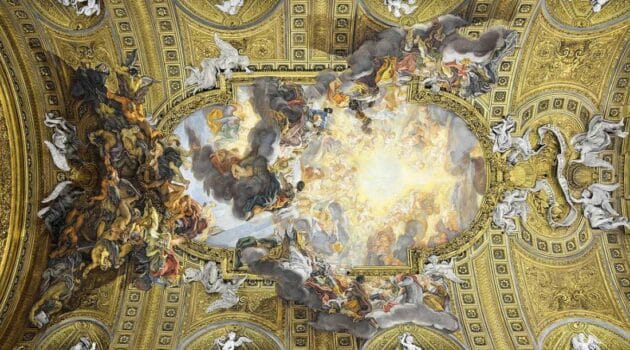
Giovanni Battista Gaulli: The Splendor of Illusion
Giovanni Battista Gaulli (1639–1709), widely recognized by his nickname Baciccio, stands as one of the most remarkable painters of the Italian Baroque. Celebrated for his mastery of illusionistic ceiling frescoes, Gaulli’s work exemplifies the theatrical grandeur and emotional intensity that define the Baroque era. His art seamlessly merged architecture, painting, and religious devotion, creating immersive experiences that continue to captivate viewers centuries later.
Born in Genoa, Italy, Gaulli was immersed from an early age in the vibrant artistic traditions of the Ligurian city. Genoa, at the time, was a hub for Baroque innovation, and young artists had access to a rich array of influences, including the dramatic chiaroscuro of Caravaggio and the decorative opulence of Rubens and Peter Paul’s followers. Gaulli trained under the Genoese painter Bernini, an association that profoundly shaped his artistic approach. It was in Rome, however, that Gaulli’s talents would flourish, under the patronage of the Church and the elite.
Gaulli’s artistic style is immediately recognizable for its dynamic compositions, vivid color palettes, and masterful use of light and shadow. His signature technique, illusionistic fresco, allowed him to create the sensation that painted figures were emerging from architectural spaces, blending the real and the imagined. This method, rooted in the Baroque fascination with perspective and spectacle, made Gaulli a sought-after artist for religious commissions in Rome. His paintings often aimed to evoke emotional and spiritual responses, drawing viewers into the narrative and symbolism of the work.
One of Gaulli’s most famous masterpieces is the ceiling fresco of the Church of the Gesù in Rome, completed between 1676 and 1679. Titled The Triumph of the Name of Jesus, this monumental fresco is widely regarded as a pinnacle of Baroque illusionism. The work covers the entire nave ceiling and depicts the heavenly vision of Christ’s glory, with angels and saints seemingly descending into the viewer’s space. What distinguishes this fresco is Gaulli’s ability to blend architecture and painting: stucco figures project outward, while painted figures appear to float beyond the physical boundaries of the ceiling, creating a powerful sense of movement and depth. This synthesis of real and painted elements exemplifies the Baroque objective of overwhelming the senses and inspiring devotion through artistic spectacle.
In addition to The Triumph of the Name of Jesus, Gaulli produced numerous altarpieces, portraits, and frescoes that underscore his versatility and technical mastery. His early works reflect the influence of his Genoese training, characterized by precise figure drawing and rich, vibrant coloration. Later works demonstrate the heightened theatricality and emotional intensity typical of Roman Baroque art. Notable examples include The Adoration of the Shepherds, Saint Agnes and the Vision of Angels, and The Glory of Saint Ignatius. In each piece, Gaulli employs dramatic foreshortening, luminous colors, and gestural dynamism to guide the viewer’s gaze and evoke a sense of divine presence.
Gaulli’s contributions extended beyond mere decoration. He played a pivotal role in shaping Baroque visual culture, particularly in Rome, where the Catholic Church sought to use art as a means of spiritual communication and persuasion. The Counter-Reformation agenda emphasized clarity, emotion, and grandeur in religious art, and Gaulli’s works perfectly aligned with these objectives. His ability to manipulate light, space, and perspective made his art a powerful instrument for conveying theological ideas, reinforcing the Church’s message through immersive and emotionally charged experiences.
The legacy of Giovanni Battista Gaulli lies not only in his technical brilliance but also in his capacity to transform spaces into living theaters of devotion. His frescoes remain celebrated for their ability to combine illusion with narrative, blending human drama and celestial wonder in a seamless continuum. Gaulli influenced a generation of artists, particularly in the realm of ceiling painting, where his techniques of trompe-l’oeil, foreshortening, and sculptural integration set new standards for spatial illusion.
Gaulli passed away in 1709, leaving behind a body of work that epitomizes the grandeur, drama, and spirituality of the Baroque era. Today, art historians recognize him as a master of visual illusion, capable of creating works that are both aesthetically stunning and spiritually evocative. His art continues to inspire admiration for its technical sophistication and its power to move the viewer emotionally, exemplifying the Baroque ideal of art as a profound and immersive experience.
Giovanni Battista Gaulli’s life and art exemplify the fusion of creativity, religious devotion, and technical mastery. From his Genoese roots to his celebrated frescoes in Rome, Gaulli’s work demonstrates the enduring appeal of Baroque art, its capacity to awe, inspire, and transcend the boundaries of ordinary perception. His legacy as a painter of light, movement, and divine illusion ensures that his contribution to art history remains as vivid today as it was over three centuries ago.
What Is Giovanni Battista Gaulli Known For
In the grand churches of Rome, where baroque art explodes across domes and ceilings in celestial choreography, one name rises in gilded letters: Giovanni Battista Gaulli. Known affectionately as Il Baciccio, Gaulli was a master of illusion, a pioneer of theatrical ceiling painting, and a bridge between the grandeur of the High Baroque and the delicate emotions of the Rococo. His life, filled with passion, ambition, and relentless creativity, was a testament to the power of art to inspire awe and elevate the soul.
A Life Born in a Time of Artistic Ferment
Giovanni Battista Gaulli was born on May 8, 1639, in Genoa, a port city that was a melting pot of trade, culture, and creativity. Orphaned during a devastating plague at a young age, he was taken in by a local art dealer who recognized the boy’s talent and exposed him to the vibrant world of Genoese painting. The Genoese school, with its dramatic contrasts and deep shadows, left a profound mark on the young artist.
By his late teens, Gaulli had shown enough promise to travel to Rome, the beating heart of the Catholic world and the artistic capital of Europe. It was in Rome that his artistic journey would truly begin, and where he would meet the man who would change his life: Gian Lorenzo Bernini.
Mentorship Under Bernini: A Turning Point
Bernini, the colossus of Baroque sculpture and architecture, saw something extraordinary in Gaulli. The sculptor was not only impressed by his natural talent but also by his adaptability, intellect, and imaginative vision. Bernini took the young painter under his wing, mentoring him and guiding him into the elite circles of Roman art and religion.
It was under Bernini’s patronage that Gaulli received the commission that would define his career: the decoration of the ceiling of the Church of the Gesù in Rome, the mother church of the Society of Jesus (Jesuits).
Triumph in the Heavens: “The Triumph of the Name of Jesus”
Completed between 1672 and 1685, the ceiling fresco of the Church of the Gesù, titled “The Triumph of the Name of Jesus”, is one of the most extraordinary achievements in Baroque art. Gaulli combined fresco and stucco to create an illusionistic vision of heaven bursting into the church’s nave.
In this monumental work, clouds swirl, angels fly, and the damned are cast into shadow and fire, all converging around the radiant monogram of Christ, “IHS”. The painting was revolutionary for its use of quadratura, a technique that made architectural space seem to open up to the heavens. Visitors to the church are often left breathless, unsure of where the real ceiling ends and the painted heavens begin.
This masterpiece sealed Gaulli’s reputation as a visionary of Baroque illusionism, earning him accolades and commissions from across Italy and Europe.
Gaulli is best known for his mastery of Baroque ceiling frescoes, particularly those that blend painting with architecture to create immersive, three-dimensional illusions. His style is characterized by:
Dramatic use of chiaroscuro (light and shadow).
Vivid and dynamic movement.
Theatrical composition with spiritual intensity.
Sophisticated foreshortening that creates an illusion of infinite space.
He was not just a painter of spiritual ecstasy but also a portraitist, capturing Roman elites with a penetrating, yet graceful touch.
Gaulli’s Most Famous Paintings
While “The Triumph of the Name of Jesus” remains his magnum opus, Gaulli left behind a portfolio of masterful works that continue to captivate art lovers.
1. The Triumph of the Name of Jesus (1672–1685)
Location: Church of the Gesù, Rome
Medium: Fresco and stucco
Significance: Gaulli’s masterpiece, a fusion of architecture, sculpture, and painting into a unified spiritual vision.
2. Adoration of the Name of Jesus
Location: Church of the Gesù (nave vault and dome)
Often considered a companion piece to the ceiling fresco, continuing the themes of divine glorification.
3. Portrait of a Young Man (circa 1670s)
Location: Museo Thyssen-Bornemisza, Madrid
A striking example of Gaulli’s sensitivity as a portraitist, capturing elegance and emotional subtlety.
4. The Baptism of Christ
Location: Church of San Tommaso di Villanova, Castel Gandolfo
A graceful, flowing depiction of Christ’s baptism, infused with divine light and dynamic composition.
5. Assumption of the Virgin
Location: Church of Santa Maria dell’Orazione e Morte, Rome
Another ceiling fresco showing the Virgin ascending into heaven surrounded by angels and cherubs.
6. Allegory of the Divine Wisdom
Location: Palazzo Barberini, Rome
A philosophical and spiritual allegory rendered with Gaulli’s typical flair for dramatic movement and color.
How Many Paintings Did Giovanni Battista Gaulli Create?
Though exact numbers are hard to determine due to lost or undocumented works, art historians estimate that Gaulli created over 150 documented works, including:
Major fresco cycles in churches across Rome and Genoa.
Dozens of altarpieces.
Numerous portraits of Roman nobility and church officials.
Smaller religious panels and drawings, many of which are preserved in private collections and museums.
His active career spanned nearly five decades, from the 1660s until his death in 1709, during which he maintained a large studio of assistants and students.
What Is the Most Expensive Painting by Gaulli?
While Gaulli’s works are mostly frescoes, which are immovable and thus not sold on the open art market, several canvas works and portraits attributed to him have come up for auction.
The most expensive Gaulli painting ever sold at public auction is believed to be:
“Portrait of a Young Nobleman”
Auction House: Sotheby’s or Christie’s (exact sale year varies by record)
Sale Price: Estimated between $700,000 to $1.2 million USD
Medium: Oil on canvas
Note: These paintings, often of uncertain attribution due to workshop involvement, are rare and highly valued.
However, private sales of his altarpiece-style works may have commanded higher sums. His ceiling works, especially those in the Gesù, are considered priceless.
Legacy of Giovanni Battista Gaulli
Gaulli’s influence on the world of Baroque art is profound. His innovations in illusionistic ceiling painting laid the groundwork for later artists like Andrea Pozzo and Giovanni Battista Tiepolo. His ability to fuse theatricality with devotional intensity defined a generation of ecclesiastical art.
Beyond his technical mastery, Gaulli embodied the spiritual aspirations of the Catholic Reformation. In a time when the Church sought to reclaim its authority through beauty and awe, his paintings became instruments of divine persuasion. His works were designed not just to be seen