Filippo Lippi: Life, Art, and Legacy of a Renaissance Master
Filippo Lippi was one of the most influential Italian painters of the early Renaissance, known for his distinctive style that combined delicate beauty with humanistic expression. Born around 1406 in Florence, Lippi’s life and work epitomize the interplay of religious devotion, artistic innovation, and personal drama that characterized Renaissance Italy.
Lippi was orphaned at a young age and entered the Carmelite monastery of Santa Maria del Carmine in Florence, where he began his artistic training. Despite the monastic setting, Lippi’s talent quickly became evident, and he received commissions that allowed him to develop a style marked by graceful figures, refined attention to detail, and a nuanced approach to color and light. His early exposure to the religious environment deeply influenced his subject matter, which predominantly featured sacred themes, yet he brought an unprecedented sense of humanity and intimacy to these works.
A turning point in Lippi’s career occurred under the influence of Masaccio, whose innovations in perspective and naturalism profoundly impacted the young painter. Lippi absorbed these lessons, integrating linear perspective and realistic spatial composition into his own work, but he added a unique lyricism and softness that distinguished him from his contemporaries. His figures often exhibit tender expressions and delicate gestures, creating a sense of emotional depth that was rare for the period.
Among Lippi’s most celebrated early works is the Coronation of the Virgin (c. 1434–1435) in the cathedral of Spoleto. This altarpiece demonstrates his mastery of composition and attention to narrative detail. The figures are arranged harmoniously, with the central action clearly highlighted while secondary figures support the scene without overcrowding it. The use of soft, flowing lines and luminous colors adds a sense of ethereal beauty, signaling a shift from the rigid Gothic traditions toward Renaissance naturalism.
Another major work, Madonna and Child with Two Angels (c. 1455), showcases Lippi’s skill in portraying tender human emotion within sacred contexts. The Madonna is depicted with a gentle, contemplative expression, while the child’s lively gestures and the angelic figures’ playful interactions convey warmth and accessibility. Lippi’s ability to humanize religious subjects made his work widely admired and highly influential, inspiring a generation of Florentine painters, including Sandro Botticelli, who was himself a pupil of Lippi.
Lippi’s career was also marked by personal drama, which added a layer of intrigue to his biography. Despite his monastic vows, he fell in love with Lucrezia Buti, a novice at the convent of Prato, and they had two children together. This scandalous relationship did not hinder his professional success; he continued to receive significant commissions, including frescoes for the Cathedral of Prato, where he depicted scenes from the life of the Virgin Mary with vivid storytelling and striking compositions. These frescoes exemplify Lippi’s ability to blend narrative clarity, emotional resonance, and sophisticated spatial arrangement.
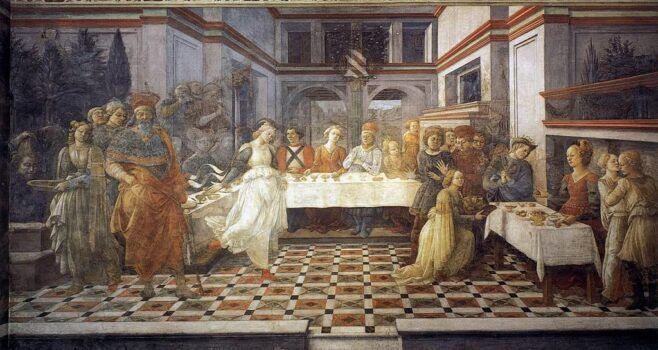
One of Lippi’s most ambitious projects was the Stories of St. Stephen and St. John the Baptist in the Cathedral of Prato (1452–1465). These frescoes demonstrate his command of narrative sequence, capturing complex religious stories with both drama and human warmth. Lippi’s use of perspective enhances the realism of the settings, while his delicate rendering of faces and gestures brings the figures to life, emphasizing the psychological and emotional dimensions of the scenes.
Lippi also worked extensively in panel painting, producing altarpieces for various Florentine churches. His Annunciation (c. 1440) illustrates his mastery of light and color, with angelic figures interacting naturally with the Virgin Mary, set against a background that balances architectural precision with atmospheric subtlety. Similarly, Adoration of the Magi (c. 1459) exemplifies Lippi’s ability to organize complex compositions, guiding the viewer’s eye through intricate arrangements while maintaining clarity and elegance.
The influence of Filippo Lippi on Renaissance art cannot be overstated. His synthesis of naturalism, emotional expressiveness, and compositional innovation helped define the aesthetic of early Florentine painting. Lippi’s pupils and followers, including Botticelli and his own son Filippino Lippi, carried forward his stylistic principles, ensuring that his approach to form, color, and narrative continued to shape Italian painting long after his death in 1469.
Lippi’s legacy lies not only in the technical skill of his works but also in the humanity and warmth he brought to religious subjects. By portraying sacred figures with tenderness, psychological depth, and graceful realism, he bridged the gap between devotional art and human experience. Today, his paintings are celebrated in museums and churches across Italy and beyond, serving as enduring reminders of the early Renaissance’s innovative spirit and the profound impact of one of its most gifted artists.
Filippo Lippi represents a critical figure in the development of Renaissance painting. His life was a blend of artistic brilliance, personal controversy, and relentless innovation. Through his frescoes, altarpieces, and devotional panels, Lippi not only advanced the techniques of perspective, composition, and naturalistic representation but also infused his subjects with a humanity that continues to captivate audiences. His influence on subsequent generations underscores his importance as both an artist and a pivotal contributor to the cultural flowering of 15th-century Florence.
A Life Shaped by the Cloister and the Canvas
Filippo Lippi was born in Florence around 1406, a city at the center of Renaissance innovation. Orphaned at the age of two, young Filippo was taken in by the Carmelite friars of the monastery of Santa Maria del Carmine. It was here, surrounded by frescoes by Masaccio, that Lippi’s artistic destiny began to take root.
Though he took vows as a Carmelite friar, the cloister could not contain his burgeoning artistic spirit. By 1432, Lippi left the monastery, turning fully to painting, a decision that would change the course of Italian art.
Filippo Lippi: The Artist and the Innovator
Lippi’s early works bear the influence of Masaccio, his Florentine predecessor. However, Lippi quickly developed his own distinct style, softer, more lyrical, and imbued with a tender humanism. Where Masaccio brought gravity and solidity, Lippi introduced grace, beauty, and emotion, especially in his portrayals of the Virgin Mary.
His figures were not just religious icons; they were living beings, warm, expressive, and delicate. His women, in particular, had an ethereal beauty that made his Madonnas some of the most beloved in art history. This human touch, along with his technical mastery in using light, color, and composition, made Lippi one of the most sought-after painters of his time.
Love, Scandal, and Inspiration
Lippi’s personal life was as legendary as his professional achievements. While painting a commission in Prato Cathedral, he met Lucrezia Buti, a beautiful young woman placed in a convent. In a turn worthy of a romantic novel, Lippi persuaded her to model for his Virgin Mary. They fell in love, and in a scandal that shocked the Church, he abducted her from the convent. They had a son, Filippino Lippi, who would himself become a celebrated Renaissance painter.
While the scandal nearly cost him his standing, it also cemented Lippi’s image as a rebel artist, driven by passion and vision. His life was a vivid contradiction, monk and lover, devout and defiant, visionary and rogue.
Filippo Lippi is best known for his religious paintings, particularly his Madonnas and Annunciation scenes. Unlike his predecessors, Lippi brought an emotional realism to these sacred subjects. He fused elegance with spirituality, turning theological themes into deeply human narratives.
His work is also noted for:
Graceful linearity and flowing contours
Soft modeling of figures, especially female ones
Intimate and tender emotional expressions
Pioneering use of perspective and spatial arrangement
Rich yet delicate color palettes
He played a crucial role in moving Florentine painting from the stark realism of Masaccio toward the more decorative and poetic styles that would later define the High Renaissance.
Most Famous Paintings by Filippo Lippi
Filippo Lippi left behind a body of work that resonates to this day. Some of his most famous paintings include:
1. Madonna and Child with Two Angels (c. 1465)
Location: Uffizi Gallery, Florence
Perhaps Lippi’s most iconic work, this piece captures the Virgin Mary in a moment of serene beauty and maternal tenderness. The angel peeking playfully toward the viewer adds a human touch rarely seen before in religious painting.
2. Coronation of the Virgin (1441–1447)
Location: Uffizi Gallery, Florence
Commissioned for the high altar of Sant’Ambrogio, this massive and complex altarpiece depicts the Virgin being crowned in heaven, surrounded by a celestial chorus of saints and angels. The composition is rich in symbolism and color.
3. Annunciation (c. 1440)
Location: San Lorenzo, Florence
A delicate and luminous depiction of the Archangel Gabriel greeting Mary. The soft use of light and elegant positioning of the figures highlight Lippi’s genius in conveying divine mystery with gentle grace.
4. The Funerary Monument to Sir John Hawkwood (1436)
Location: Florence Cathedral
Though more austere, this equestrian portrait demonstrates Lippi’s versatility and command over large-scale compositions.
5. Frescoes in the Cathedral of Prato (1452–1465)
Lippi’s fresco cycle depicting the Lives of St. Stephen and St. John the Baptist is a masterpiece of narrative painting. These frescoes, filled with drama, detail, and architectural marvels, are among his greatest achievements.
The Most Expensive Filippo Lippi Painting
In the modern art market, few works by Lippi have come up for sale due to their rarity and value. The most expensive painting attributed to Filippo Lippi is:
“The Madonna and Child Enthroned with Two Angels”
Estimated value: Over $50 million
While exact figures can vary, and many works reside in museum collections never to be sold, this piece’s auction estimate reflects both the quality of the work and its historical importance. In private dealings, Lippi’s paintings can command prices that rival works by later Renaissance masters.
How Many Paintings Did Filippo Lippi Create?
The exact number of Filippo Lippi’s paintings is not precisely known due to lost works, misattributions, and collaborative pieces (especially with workshop assistants and his son Filippino). However, art historians attribute roughly 40–50 works directly to him, including:
Altarpieces
Panel paintings
Fresco cycles
Tondo (round) paintings
Small devotional works
Some of his paintings have been misattributed over the centuries or confused with those of his son or contemporaries like Botticelli, whom Lippi taught.
Where Can You See Filippo Lippi’s Paintings Today?
Lippi’s paintings are scattered across Italy and the world, preserved in museums, churches, and cathedrals. Key locations include:
1. Uffizi Gallery, Florence
Home to Madonna and Child with Two Angels and Coronation of the Virgin
2. Cathedral of Prato
Houses the monumental fresco cycle on the lives of St. Stephen and St. John the Baptist
3. National Gallery, London
Displays several of his smaller panel works and Madonnas
4. Louvre Museum, Paris
Holds a few works attributed to both Filippo and his workshop
5. Museo Nazionale di Capodimonte, Naples
Includes lesser-known but still stunning works by Lippi
6. Metropolitan Museum of Art, New York
Contains important Lippi paintings and drawings
Lippi’s art continues to shine in the great halls of the world’s premier museums, drawing thousands who marvel at his spiritual vision and sensual beauty.
The Legacy of Filippo Lippi
Filippo Lippi’s impact on Renaissance art is profound. He trained Sandro Botticelli, whose work would define the golden age of Florentine painting. Lippi’s son, Filippino Lippi, also carried forward his father’s stylistic innovations into the High Renaissance, bridging the gap between generations of Italian masters.
Lippi’s contributions include:
Bridging Gothic and Renaissance styles: Lippi helped move Italian art away from the rigid forms of Gothic art toward the naturalism and grace of the Renaissance.
Humanizing the sacred: He painted saints and Madonnas as real, emotional beings, not distant icons.
Innovating visual storytelling: His narrative frescoes show a masterful grasp of drama, pacing, and spatial composition.
Inspiring future generations: Lippi’s influence extends through Botticelli and beyond, shaping the very language of Renaissance visual culture.
Despite his scandalous personal life, Lippi’s artistry was so respected that he received major commissions even from the Medici family and Pope Pius II.
Filippo Lippi’s story is a study in contrasts. A monk who defied celibacy, a painter who elevated the divine through sensual beauty, a father, a lover, and a teacher, he embodied the Renaissance in all its complexity. His works are both windows into the spiritual ideals of his time and mirrors of the emotional depth that art can achieve.
Through his paintings, we see not only biblical stories but also the tender humanity of the figures, reflecting the universal truths of love, sorrow, joy, and grace. He was a master of bringing heaven down to earth, one soft brushstroke at a time.