Domenico Ghirlandaio: Chronicler of Florence and Master of Renaissance Realism
Domenico Ghirlandaio (1448–1494) is one of the most important painters of the Italian Renaissance, celebrated for his ability to combine religious storytelling with detailed portrayals of contemporary Florentine life. Living and working during a period of extraordinary artistic energy, Ghirlandaio helped define the visual language of late 15th-century Florence. His paintings are not only devotional images but also historical documents, preserving the faces, fashions, and values of his age with remarkable clarity.
Born Domenico di Tommaso Bigordi in Florence, Ghirlandaio earned his nickname from his father’s profession as a goldsmith who specialized in making decorative garlands (ghirlande) for women’s hair. This early exposure to craftsmanship and design shaped Domenico’s strong sense of structure, ornament, and clarity. He trained initially as a goldsmith before turning to painting, an apprenticeship that likely contributed to the precision and disciplined composition that characterize his mature work.
Ghirlandaio developed his artistic style within the Florentine tradition shaped by artists such as Masaccio, Fra Angelico, and Andrea del Verrocchio. From Masaccio he absorbed a respect for solid form and perspective; from Fra Angelico, a calm devotional tone; and from Verrocchio’s circle, an attention to lifelike detail. Unlike some of his contemporaries who pursued dramatic experimentation, Ghirlandaio favored balance, legibility, and narrative clarity. His art was designed to be immediately understood by viewers, especially within public and religious spaces.
One of Ghirlandaio’s greatest strengths was fresco painting, the dominant medium for large-scale decoration in Renaissance Italy. Fresco required speed, planning, and technical mastery, and Ghirlandaio excelled in organizing large workshops capable of completing ambitious cycles on time. His ability to manage assistants efficiently made him a favored artist among wealthy patrons, religious orders, and civic institutions.
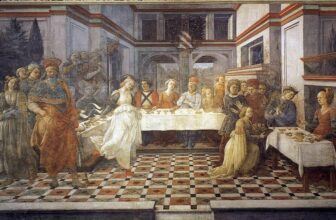
Among his most important works is the fresco cycle in the Tornabuoni Chapel of Santa Maria Novella in Florence (1485–1490). This monumental project depicts scenes from the lives of the Virgin Mary and Saint John the Baptist. While rooted in biblical narrative, the frescoes are filled with portraits of contemporary Florentines, including members of the Tornabuoni family and other prominent citizens. These figures appear dressed in elegant Renaissance clothing, set within architecture inspired by classical antiquity. The cycle exemplifies Ghirlandaio’s unique talent for merging sacred history with present-day reality.
Another major masterpiece is the fresco cycle in the Sassetti Chapel of Santa Trinita (1482–1485), illustrating the life of Saint Francis. Here, Ghirlandaio places religious scenes within recognizable Florentine settings, including a famous depiction of Piazza della Signoria. The work reflects Florence’s civic pride and the close relationship between religion and public life during the Renaissance. The figures are calm, dignified, and carefully individualized, reinforcing Ghirlandaio’s reputation as a master portraitist.
In addition to frescoes, Ghirlandaio produced notable panel paintings. Works such as Portrait of an Old Man and His Grandson reveal his extraordinary sensitivity to human emotion and realism. The painting presents aging and youth side by side, with unflinching honesty and deep tenderness. This portrait, like many others, shows that Ghirlandaio’s interest extended beyond ideal beauty to the truthful depiction of human character.
Ghirlandaio’s workshop played a crucial role in the artistic life of Florence, and his influence extended through his pupils. Most famously, Michelangelo Buonarroti briefly apprenticed in Ghirlandaio’s workshop as a teenager. While Michelangelo’s later style diverged dramatically, his early exposure to fresco technique and large-scale narrative composition under Ghirlandaio’s guidance was formative.
Historically, Ghirlandaio’s importance lies in his role as a visual historian of Florence at its cultural peak. His paintings document the social hierarchy, religious customs, architecture, and clothing of the late 15th century with extraordinary precision. Unlike artists driven by intense personal expression, Ghirlandaio functioned as a civic painter—someone whose art served the collective identity and memory of the city.
Domenico Ghirlandaio died in 1494 at the age of 45, a year of political upheaval marked by the fall of the Medici and the death of Lorenzo the Magnificent. Though his life was relatively short, his legacy endured through his works, his workshop, and his influence on the next generation of Renaissance artists.
Today, Ghirlandaio is remembered as a master of clarity, realism, and narrative balance. His art offers a window into Renaissance Florence not as an abstract ideal, but as a living, breathing society. Through his frescoes and portraits, Domenico Ghirlandaio ensured that the faces and stories of his time would endure, making him one of the most valuable chroniclers of the Italian Renaissance.
Who Was Domenico Ghirlandaio?
Ghirlandaio earned his nickname, meaning “garland maker,” from his father, who crafted gold and silver garlands for Florentine women. Originally apprenticed to his father, Ghirlandaio’s artistic destiny took a different turn when his talent for drawing led him to pursue painting.
Florence during the 15th century was the beating heart of the Renaissance, and Ghirlandaio quickly found his place among the city’s most esteemed painters. He was trained in the workshop of Alesso Baldovinetti, a painter known for his attention to landscape and perspective. Ghirlandaio absorbed his master’s lessons and evolved into a master of fresco, portraiture, and narrative scenes.
While Ghirlandaio painted with a clear eye for realism and detail, he also embraced the decorative elegance of the Florentine tradition. His art fused the sacred with the secular, often portraying biblical events in contemporary Renaissance settings, with patrons and Florentine citizens appearing alongside saints and apostles.
Ghirlandaio is best known for:
His Frescoes: Monumental fresco cycles in Florence and Rome that combine religious themes with Florentine daily life.
Narrative Clarity: His compositions are noted for their clarity, order, and richly detailed storytelling.
Realistic Portraiture: He included lifelike portraits of his patrons within religious scenes, an innovation that influenced future Renaissance painters.
Mentorship of Michelangelo: Ghirlandaio was the first master of Michelangelo Buonarroti, the towering genius of the High Renaissance.
Bridging Gothic and Renaissance: His works marked a transition from the Gothic style to the more naturalistic and human-centered art of the Renaissance.
Domenico Ghirlandaio Most Famous Paintings
While Ghirlandaio created many works throughout his career, several stand out for their artistic mastery, historical significance, and enduring beauty.
1. Fresco Cycle in the Tornabuoni Chapel (1485–1490) – Santa Maria Novella, Florence
Arguably Ghirlandaio’s magnum opus, the frescoes in the Tornabuoni Chapel narrate the lives of the Virgin Mary and St. John the Baptist. These frescoes cover the chapel walls and ceilings with vivid storytelling, Renaissance architecture, and portraits of Florentine nobility.
Highlights include:
The Birth of the Virgin
The Visitation
Zacharias Writing the Name of John
The Birth of John the Baptist
Ghirlandaio painted Florentine merchants, noblewomen, and children with astonishing detail, often including contemporaries like the Tornabuoni family. These frescoes are considered a visual document of Florentine life in the late 15th century.
2. Last Supper (1480) – Convent of San Marco, Florence
This serene and symmetrical Last Supper reflects Ghirlandaio’s skill in composition. Unlike Leonardo da Vinci’s emotionally charged version, Ghirlandaio’s interpretation is calm, formal, and deeply reverent. The balance of figures, use of architectural perspective, and soft lighting make it one of his most contemplative works.
3. Adoration of the Magi (1487) – Ospedale degli Innocenti, Florence
Commissioned for the orphanage of Florence, this panel showcases Ghirlandaio’s decorative style. The lavish costumes, architecture, and the inclusion of angels and animals enhance the grandeur of the biblical narrative.
4. The Calling of the First Apostles (1481) – Sistine Chapel, Vatican City
Invited by Pope Sixtus IV to work on the newly constructed Sistine Chapel, Ghirlandaio contributed to the fresco cycle on the life of Christ and Moses. His fresco, The Calling of the First Apostles, illustrates Christ summoning Peter and Andrew and reveals Ghirlandaio’s mature Roman style with majestic figures and spatial clarity.
5. Portrait of an Old Man and His Grandson (c. 1490) – Louvre Museum, Paris
This touching double portrait is one of Ghirlandaio’s most personal and intimate works. The old man, possibly suffering from rhinophyma, looks tenderly at the child. The emotional connection between the figures, set against a detailed landscape, makes this one of the earliest examples of psychological portraiture in the Renaissance.
What Is the Most Expensive Painting by Domenico Ghirlandaio?
While Renaissance paintings rarely appear in modern auctions due to their presence in museum collections, Ghirlandaio’s “Portrait of a Lady” (sometimes attributed to his workshop) fetched significant attention at Sotheby’s in recent decades.
However, the most valuable works by Ghirlandaio are not sold but rather priceless due to their cultural significance. The Tornabuoni Chapel frescoes, given their scale and integration into architecture, are essentially invaluable.
The Louvre’s “Portrait of an Old Man and His Grandson” is widely considered one of his most valuable standalone panel paintings. Though never auctioned, its worth is estimated in the tens of millions of dollars given its rarity and emotional depth.
How Many Paintings Did Domenico Ghirlandaio Create?
There is no precise count, but historians estimate that Ghirlandaio and his workshop created:
Over 100 individual panel paintings and portraits
At least a dozen major fresco cycles
Numerous drawings, preparatory sketches, and altar pieces
Ghirlandaio ran a large workshop that included his brothers Davide and Benedetto, and later his son Ridolfo Ghirlandaio. This studio system allowed him to take on large commissions and maintain high output.
It is believed that about 60–80 works directly bear his hand, while many more were executed by assistants under his design and supervision.
Where Can You Find Domenico Ghirlandaio’s Paintings Today?
Ghirlandaio’s masterpieces are scattered across Italy and Europe, primarily in churches and prominent museums. Some of the key locations include:
Italy
Florence
Santa Maria Novella (Tornabuoni Chapel frescoes)
Convent of San Marco (Last Supper)
Ospedale degli Innocenti
Palazzo Vecchio
Museo del Bigallo
Rome
Sistine Chapel (Vatican City)
Santa Maria Maggiore
Pisa
Campo Santo (workshop frescoes)
International
Louvre Museum, Paris (Portrait of an Old Man and His Grandson)
National Gallery, London
Metropolitan Museum of Art, New York
Gemäldegalerie, Berlin
Städel Museum, Frankfurt
Many of his works are still in their original locations, especially frescoes which cannot be moved. These offer an authentic glimpse into how Renaissance art was experienced in situ.
Domenico Ghirlandaio’s Legacy
Ghirlandaio died in 1494, at the age of 46, but his influence endured long after his death. His legacy is multifaceted:
1. Michelangelo’s Teacher
Perhaps his most lasting contribution to art history is his mentorship of Michelangelo Buonarroti. According to Giorgio Vasari, Michelangelo was apprenticed to Ghirlandaio at age 13. While Michelangelo would go on to revolutionize Renaissance art, Ghirlandaio’s influence is evident in his early works, particularly in fresco composition and human anatomy.
2. Elevating the Fresco
Ghirlandaio’s frescoes helped cement this medium as the pinnacle of public art in Renaissance Italy. His narrative clarity and mastery of perspective influenced contemporaries like Botticelli, Perugino, and Filippino Lippi.
3. Documenting Renaissance Florence
More than just religious stories, Ghirlandaio’s paintings serve as visual archives of 15th-century Florence, its architecture, fashion, social dynamics, and spiritual life.
4. Humanizing the Divine
By integrating contemporary portraits and real settings into biblical scenes, Ghirlandaio made sacred stories more relatable. His art bridged the divine and the everyday, a hallmark of the humanist ideals of the Renaissance.
5. A Family of Artists
Ghirlandaio founded a dynasty of artists. His brothers and son continued the family workshop, and his influence was felt across generations of Florentine painters.
Domenico Ghirlandaio may not have achieved the towering fame of Michelangelo or Leonardo da Vinci, but his art represents the soul of the Early Renaissance. Through his exquisite frescoes, tender portraits, and vibrant storytelling, he captured the beauty of his world, both sacred and secular.
His work endures not only on the walls of chapels and the halls of museums but in the fabric of art history itself. Ghirlandaio was a master of vision and discipline, blending faith with realism, mythology with memory. For anyone seeking to understand the Renaissance not just as a movement but as a moment of profound human expression, Ghirlandaio remains a crucial, captivating figure.