Albrecht Dürer’s Self-Portrait (1500): A Guide for Antique Art Collectors
Few artworks in Northern Renaissance history command as much fascination and scholarly devotion as Albrecht Dürer’s 1500 Self-Portrait, sometimes called Self-Portrait at Twenty-Eight. Painted when Dürer was just 28 years old, the work stands as one of the boldest statements of artistic identity ever produced. While many Renaissance masters produced self-portraits, none dared to depict themselves with such overt symbolism, spiritual gravity, and defiant self-confidence. For antique art collectors, this painting is not only a masterpiece of technique but a cultural artifact that reshaped the social meaning of being an artist.
This article provides a deep, comprehensive study of the painting suitable for seasoned collectors, covering its history, composition, symbolism, theological implications, controversies, reception, and its valuation context. Although the painting itself is held in a public institution and not available on the private market, understanding its value, historic, cultural, and financial, enhances any collector’s grasp of Renaissance art.
Albrecht Dürer in 1500
When Dürer created this self-portrait, he was already an accomplished figure in Nuremberg’s thriving artistic community. He had completed two major journeys: one to Colmar and Basel, where he encountered the legacy of Schongauer, and another to Italy, where he absorbed classical ideals and the humanist perspective. By 1500, Dürer was keenly aware of his rising status both locally and internationally. This was the dawn of a new millennium, charged with religious anticipation, humanist expansion, and commercial opportunity.
A New Conception of the Artist
Prior to the Renaissance, artists were often classified as craftsmen rather than intellectuals. Dürer, however, positioned himself as a learned creator, equal to scholars, mathematicians, and theologians. His self-portraits from 1493, 1498, and finally 1500 reflect this evolution. The 1500 self-portrait is the culmination of this self-fashioning, a visual declaration that the artist possesses innate genius, divine inspiration, and individual identity that transcends craft.
Commission and Purpose
Unlike many works created for patrons, this self-portrait was intended for Dürer’s personal collection. It hung in his studio and later in his home, indicating it served both as a professional assertion and a personal statement. Some scholars believe it functioned as a manifesto, prepared for a new century wherein Dürer would solidify his reputation as Northern Europe’s greatest artist.
Description of the Painting
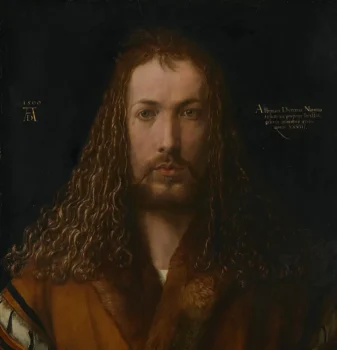
The painting is an oil on limewood panel, now housed at the Alte Pinakothek in Munich. Its composition is strikingly symmetrical:
Dürer faces the viewer directly, a pose typically reserved for depictions of Christ rather than for secular portraiture.
His right hand is raised and positioned near his chest, recalling the gesture of blessing found in icons.
He is dressed in a fur-trimmed cloak, suggesting status and self-respect.
His hair falls in carefully rendered waves, each strand beautifully articulated.
The background is a deep, dark field, intensifying the sense of sacred presence.
An inscription beside his head reads:
“I, Albrecht Dürer of Nuremberg painted myself thus, with undying colors, at the age of twenty-eight.”
The deliberate choice of wording, particularly “undying colors”, reveals his ambition to achieve lasting fame through artistic mastery.
Symbolism and Meaning
The 1500 self-portrait is among the most symbolically loaded images of early modern art. Its meaning unfolds on multiple levels: religious, artistic, personal, and philosophical.
Christ-Like Iconography
One of the most immediately noticeable features is the direct, frontal pose, strongly reminiscent of traditional depictions of Christ Pantocrator. For centuries, this pose had been reserved almost exclusively for sacred subjects. Dürer’s decision to apply it to himself was unprecedented.
Why did he do this?
Theological Idea of the “Imago Dei”:
Renaissance humanists believed that humans, created in the image of God, share in divine creativity. For Dürer, an artist imitates God’s act of creation.Artistic Genius as Divine Gift:
Dürer frequently wrote that artistic ability came from God. Depicting himself in a Christ-like manner was not an act of arrogance, but of recognition that he was a vessel for divine inspiration.Self-Identity as Creator:
The painting suggests that the human act of artistic creation echoes God’s creation of humanity.
Symbolism of Clothing
The luxurious fur coat reflects both status and dignity. Fur garments were expensive, but they also found symbolic use in Renaissance portraits to signify seriousness, learning, and moral gravity.
Hand Gesture
The gesture resembles blessing, but also highlights Dürer’s right hand, the hand of artistic creation. By placing it near his chest, he emphasizes both skill and spiritual calling.
Symmetry and Geometry
The highly symmetrical composition aligns with Dürer’s interests in proportion and geometry, which he would later formalize in his treatises. Symmetry enhances the sacred icon effect and underscores the intellectual nature of his self-presentation.
Inscription and Date
The prominent inclusion of the date “1500” has been interpreted as a millennial marker. Approaching the 16th century, many Europeans felt a sense of cosmic transition, something Dürer captures through his intense, timeless presence.
Controversies Surrounding the Painting
The self-portrait has sparked debate since the late 19th century, when art historians began to examine its theological implications more closely.
Accusations of Blasphemy or Hubris
Some early critics argued that Dürer’s use of Christ-like iconography was presumptuous or irreverent. However, most modern scholars reject this interpretation, reading the painting instead as an expression of Renaissance humanism, not religious arrogance.
Debate Over Intent
Was Dürer consciously imitating Christ?
While it is widely accepted today that he intentionally echoed sacred imagery, some scholars propose alternative readings:
A visual demonstration of artistic status
A philosophical statement about human rationality
A meditative piece for Dürer’s personal use
Psychological Interpretations
In the 20th century, some art historians approached the painting through psychoanalytic frameworks, suggesting narcissistic or self-mythologizing motives. These remain speculative, though they do highlight the painting’s unusual intensity.
The Identity Question
Another minor controversy concerns whether the image truly represents Dürer exactly as he looked or whether he updated his appearance to fit symbolic goals. Given the painting’s heavy conceptual emphasis, it is likely an idealized version of himself.
Reception Through the Centuries
16th and 17th Centuries: Limited Circulation
The painting initially remained in Dürer’s possession and then in Nuremberg for generations, meaning its early reception was relatively limited. However, Dürer’s reputation as the greatest German artist of the time ensured the painting was treated with reverence.
18th Century: Enlightenment Interest
During the Enlightenment, scholars praised Dürer for his mathematical precision and scientific approach. The self-portrait became a prime example of the “thinking artist.”
19th Century: Romantic Fascination
Romantic writers idealized Dürer as a national hero. The self-portrait, in its mystical solemnity, fit perfectly with the era’s interest in individual genius. It was widely reproduced in prints, further cementing its status.
20th Century: Modern Analysis
Art historians examined the painting more critically:
Panofsky highlighted its theological symbolism.
German scholars used it to explore national identity.
Psychological and feminist critiques broadened its interpretations.
21st Century: Cultural and Digital Icon
Today, the painting is one of the most reproduced Renaissance self-portraits and a staple of art history education. It remains highly studied due to its unique blend of piety, self-promotion, and innovation.
The Painting’s Place in Dürer’s Oeuvre
Dürer painted multiple self-portraits throughout his life:
1493 (Portrait with Thistle)
1498 (Elegant Venetian-style portrait)
1500 (The iconic Christ-like portrait)
The 1500 self-portrait is considered the pinnacle of this progression, representing not only personal maturity but Dürer’s intellectual and spiritual philosophy. For collectors of antique prints or early modern German art, understanding this arc is essential.
Artistic Techniques and Materials
Collectors and art historians often emphasize the technical brilliance of the painting:
Oil on Wood Panel
Dürer used a traditional Northern medium, achieving stunning detail and luminosity. His control of oil paint demonstrates mastery equal to his Italian contemporaries.
Fur Texture
The meticulous depiction of fur, each individual hair rendered with precision, became a hallmark of northern painting techniques.
Realism of the Face
The face is painted with subtle transitions, lifelike modeling, and deep psychological intensity.
Light and Shadow
The soft illumination from the left highlights his features while the dark background creates dramatic contrast.
Use of Line
True to his background as a printmaker, Dürer’s lines are confident, controlled, and almost sculptural.
Cultural Value and Interpretive Legacy
The painting occupies a unique position in Western art. It bridges the sacred and the secular, the medieval and the modern. It prefigures later developments in self-portraiture, from Rembrandt to Van Gogh to contemporary conceptual artists.
Influence on Later Artists
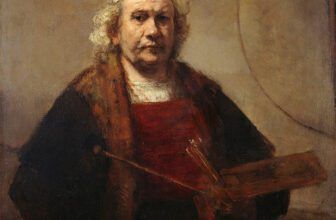
Rembrandt admired Dürer and frequently referenced his self-portrait compositions.
19th-century German artists adopted Dürer as a symbol of national heritage.
Modern painters have appropriated the frontal pose in explorations of identity.
A Prototype of the Modern Artist
Dürer’s self-portrait is crucial to the evolution of the Western concept of the artist as an autonomous creative genius, a shift that fundamentally reshaped the art world.
Provenance, Location, and Institutional Status
Current Location
The painting is housed in the Alte Pinakothek, Munich, Germany.
Provenance Highlights
Belonged to Dürer’s estate initially
Later entered the collection of the city of Nuremberg
Was acquired by Bavaria in 1805
Has remained in Munich ever since
The painting has never been on the private art market, and as a national treasure, it is considered unexportable and priceless.
Market Value and Collecting Context
Although the original painting will never be available for sale, understanding its market relevance is important for collectors.
Market Worth
Experts estimate that if the painting were hypothetically sold, which is legally impossible, its value would exceed hundreds of millions of dollars, potentially rivaling top auction world records. As one of the most important self-portraits in Western art, it would belong to the highest tier of valuation.
Collectible Alternatives
Collectors interested in Dürer can pursue:
Period prints by Dürer (woodcuts, engravings)
Later impressions of his most famous prints (e.g., The Knight, Death, and the Devil)
18th–19th century engravings reproducing the self-portrait
Early books containing his treatises on proportion and fortifications
Dürer prints remain highly sought after, with top examples fetching tens or hundreds of thousands at major auctions.
Cultural vs. Monetary Value
For serious collectors, the painting’s monetary value is secondary to its cultural and conceptual significance. It represents:
The rise of the autonomous artist
The shift from medieval workshop culture to Renaissance individualism
The integration of northern technical precision with Italian humanism
Why This Painting Still Matters Today
Dürer’s 1500 self-portrait remains one of the most analyzed and admired images in European art because it asks a bold, timeless question:
What does it mean to be an artist?
The self-portrait defies boundaries, between artist and icon, between humanity and divinity, between craft and intellect. It captures a moment of personal and cultural transformation that still resonates with viewers today.
For antique art collectors, understanding this painting’s place in history enhances the appreciation of every Dürer print, every Northern Renaissance panel, and every artistic innovation that followed.
Albrecht Dürer’s Self-Portrait (1500) is far more than a depiction of an artist at 28, it is a groundbreaking statement about creative identity, human dignity, and divine inspiration. Its symbolism, controversies, technical mastery, and profound cultural impact make it one of the most important paintings of the Renaissance.
While the original resides permanently in the Alte Pinakothek, Munich, its influence is universal. For collectors, understanding its history enriches any acquisition related to Dürer and deepens one’s appreciation of the Northern Renaissance’s intellectual and artistic legacy.