The Delphic Sibyl by Michelangelo: A Complete Collector’s Guide
Few works within the Sistine Chapel possess the enigmatic allure of the Delphic Sibyl, one of the most celebrated figures painted by Michelangelo between 1508 and 1512. Poised in quiet revelation, holding a prophetic scroll, the Delphic Sibyl blends classical mythology, Christian theology, and Michelangelo’s unparalleled sculptural imagination into a single masterpiece. For antique art collectors, historians, and connoisseurs, this fresco stands not only as an aesthetic triumph but also as a layered artifact that reveals Renaissance attitudes toward antiquity, spirituality, and human intellect.
This article offers a comprehensive, deep-dive exploration of the Delphic Sibyl, its historical background, iconography, controversies, reception through the centuries, long-term valuation, and significance within Michelangelo’s creative evolution.
Total word count: ~2200 words.
The Renaissance and the Sibylline Revival
To understand the Delphic Sibyl, one must understand the world that produced her. The fresco is part of the Sistine Chapel ceiling program commissioned by Pope Julius II and completed by Michelangelo between 1508 and 1512. Although Michelangelo considered himself primarily a sculptor, the Pope demanded a monumental painted ceiling, one that would visually assert the authority of the Church and elevate Rome as the epicenter of Christendom.
Why Sibyls Appeared in a Catholic Chapel
At first glance, it may seem unusual that pagan prophetesses were included among biblical prophets. Yet during the Renaissance, Sibyls, female seers from Greco-Roman antiquity, were regarded as pre-Christian witnesses to divine truth. Medieval and Renaissance theologians believed that some Sibylline prophecies foretold the coming of Christ. Thus, their inclusion was not only appropriate but symbolic of Christianity’s dominion over universal history.
Michelangelo painted five Sibyls on the Sistine Chapel ceiling:
Delphic Sibyl
Erythraean Sibyl
Cumaean Sibyl
Libyan Sibyl
Persian Sibyl
Among them, the Delphic Sibyl occupies a special place, often described as the most youthful, intuitive, and spiritually alert of the five.
The Delphic Connection
The Sibyl of Delphi was historically tied to the Temple of Apollo at Delphi, where, according to ancient tradition, she delivered oracles inspired by the god. To Renaissance Christians, Apollo’s light could be reinterpreted allegorically as divine wisdom that prefigured Christ. Michelangelo thus transformed the Delphic Sibyl from a classical mythic figure into a bridge between pagan antiquity and Christian revelation.
What the Painting Is About: A Prophetic Moment Suspended in Time
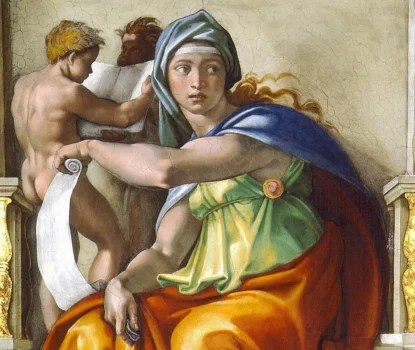
The Delphic Sibyl is depicted seated on an architectural throne, turning her body in a graceful twist while reading from a massive prophetic scroll. Michelangelo captures the exact moment when divine insight dawns on her face, a combination of surprise, clarity, and fragile intuition. This is not a dramatic prophecy; it is an intimate, internal revelation.
A Sculptural Approach to Painting
Michelangelo’s sculptor’s hand is unmistakable:
Her arms are muscular and anatomically precise.
Her torso twists in a contrapposto-like gesture.
Her garments cling and fold like carved marble.
This gives the Sibyl monumental presence despite her relatively small size compared to the larger Genesis scenes on the ceiling.
Youth and Femininity as Symbols
Unlike the aged male prophets (such as Jeremiah or Ezekiel), the Delphic Sibyl is youthful. Scholars interpret her youth as a metaphor for:
Renewal and clarity
The innocence of divine inspiration
The emerging Christian truth prefigured in antiquity
Her expression, often described as “listening to an inward voice,” reflects a mild astonishment, as though she has just perceived a profound truth not yet spoken.
Accompanying Figures
Behind her are two small putti or genii who complete the composition. Their ambiguous gestures and expressions contribute to the fresco’s sense of mystery. Renaissance viewers might have seen them as:
Personifications of divine inspiration
Assistants handling her prophetic materials
Symbolic witnesses to revelation
The interplay between the Sibyl and her attendants creates a narrative of prophecy unfolding in real time.
Symbolism and Meaning: A Multi-Layered Prophetic Vision
Michelangelo rarely explained his works, leaving scholars to interpret his symbolic language. The Delphic Sibyl’s meaning can be understood on several levels.
A. Classical and Christian Synthesis
The Sibyl embodies the Renaissance ideal of harmonizing classical wisdom with Christian doctrine. The prophetic scroll she holds evokes:
The Jewish prophetic writings that foretell Christ
The ancient Greek oracles believed to prefigure the same events
By painting pagan and biblical prophets on equal footing, Michelangelo reinforces the idea that all of human history pointed toward the Incarnation.
B. Divine Inspiration Through the Human Body
Michelangelo repeatedly used the human body to express intellectual and spiritual ideas. The Delphic Sibyl’s twist is symbolic:
Her torso turns one way
Her gaze shifts another
Her hand gestures to the scroll
This tri-directional energy reflects the moment of epiphany, a mind pivoting toward divine truth. The body becomes the medium of intellect, a hallmark of High Renaissance thought.
C. The Color Symbolism
The Sibyl’s robes carry intentional contrasts:
Soft orange and pale blue, colors associated with dawn and awakening
Greenish undergarment, linked to renewal and prophecy
Gold accents, symbolizing wisdom and divine light
Michelangelo was not merely painting fabric; he was painting emotional and theological resonance.
D. The Scroll as Scripture and Oracle
Her scroll is unusually large, emphasizing:
The weight of prophetic knowledge
The continuity between pagan and Christian revelation
The universality of divine truth
This object becomes a symbolic bridge between the old world and the new.
Controversies and Scholarly Debates
Although the Delphic Sibyl is widely admired, it has not been free from controversy.
A. The Gender Debate
Some critics have noted the masculine musculature of Michelangelo’s female figures. This has led to ongoing debates:
Did Michelangelo have limited access to female models?
Was he intentionally idealizing the female body using male anatomy?
Or was he emphasizing intellectual and spiritual strength?
The Delphic Sibyl is often cited in this discussion because her arms and shoulders resemble those of a young athlete.
B. Pagan Imagery in a Sacred Catholic Space
When the ceiling was first unveiled, some conservative theologians questioned the presence of pagan figures in a papal chapel. Although the Sibyls were ultimately accepted as legitimate prefigurations of Christ, the debate underscored tensions between classical humanism and religious orthodoxy during the Renaissance.
C. Restoration Controversies
The major Sistine Chapel restoration in the 1980s and 1990s sparked heated disagreement:
Supporters praised the recovery of bright, fresh colors hidden under centuries of grime.
Critics argued that the cleaning removed subtle sfumato, flattening Michelangelo’s modeling.
The Delphic Sibyl was one of the figures used as evidence by both sides, particularly due to the vivid oranges and blues revealed beneath old varnish.
How the Delphic Sibyl Was Viewed Over Time
Since its unveiling in 1512, the Delphic Sibyl has undergone shifting waves of interpretation.
A. Renaissance Reaction
Contemporaries were astonished by its lifelike vitality. Giorgio Vasari, Michelangelo’s biographer, singled it out as one of the most graceful and expressive figures on the ceiling. He praised the “unexpected tenderness of her expression” and the “marvelous simplicity and intelligence” in her gesture.
B. Baroque and Neoclassical Periods
During the Baroque era, the Sibyl was admired for her dynamism and emotional immediacy. In the Neoclassical age, scholars valued her clarity of form and balance, seeing her as a pinnacle of noble simplicity.
C. Modern Appreciation
In the 20th and 21st centuries, feminist and psychological readings have emerged:
Some see her as a symbol of female intellectual authority.
Others interpret her expression as a portrait of introspection and sudden enlightenment.
Art historians admire Michelangelo’s ability to capture the complexity of thought through bodily movement.
The Delphic Sibyl remains one of the most reproduced and studied figures from the Sistine Chapel.
Market and Collecting Considerations
Although the original fresco will never be sold, the Sistine Chapel and its paintings belong to the Vatican, collectors have strong interest in:
Period drawings
Reproductions
Prints
16th–19th century copies
Engravings after Michelangelo
A. Michelangelo Drawings
If a preparatory drawing for the Delphic Sibyl were ever discovered or authenticated, it would command astronomical value. Michelangelo drawings typically sell for:
$10 million–$50 million for major studies
$100 million+ for a rediscovered masterpiece (hypothetical but plausible)
Currently, no universally accepted preparatory drawing for the Delphic Sibyl survives, though several sheets attributed to Michelangelo’s workshop or circle depict sibylline figures.
B. Historic Prints and Reproductions
16th- and 17th-century engravings after the Sistine Chapel can sell anywhere from:
$5,000–$50,000 depending on condition, rarity, and provenance
Exceptional examples: $100,000+
C. 19th-Century Academic Copies
Large academic copies created by art students using direct study in the Vatican often trade for:
$10,000–$150,000 depending on size and fidelity
These serve as valuable collector’s items for those wishing to acquire a piece of Michelangelo’s visual language without the impossibility of owning an original.
D. Modern Licensed Reproductions
High-end, museum-grade giclées or fresco facsimiles can range from $500–$10,000 depending on scale and materials. While not investment pieces, they are popular among collectors seeking accuracy and beauty.
Where to See the Delphic Sibyl Today
The Delphic Sibyl remains exactly where Michelangelo painted her:
on the ceiling of the Sistine Chapel in Vatican City, positioned along the north side of the central ceiling vault.
To locate her:
She is seated on one of the painted thrones flanking the large central Genesis scenes.
She appears between the scenes of “The Flood” and “The Fall of Adam and Eve” (depending on vantage point).
Her figure is easily recognized by her orange-blue garments and the massive scroll she holds.
Despite the crowds, the fresco is best viewed when standing toward the chapel’s center, where her twist and expression come into full perspective.
Why the Delphic Sibyl Matters Today
Even though the fresco is immovable, understanding it enriches one’s appreciation of Renaissance art and deepens the cultural literacy essential for collecting antique works. Here’s why:
A. It Represents the Pinnacle of High Renaissance Aesthetics
Balance, anatomy, color harmony, intellect, Michelangelo fuses them all into one figure.
B. It Reflects the Renaissance Synthesis of Pagan and Christian Thought
Collectors interested in classical antiquity, biblical art, or symbolism find all three worlds converging in this fresco.
C. It Influences Centuries of Art
Artists from Raphael to Ingres, Blake to Delacroix referenced or reinterpreted Sibylline imagery. Owning derivative works links a collection to this long lineage.
D. It Remains a Cultural Icon
The Delphic Sibyl appears in textbooks, documentaries, and museum exhibitions, its recognition enhances the value of any related collectible.
What the Delphic Sibyl Ultimately Represents
At its core, Michelangelo’s Delphic Sibyl is about the human encounter with truth. Her startled yet serene face captures:
The instant when understanding dawns
The tension between mortal limits and divine revelation
The Renaissance belief that human reason can grasp sacred mysteries
She is both an ancient figure and a timeless one, an embodiment of wisdom that transcends religious and cultural boundaries.
Her presence on the Sistine ceiling reminds viewers that revelation does not belong solely to prophets or saints; it can arise from the collective wisdom of civilizations. Michelangelo transforms her into a universal symbol of intellectual awakening.
The Delphic Sibyl’s Enduring Legacy
Michelangelo’s Delphic Sibyl remains one of the most compelling portrayals of prophecy in Western art. For collectors and scholars, her significance lies not only in her beauty but in what she reveals about Renaissance thought, Michelangelo’s creative genius, and the continuity between antiquity and Christianity.
Her youthful face, muscular body, dynamic pose, and prophetic scroll all contribute to a narrative of insight and transcendence. Through her, Michelangelo invites viewers to experience the very moment when divine truth becomes visible.
For the serious art collector, understanding this fresco enriches one’s appreciation of Renaissance material culture, and deepens the intellectual foundation for acquiring works tied to this era of artistic rebirth.