Edgar Degas’ Self-Portrait
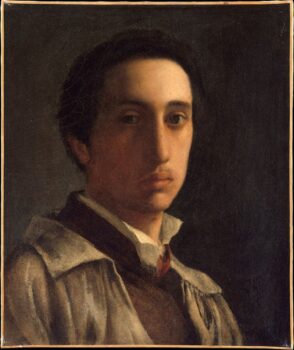
Edgar Degas, the enigmatic Impressionist painter renowned for his evocative depictions of ballet dancers and Parisian life, left behind a legacy of artistic brilliance that continues to captivate audiences around the world. Among his lesser-known works is a self-portrait that offers a profound insight into the psyche of the artist, a window into the soul of a man whose creative genius was matched only by his inner turmoil and existential angst. Painted in 1855, when Degas was just twenty-one years old, this haunting self-portrait stands as a testament to his enduring legacy as one of the most influential figures in the history of art.
At first glance, Degas’ self-portrait appears deceptively simple, a stark, unadorned depiction of a young man staring out at the viewer with a piercing intensity. His gaze is direct and unwavering, his expression inscrutable and enigmatic. Yet, upon closer inspection, the painting reveals itself to be a study in contrasts, a juxtaposition of light and shadow, clarity and ambiguity, that mirrors the inner contradictions of the artist himself.
Degas’ self-portrait is rendered with a striking economy of form and color. The background is rendered in muted shades of brown and gray, while the artist’s face emerges from the darkness with a luminous, almost ethereal quality. His features are carefully delineated, his eyes piercing and penetrating, as if searching for some elusive truth beyond the confines of the canvas. There is a sense of introspection and self-awareness in his expression, a quiet intensity that hints at the depths of his artistic sensibility.
What sets Degas’ self-portrait apart is its psychological depth and complexity. Unlike many self-portraits, which seek to project an idealized image of the artist, Degas’ painting feels refreshingly honest and unguarded. There are no pretensions or affectations here just the unvarnished truth of a man confronting himself in the mirror and inviting the viewer to join him on his journey of self-discovery.
At the same time, Degas’ self-portrait is a study in the alienation and isolation that often accompanies the life of the artist. The figure is positioned against a blank, featureless background, his face illuminated by an otherworldly glow that seems to emanate from within. There is a palpable sense of loneliness and existential angst in his expression, a feeling of being adrift in a world that is at once familiar and unknowable.
Throughout his career, Degas struggled with feelings of inadequacy and self-doubt, grappling with the demands of his chosen profession and the pressures of society. His self-portrait serves as a poignant reminder of the emotional turmoil that lay beneath the surface of his outward success, a reminder of the fragility and vulnerability of the human spirit in the face of life’s uncertainties.
Yet, for all its melancholy undertones, Degas’ self-portrait also radiates a sense of resilience and determination. Despite the challenges he faced, Degas remained steadfast in his commitment to his artistic vision, producing a body of work that continues to inspire and enchant audiences to this day. In his self-portrait, we see not just the face of a man, but the spirit of an artist, a soul driven by an insatiable thirst for beauty and truth, and a relentless desire to capture the fleeting moments of life with all the passion and intensity of his being. image/metmuseum