What is the meaning of Saturn devouring his son
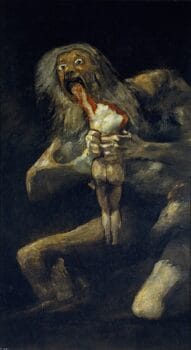
Saturn devouring his son is one of the most disturbing yet profoundly symbolic stories in ancient mythology. Rooted in Roman mythology , and derived from the earlier Greek myth of Cronus , it tells of the god Saturn (Cronus in Greek) who, fearing that he would be overthrown by one of his children, ate each one upon their birth. The image, most famously depicted in Francisco Goya’s haunting painting Saturn Devouring His Son, has fascinated and horrified generations. But why did Saturn commit such a gruesome act? To understand this question, we must explore its historical, psychological, and symbolic dimensions.
Saturn was told by a prophecy that one of his children would eventually overthrow him, just as he had overthrown his own father, Uranus. Determined to prevent history from repdevouring itself, Saturn consumed each child immediately after they were born. However, his wife, Ops (or Rhea in Greek mythology), eventually tricked him by hiding their youngest son, Jupiter (Zeus in Greek mythology), and giving Saturn a stone wrapped in swaddling clothes instead. Jupiter later grew up, returned, and fulfilled the prophecy by overthrowing Saturn and becoming king of the gods.
On a literal level, this is about a cycle of power and fear. Saturn’s actions are driven by a deep fear of losing control, a theme that recurs throughout history and literature. Kings, rulers, and powerful individuals have often gone to extreme lengths to preserve their reign , sometimes even turning against their own families. In Saturn’s case, the fear of losing power led to destructive, irrational behavior.
Psychologically, this can be interpreted through a Freudian or Jungian lens. Saturn represents the old order, the tyrannical father figure who suppresses the next generation. His devouring of his children can be seen as a metaphor for how old systems or traditions try to prevent the rise of new ideas or change. In Jungian terms, Saturn may represent the shadow aspect of the psyche , the dark, repressed parts of ourselves that fear growth and transformation.
Symbolically, Saturn devouring his children is also a representation of time consuming everything. Time devours youth, potential, and even the gods themselves. This interpretation turns into a reflection on the human condition , our mortality, our struggle with legacy, and our eventual replacement by the next generation. Saturn becomes not just a tyrant, but a tragic figure doomed by the very forces he tries to resist.
Finally, in a broader cultural sense, it warns against the dangers of unchecked power and the consequences of trying to defy fate. No matter how powerful one becomes, the natural order , whether it’s time, fate, or generational change , cannot be stopped. By attempting to prevent his downfall, Saturn ensured it.
In conclusion, Saturn devouring his son speaks to universal human fears: of losing control, of being replaced, of facing the passage of time. Its lasting power lies in its ability to reflect both the personal and political dimensions of power and transformation.
What is the meaning of Saturn devouring his son
The painting is a visual representation of an ancient mythological story in which Saturn consumes his children. The image is grotesque, visceral, and deeply unsettling, but what does it truly signify? To understand its meaning, we must delve into the mythology of Saturn, the reasons behind his horrific act, and the broader philosophical implications of Goya’s work.
In Roman mythology, Saturn was the god of time, wealth, agriculture, and renewal. However, his story is dark and tragic. Saturn was forewarned by a prophecy that one of his sons would overthrow him, just as he had overthrown his father, Uranus. To prevent this from happening, Saturn took extreme measures, devouring each of his children as soon as they were born.
Saturn was married to Ops, and together they had several children, including Jupiter, Neptune, and Pluto. Each time Ops gave birth, Saturn would swallow the child whole, ensuring that none could grow strong enough to challenge his rule.
However, Ops devised a clever plan to save their youngest son, Jupiter. She secretly gave birth and hid the infant, instead handing Saturn a stone wrapped in swaddling clothes. Saturn, blinded by paranoia, swallowed the stone, believing he had consumed his child. Jupiter was raised in secrecy, and when he came of age, he fulfilled the prophecy by overthrowing Saturn and forcing him to regurgitate his siblings, who had remained alive in his stomach. This marked the rise of the Olympian gods and the downfall of the Titans.
The painting has been interpreted as a metaphor for insanity, tyranny, aging, and the devouring nature of time itself. Some see it as a reflection of Goya’s mental state or his disillusionment with the political chaos of post-Napoleonic Spain. Others view it as a timeless allegory of power’s self-destruction.
Who Painted Saturn Devouring His Son?
The painting was created by Francisco José de Goya y Lucientes (1746–1828), one of Spain’s most influential and innovative painters. Goya began his career as a court painter for the Spanish monarchy, producing portraits and decorative works in the Rococo and Neoclassical styles. However, after a serious illness in the 1790s that left him deaf, Goya’s artistic vision darkened considerably. His later works explore themes of madness, violence, war, and the grotesque.
Saturn Devouring His Son was not painted for public exhibition or royal patronage. Instead, it was one of Goya’s “Black Paintings”, a series of deeply disturbing murals he painted directly onto the walls of his private home, known as Quinta del Sordo (House of the Deaf Man), near Madrid. These works were never titled or explained by Goya himself, leaving generations of scholars to interpret them through the lens of psychology, history, and symbolism.
How Was Saturn Devouring His Son Painted?
Unlike traditional oil paintings on canvas, Saturn Devouring His Son began as a mural, painted directly onto the plaster walls of Goya’s dining room between 1819 and 1823, during the final years of his life. Goya used oil paints on plaster, applying dark pigments to create stark contrasts and a chilling sense of depth and movement. The technique was experimental and unconventional, especially for an aging artist working in near-isolation.
After Goya’s death in 1828, the house changed ownership. In the 1870s, the banker Baron Frédéric Émile d’Erlanger financed a delicate and risky operation to transfer the murals to canvas. This process involved carefully detaching the paint layer from the plaster and mounting it onto a canvas support. Though some details were inevitably lost or altered during the transfer, the core emotional and visual impact of the work remained intact.
The canvas version of Saturn Devouring His Son measures 143.5 cm × 81.4 cm (approximately 56.5 in × 32 in) and is dominated by the image of a wild-eyed, emaciated figure biting into a partially devoured corpse. The god’s face is a mask of insanity, his fingers are claw-like, and the background is almost entirely black, emphasizing the isolation and horror of the act.
What Type of Art Is Saturn Devouring His Son?
Saturn Devouring His Son defies easy classification, but it is most commonly associated with the Romanticism movement. Romanticism in the 19th century was characterized by an emphasis on emotion, imagination, and the sublime, often delving into the irrational, the uncanny, and the tragic. Unlike Neoclassicism, which focused on order and beauty, Romanticism embraced the chaos of human experience, and Goya was one of its most radical proponents.
The painting can also be considered a precursor to modern Expressionism and Surrealism. Its raw emotional intensity, distorted anatomy, and nightmarish subject matter predate the psychological explorations of artists like Edvard Munch and Salvador Dalí. In many ways, Goya’s Black Paintings are the spiritual ancestors of modern and contemporary dark art.
How Many Sons Did Saturn Eat?
In mythological accounts, Saturn devoured five of his children: Vesta (Hestia), Ceres (Demeter), Juno (Hera), Pluto (Hades), and Neptune (Poseidon). Jupiter was the only one who escaped and later liberated his siblings. Some variations of the story suggest different numbers of children or emphasize specific gods, but the core narrative remains the same: Saturn consumed his offspring to prevent his own downfall.
What Happened to Saturn’s Children?
Although Saturn consumed his children, they did not perish. When Jupiter grew strong enough, he forced Saturn to regurgitate them, leading to the Titanomachy, a massive war between the Titans and the Olympians. Ultimately, the Olympians emerged victorious, and Saturn, along with many other Titans, was cast into Tartarus, a dark abyss of punishment.
In some versions, Saturn was not doomed to eternal suffering but instead fled to Italy, where he became a benevolent ruler associated with the Golden Age, a period of peace and prosperity.
The Message of Saturn Devouring His Son
Goya’s painting of Saturn devouring his son is not just a retelling of the story, it is a deeply symbolic and psychological piece. The painting is part of Goya’s Black Paintings, a series of dark and intense works created in his later years. These paintings reflect his declining mental health, disillusionment with humanity.
The themes in Saturn Devouring His Son include:
- The Passage of Time: Saturn is also a symbol of time (Cronus/Kronos in Greek means “time”). His act of devouring his children can be interpreted as time consuming everything, youth, power, and life itself. It is a chilling reminder of the inevitability of decay and mortality.
- Paranoia and Madness: Goya’s depiction of Saturn is wild-eyed, bloodied, and feral. This suggests a descent into madness, highlighting the psychological torment of those who cling too tightly to power or fear the future.
- A Critique of War and Oppression: Some art historians suggest that Goya’s painting is a critique of the violence and tyranny of his time, particularly the Spanish Inquisition and the Napoleonic Wars. Saturn’s cannibalism mirrors the way governments and institutions consume their own people in the pursuit of control.
Is Saturn Devouring His Son Neoclassical or Romantic?
Goya’s painting is firmly rooted in the Romantic movement. While Neoclassicism emphasized order, rationality, and idealized beauty, Romanticism was driven by emotion, individualism, and the sublime, often portraying horror, madness, and the darker aspects of humanity.
Elements that make Goya’s painting Romantic include:
- Intense Emotion: The grotesque horror and psychological torment in the painting are hallmarks of Romanticism.
- Dark and Raw Aesthetic: Unlike the polished and structured works of Neoclassicism, Goya’s piece is rough, with thick, expressive brushstrokes that add to its unsettling nature.
- Personal Expression: The painting reflects Goya’s own fears and state of mind, a key trait of Romantic art, which often prioritized personal and emotional expression over historical accuracy or idealized forms.
Where Is Saturn Devouring His Son Today?
Saturn Devouring His Son is housed in the Museo del Prado in Madrid, Spain. The Prado Museum is one of the world’s most important art museums, featuring an extraordinary collection of Spanish masters such as Velázquez, El Greco, and Goya himself.
The painting resides in a special section dedicated to Goya’s Black Paintings, alongside other unsettling works like Witches’ Sabbath, The Dog, and Two Old Men Eating Soup. These paintings are displayed in subdued lighting, preserving the fragile state of the transferred canvases while maintaining the eerie, intimate atmosphere intended by Goya.
Visitors to the Prado are often struck by the raw immediacy of Saturn Devouring His Son, which contrasts sharply with the polished grandeur of other museum pieces. It continues to provoke strong reactions, fascination, disgust, sorrow, awe, and remains a major draw for art lovers, historians, and casual tourists alike.
The Legacy of Saturn Devouring His Son
Saturn devouring his son is an enduring tale of fear, power, and fate, and Goya’s painting captures its darkest essence. Whether viewed as a commentary on cruelty on intense badwill, the inevitability of time, or the madness of people, the image remains one of the most striking and disturbing pieces of art in history. Goya’s vision transforms an ancient myth into a chilling reflection of human nature, one that continues to provoke thought and emotion centuries after its creation.