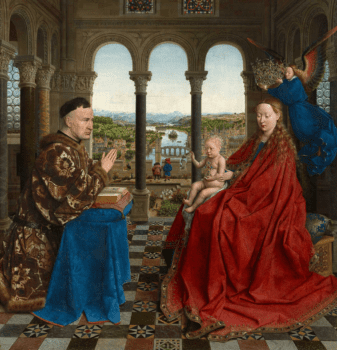
The Madonna of Chancellor Rolin Painting
The Madonna of Chancellor Rolin, painted by Jan van Eyck around 1435, is one of the most celebrated works of Early Netherlandish painting. Commissioned by Nicolas Rolin, the powerful Chancellor of the Duchy of Burgundy, the painting exemplifies van Eyck’s mastery of oil technique while serving as a complex synthesis of religious devotion, political self-representation, and meticulous observation of the material world. Today housed in the Louvre Museum, the work stands as a landmark in the development of Northern Renaissance art.
The composition depicts the Virgin Mary enthroned with the Christ Child, seated opposite Chancellor Rolin within an architectural setting that resembles a loggia or chapel. Rolin is shown kneeling in prayer, hands clasped, facing the Madonna and Child. Although placed in the same pictorial space, the figures are not interacting directly; their gazes do not meet, underscoring a hierarchy between the divine and the mortal. Mary, monumental and serene, occupies a central position, while the Christ Child raises his hand in blessing, reinforcing the painting’s devotional function.
One of the most striking aspects of the painting is van Eyck’s extraordinary attention to detail. The surfaces of fabrics, jewels, marble columns, and embroidered garments are rendered with astonishing precision. Mary’s robe, a rich red symbolizing love and suffering, cascades in carefully observed folds, while the jewels in her crown and the angel’s garment reflect light with jewel-like clarity. Rolin’s attire, though comparatively restrained, conveys wealth and authority through subtle textures and fine materials. This hyper-realism reflects van Eyck’s innovative use of oil paint, which allowed for layered glazes and nuanced tonal transitions that were unprecedented at the time.
The architectural space plays a crucial symbolic role. The loggia opens onto an expansive landscape featuring a river, bridges, fields, and a distant city. This panoramic view is not merely decorative; it reflects the medieval conception of a divinely ordered universe. The transition from the sacred interior to the worldly exterior suggests a connection between heaven and earth, with Mary acting as an intermediary between the divine realm and human society. The cityscape in the background is often interpreted as an idealized vision of a Burgundian city, possibly referencing Rolin’s political domain and reinforcing his status within a Christian cosmic order.
Symbolism permeates the painting at multiple levels. The garden visible beyond the loggia may allude to the hortus conclusus (enclosed garden), a traditional symbol of Mary’s purity. The peacocks perched on the balustrade symbolize immortality and resurrection, while the meticulously depicted tiles and columns evoke classical antiquity, suggesting continuity between the ancient world and Christian civilization. Even the placement of Rolin within the sacred space is symbolically charged: although he is physically close to the Virgin and Child, his position remains clearly subordinate, emphasizing humility and piety rather than presumption.
The painting also functions as a statement of personal devotion and political legitimacy. As Chancellor, Rolin was one of the most powerful figures in Burgundy, and his inclusion in the painting serves to associate his authority with divine approval. However, van Eyck avoids overt flattery. Rolin’s features are rendered with uncompromising realism, including signs of age and individuality, reinforcing the moral seriousness of the image. This balance between realism and idealization reflects the broader aims of Northern Renaissance art: to reconcile the spiritual with the tangible world.
In art-historical terms, The Madonna of Chancellor Rolin represents a turning point in European painting. It demonstrates a new approach to space, light, and realism that differs markedly from the idealized forms of the Italian Renaissance. Rather than relying on linear perspective alone, van Eyck constructs depth through atmospheric effects and detailed observation. The painting’s integration of portraiture, landscape, and religious imagery influenced generations of artists in Northern Europe.
The Madonna of Chancellor Rolin is a carefully constructed visual argument about faith, power, and the structure of the world. Through technical innovation, symbolic richness, and psychological subtlety, Jan van Eyck created a work that encapsulates the intellectual and spiritual ambitions of the fifteenth-century Burgundian court. Its enduring significance lies in its ability to unite the divine and the earthly within a single, coherent vision.
The Meaning and History of Madonna of Chancellor Rolin
The Madonna of Chancellor Rolin is a masterpiece of early Netherlandish painting, created by the renowned artist Jan van Eyck around 1435. This extraordinary artwork is both a devotional image and a display of wealth and power, combining religious iconography with an unprecedented level of realism.
The painting presents a deeply symbolic representation of the Virgin Mary and the Christ Child, witnessed by Chancellor Nicolas Rolin, a powerful figure in the Burgundian court. But what is the deeper meaning behind this painting? Who was Chancellor Rolin, and why was this artwork commissioned? In this exploration, we will answer these questions and examine the significance of Madonna of Chancellor Rolin in art history.
Who Was Chancellor Rolin?
Nicolas Rolin (1376–1462) was a prominent figure in 15th-century France. He served as Chancellor to Philip the Good, Duke of Burgundy, for over four decades. As one of the most influential men in Burgundy, Rolin played a crucial role in political negotiations, diplomacy, and legal affairs. He was known for his administrative acumen and for helping consolidate the power of the Burgundian state, which was one of the wealthiest and most powerful political entities in Europe at the time.
Rolin was also a devout Christian and a significant patron of the arts. His deep religious convictions are evident in the commissioning of several religious artworks and the foundation of the Hospices de Beaune, a hospital for the poor that still stands today. His wealth and influence allowed him to commission one of the greatest painters of his time, Jan van Eyck, to create Madonna of Chancellor Rolin.
The Meaning of the Madonna of Chancellor Rolin
Jan van Eyck’s painting is a strikingly detailed and symbolic work of art that conveys themes of divine grace, power, and devotion. The composition is meticulously structured, with each element serving a deeper theological or social meaning.
Religious Symbolism
At the center of the painting, the Virgin Mary sits on a throne, holding the Christ Child on her lap. This depiction follows the traditional iconography of the Madonna enthroned, symbolizing her role as the Queen of Heaven. The Christ Child raises His hand in blessing toward Chancellor Rolin, who kneels in a gesture of devotion and humility.
The interaction between Rolin and the Virgin Mary suggests a form of direct intercession, emphasizing the power of prayer and the divine grace bestowed upon the faithful. This arrangement also reflects the growing trend of personal devotion in 15th-century religious art, where patrons desired a more intimate connection with the divine.
Wealth and Power
The setting of the painting is a richly decorated loggia that overlooks a breathtaking landscape. The intricate architectural details and opulent decorations reflect Rolin’s immense wealth and status. The columns, adorned with carvings of biblical scenes, serve as a reminder of divine judgment and righteousness.
Beyond the loggia, a vast, meticulously rendered cityscape stretches into the distance. The landscape symbolizes the unity between earthly and heavenly realms, reinforcing the idea that divine grace extends into worldly affairs. The presence of an elaborate city suggests Burgundian prosperity and serves as an indirect testament to Rolin’s contributions to the duchy’s success.
The Angels and the Divine Realm
Above the Virgin and Child, two angels hold a richly decorated crown above Mary’s head, symbolizing her coronation as Queen of Heaven. This celestial element enhances the painting’s theological significance, emphasizing the divine nature of Mary’s role in Christian doctrine.
The angels’ presence also underscores the contrast between the earthly and heavenly spheres. While Rolin is a powerful earthly figure, his position in the painting is still subordinate to the Virgin and Christ, reinforcing the idea that temporal power is secondary to divine authority.
What Is Happening in The Painting?
The painting depicts Chancellor Nicolas Rolin kneeling before the Virgin Mary, who sits on a throne holding the Christ Child. Both are inside a richly decorated loggia that opens onto a sweeping cityscape. Behind Rolin, a tiny angel descends to crown Mary as Queen of Heaven. On the opposite side, two figures, often described as witnesses, perhaps van Eyck himself and his brother, stand in the background balcony and look out upon the landscape. Christ, sitting calmly on Mary’s lap, raises His hand in blessing toward Rolin.
What makes the composition striking is that Rolin appears equal in size and status to the holy figures. This bold choice visually expresses Rolin’s belief in his closeness to the divine. It suggests that his political power and religious devotion give him access to eternal grace. The painting communicates a deeply personal spiritual encounter, but with monumental political messaging embedded throughout.
A Heavenly Portal Hidden in a Realistic Interior
Van Eyck was celebrated for his ability to combine intense realism with spiritual meaning. Here, he uses architectural precision to signal that this visible world is not ordinary. The loggia splits neatly into two realms:
Heaven on the left, ruled by Mary and Christ, filled with divine symbols.
Earth on the right, where Rolin sits and the worldly city spreads outward.
Yet the border between these worlds is deliberately blurred. The shared space suggests a moment where Heaven and Earth meet directly. Rolin does not dream this scene, he experiences it.
The structure functions like a portal, making the sacred feel physically present. The columns, patterned tiles, and marble walls all meticulously follow mathematical perspective, anchoring the miraculous event in believable space. This transforms a devotional image into an immersive experience for viewers.
Revolutionary Use of Perspective and Architecture
Before van Eyck, medieval religious art often relied on flat backgrounds and symbolic arrangements. Van Eyck broke from tradition by placing holy figures inside a real location with careful geometric perspective. The vanishing point lies at the center of the garden beyond the loggia, drawing our eyes forward into depth. The columns create a rhythm that pulls viewers inward, guiding them gradually from the earthly foreground toward heavenly revelation.
Van Eyck’s architecture does more than organize space, it builds theology. The stability and harmony of the structure evoke divine order, reinforcing the presence of God within material reality. This was a groundbreaking idea: the sacred could be encountered through the real world, not beyond it.
Light as a Symbol of Revelation
Light in this painting flows softly across every surface, revealing textures in stone, fabric, and distant buildings. Unlike dramatic Italian contrasts, van Eyck uses diffused, omnipresent illumination, symbolizing God’s grace spreading evenly throughout creation. Nothing is hidden; every detail matters. This expresses the theological belief that divine truth can be discovered by observing the world directly.
The deep background landscape, filled with bustling life, bridges, vineyards, ships, and houses, shows the universe functioning under God’s watchful light. Van Eyck extends sacred meaning into the horizon, illustrating the unity between the divine and the everyday.
The Crown, The Book, The Garden: Three Powerful Symbols
Van Eyck’s work is rich with iconography. Three key symbols stand out:
1. The Crown
The angel behind the Virgin holds a beautifully crafted crown, adorned with jewels and pearls. It emphasizes Mary’s role as Queen of Heaven, chosen to reign beside Christ. The crown elevates this scene beyond the earthly domain of Burgundian politics into cosmic authority. Yet the angel’s humble scale keeps the focus on Mary’s spiritual majesty rather than displays of wealth.
2. The Book
The prayer book lying open before Rolin symbolizes his piety and wisdom. Though politically ambitious, he is presented as a devout Christian scholar. The book links Rolin’s earthly duties to divine scripture, legitimizing his power as God-supported governance. Van Eyck promotes the idea that governing justly requires reading and living by holy teachings.
3. The Garden
The lush paradise visible beyond the columns is filled with symbolic plants: roses for Mary’s purity, lilies for innocence, irises for the Passion of Christ. This enclosed space, known as the hortus conclusus, represents the Virgin’s protective sanctity. It is both a literal garden and a metaphor for salvation. Human salvation unfolds within Mary’s divine intercession.
Together, the crown, the book, and the garden create a narrative of authority, devotion, and eternal life.
Why This Painting Transformed Religious Art
Van Eyck’s masterpiece changed artistic history by showing that:
The divine could be portrayed through realism, not fantasy.
Perspective and precision could enhance spiritual meaning.
Light could symbolize God’s presence in every detail.
Narrative symbolism could be embedded in daily environments.
Instead of separating Heaven from human life, van Eyck fused them into one breathtaking vision. The Madonna of Chancellor Rolin teaches viewers that the sacred is not distant, it can unfold inside any ordinary moment.
Who Commissioned the Madonna of Chancellor Rolin?
The painting was commissioned by Nicolas Rolin himself. As a man of immense influence and piety, Rolin sought to create a lasting legacy that would affirm both his devotion and his status. Art patronage was a means of securing spiritual merit and demonstrating one’s influence, and Rolin was no stranger to this practice.
His decision to commission Jan van Eyck, one of the most celebrated painters of his time, suggests a deliberate effort to produce an artwork of unparalleled quality. Van Eyck was known for his mastery of oil painting, which allowed for exquisite details and lifelike realism, making him the perfect choice to execute such an ambitious work.
By commissioning this painting, Rolin not only ensured his place in religious history but also solidified his public image as a devout and powerful figure in Burgundian society.
Where Is the Madonna of Chancellor Rolin Today?
The Madonna of Chancellor Rolin is currently housed in the Louvre Museum in Paris, France. The painting became part of the French national collection after the secularization and redistribution of church property during the French Revolution.
Today, it remains one of the Louvre’s prized possessions, admired for its intricate details, luminous color palette, and unparalleled realism. It continues to attract art historians and visitors from around the world who seek to study and appreciate Jan van Eyck’s genius.
The Artistic Legacy of the Madonna of Chancellor Rolin
Van Eyck’s Mastery of Oil Painting
One of the most striking aspects of this painting is Van Eyck’s technique. He was a pioneer of oil painting, which allowed him to achieve extraordinary levels of detail, depth, and luminosity. The transparency and layering of colors create a sense of realism that was groundbreaking for the time.
His meticulous attention to light and texture is evident in the reflective surfaces of the marble floor, the luxurious fabrics, and the shimmering landscape beyond the loggia. These elements contribute to the overall effect of divine presence and material splendor.
Influence on Later Art
Van Eyck’s work had a profound impact on the development of Northern Renaissance art. His mastery of perspective, atmospheric depth, and meticulous detail influenced generations of artists. The Madonna of Chancellor Rolin serves as an exemplary model of how religious themes could be intertwined with personal portraiture, a concept that became increasingly popular in Renaissance art.
Artists such as Rogier van der Weyden, Hans Memling, and even the Italian Renaissance painters studied Van Eyck’s techniques, incorporating similar elements into their works.
The Madonna of Chancellor Rolin is a devotional painting; it is a masterful blend of religious symbolism, personal ambition, and artistic innovation. Nicolas Rolin, as a powerful chancellor and patron, sought to immortalize his faith and influence through this stunning composition. Jan van Eyck, through his unparalleled skill, brought this vision to life with breathtaking detail and depth.
Today, as it stands in the Louvre Museum, the painting continues to captivate audiences with its richness and complexity. It serves as a testament to the enduring power of art to bridge the human and divine, the earthly and the heavenly.
Through this masterpiece, we gain insight into the mind of a man who sought to leave his mark on history, not only through politics but through beauty, faith, and artistic patronage.


