A Deep Dive into Le Pandémonium by John Martin
In the thunderous heart of Romanticism and apocalyptic vision, few painters dared to envision hellish grandeur and celestial cataclysm quite like John Martin. His painting Le Pandémonium (or Pandemonium, completed circa 1841) stands as one of his most dramatic, enigmatic, and visionary works. A fiery sermon of damnation rendered in oil and shadow, Le Pandémonium is not just a depiction of Hell’s capital, it is a philosophical epic on canvas, confronting humanity’s moral failures, spiritual rebellion, and the awe-inspiring power of divine justice.
Le Pandémonium by John Martin: A Monumental Vision of Chaos and Imagination
John Martin (1789–1854) stands as one of the most celebrated figures in British Romantic painting, renowned for his dramatic landscapes and apocalyptic scenes that capture both the sublime and the terrifying. Among his most intriguing works is Le Pandémonium, a painting that epitomizes Martin’s fascination with grandeur, chaos, and the biblical imagination. Completed in the early 19th century, this painting remains a testament to his technical prowess, imaginative scope, and profound engagement with the literary and theological currents of his time.
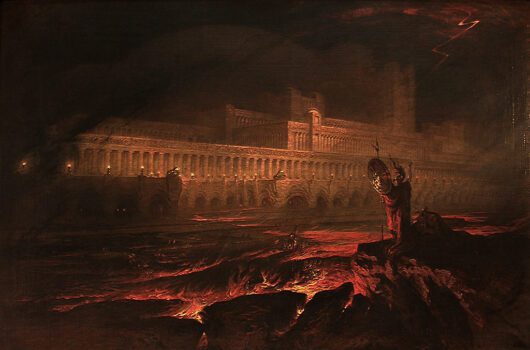
Le Pandémonium draws its inspiration from John Milton’s Paradise Lost, particularly the infernal architecture of Hell, which Milton describes as a palace for Satan and his fallen angels. Martin’s depiction, however, is far from a literal illustration of Milton’s text; instead, it is a vision of sublime terror, a spectacle in which architecture, fire, and human figures collide in a dramatic theatrical composition. The painting captures the construction of Pandemonium, the infernal capital of Hell, with towers and spires that rise like jagged teeth against a stormy sky, while waves of flames and smoke engulf the city below. In this scene, Martin communicates the overwhelming scale and magnitude of evil, using light and shadow to create a sense of depth, movement, and tension that pulls the viewer into the narrative.
Technically, Martin’s mastery of scale and perspective is evident in Le Pandémonium. The architectural forms dominate the canvas, dwarfing the human figures and emphasizing the monumental scope of the infernal city. His use of light is particularly striking; fiery glows illuminate the city while casting ominous shadows that enhance the sense of drama and chaos. This interplay of illumination and darkness is characteristic of Martin’s style and reflects the Romantic preoccupation with the sublime, the simultaneous feeling of awe and terror in the face of forces beyond human comprehension. Unlike many of his contemporaries, Martin’s landscapes and architectural fantasies are not merely backdrops but active participants in the narrative, almost characters in their own right, conveying moral and emotional intensity.
Le Pandémonium also reflects broader cultural and intellectual currents of the early 19th century. The Romantic era was marked by a fascination with the extraordinary, the catastrophic, and the divine. Martin’s work resonates with this ethos, combining biblical subject matter with imaginative freedom, producing a visual spectacle that addresses both spiritual and aesthetic concerns. Moreover, Martin’s apocalyptic vision spoke to contemporary anxieties about social upheaval, industrialization, and political revolution. The grandiosity and chaos depicted in Pandemonium can be seen as an allegory for a world in turmoil, reflecting the Romantic desire to grapple with forces, both divine and human, that are beyond ordinary understanding or control.
The reception of Le Pandémonium further highlights Martin’s unique position in the art world of his time. While some critics dismissed his work as excessively theatrical or sensational, others admired his ability to fuse narrative, scale, and emotional intensity. The painting became emblematic of Martin’s style: monumental compositions, dramatic chiaroscuro, and visionary imagination. It influenced not only his contemporaries but also later generations of artists, writers, and even filmmakers, particularly those drawn to epic scenes of apocalypse and catastrophe. The visionary quality of Le Pandémonium makes it a precursor to cinematic depictions of dystopia and inferno, long before moving images could capture such scale and intensity.
Importantly, Martin’s work also invites reflection on the relationship between art and literature. His engagement with Milton’s text demonstrates how visual art can reinterpret literary sources, expanding their narrative possibilities. In Le Pandémonium, Martin transforms Milton’s words into a visual experience that heightens the drama, suspense, and terror inherent in the original poem. By doing so, he bridges the gap between literary imagination and visual spectacle, creating a work that is as intellectually stimulating as it is visually arresting.
Today, Le Pandémonium remains a powerful example of Romantic artistic ambition. It exemplifies Martin’s capacity to combine technical skill, imaginative vision, and cultural commentary. The painting invites viewers to confront chaos and grandeur, to reflect on the nature of evil, and to experience the sublime in its most overwhelming form. More than a mere illustration of Milton’s text, it is a profound meditation on human experience, divine judgment, and the awe-inspiring power of imagination itself.
John Martin’s Le Pandémonium is not only a masterful work of Romantic art but also a historical artifact reflecting the cultural, literary, and theological concerns of the early 19th century. Through its monumental scale, dramatic composition, and visionary power, it continues to captivate audiences, offering a timeless exploration of chaos, grandeur, and the sublime. Martin’s ability to transform literary inspiration into a visual spectacle ensures that Le Pandémonium remains a cornerstone of Romantic art and an enduring symbol of the boundless possibilities of imagination.
Who Was John Martin?
Before plunging into the abyss of Pandemonium, it’s crucial to understand the man behind the vision. John Martin (1789–1854) was an English Romantic painter known for his dramatic, vast, and often biblical or apocalyptic scenes. A contemporary of J.M.W. Turner and William Blake, Martin carved a unique niche by depicting scenes of divine wrath, the destruction of cities, and infernal landscapes with a theatrical intensity that bordered on the cinematic.
Despite critics being divided on whether he was a genius or a sensationalist, Martin enjoyed widespread popularity in his time. His works were highly influential, not just in art, but also in literature, theater, and later, in cinema and science fiction.
What is Le Pandémonium All About?
Pandemonium is a visual representation of Hell’s capital, as described in John Milton’s “Paradise Lost”, Book I. The term “Pandemonium” (from the Greek pan = all, and daimonion = demons) was coined by Milton to describe the grand palace constructed by the fallen angels in Hell.
Martin’s painting captures the moment when Satan addresses the demonic council, presiding over the underworld’s newly built metropolis, a sprawling infernal city filled with corrupted majesty, smoldering light, and architectural ambition.
The painting is not just an illustration of literature. It is a moral and spiritual allegory, a meditation on pride, rebellion, and the delusions of grandeur. By showing Hell not as a pit of chaos but a city of terrifying beauty, Martin reverses the viewer’s expectations and poses deeper questions about power, order, and evil.
Composition and What Is Happening in the Painting
The eye is immediately drawn to a central platform bathed in an eerie, reddish golden light. Here, Satan stands, aloof, regal, and commanding. He is delivering a speech to a vast assembly of demons, who sit in semi-circular ranks, much like a parliament or Senate. The structure resembles a Gothic or neoclassical amphitheater, but twisted into a darker, more infernal style. There is a sublime sense of scale: the demons, though terrible, are dwarfed by the towering architecture that looms around them.
Above, colossal arches and pillars rise into the smoky sky. Volcanic eruptions or sulfuric fires glow in the distance. The entire scene is composed of immense architectural forms, layered perspectives, and interplaying light and shadow that create a sense of endless depth.
What is “happening” in the scene is more metaphysical than literal: it is a moment of oration, a call to arms, a rallying cry from the Prince of Darkness to the legions who followed him. Satan is about to propose revenge against Heaven through the corruption of Earth.
Symbolism and Interpretation
a. Satan as the Tragic Hero
Satan is presented not as a grotesque monster but a fallen hero, echoing the Miltonic tradition. Martin, like Milton, was fascinated by the idea of Satan as a noble rebel, echoing the Romantic archetype of the defiant antihero. Clothed in flowing robes, he is not repellent but magnetic, conjuring admiration even in his fall.
This presentation raises ethical and philosophical questions. Is evil more seductive when clothed in beauty and order? Can rebellion be righteous if it is eloquent and majestic?
b. The Infernal City
The city of Pandemonium itself symbolizes the perversion of human ambition. Its grandeur mirrors human civilization, but twisted into a monument of pride and fallenness. It is not chaotic like traditional depictions of Hell. Instead, it is organized, rational, even utopian in appearance. This irony is intentional.
Martin seems to suggest that evil does not always appear chaotic or ugly. It often wears the mask of progress, beauty, or power.
c. Light and Darkness
Martin’s use of light as a narrative force is masterful. The glow around Satan isn’t heavenly, it’s sulfuric, unnatural, and yet mesmerizing. Light emanates from below rather than above. This inversion of divine symbolism shows how Hell mimics Heaven, a counterfeit paradise with its own false light.
d. Architecture as Ideology
The monumental scale of the buildings represents the demonic aspiration to rival Heaven. Pandemonium is not a ruin, it is a freshly built capital, symbolizing ambition, blasphemy, and arrogance. Its design evokes ancient Rome, Gothic cathedrals, and Enlightenment ideals, all reimagined through a hellish lens. Martin critiques the hubris of civilizations that build grand systems while ignoring spiritual decay.
Artistic Style and Technique
John Martin’s work is best categorized within the Romantic movement, but with unique elements of sublime art, apocalyptic painting, and even early science fiction aesthetics.
a. Romanticism and the Sublime
Martin’s art is grounded in the Romantic fascination with the sublime, experiences that overwhelm the senses, inspiring awe and terror. Like his contemporaries (Caspar David Friedrich or Turner), Martin uses vast, overwhelming space to dwarf humanity and exalt metaphysical forces.
b. Theatrical Composition
His compositions have a theatrical quality, resembling opera sets or early cinematic landscapes. The use of foreground figures, sweeping curves, and spiraling perspective leads the viewer’s eye deeper into the narrative. You are not just looking at the painting, you are being drawn into it.
c. Innovative Techniques
Martin was a technical innovator. He used mezzotint engraving to popularize his paintings and reach a wider audience. His use of chiaroscuro (light/dark contrast), atmospheric effects, and detailed etching was advanced for his time and influential to later fantasy and science fiction illustrators.
Influence and Legacy
Le Pandémonium influenced not only 19th-century art but also modern visual culture. Martin’s visionary imagination inspired:
Fantasy and sci-fi artists such as Gustave Doré, H.R. Giger, and concept designers in films like Blade Runner, The Lord of the Rings, and Hellboy.
Writers and poets including Victor Hugo, Edgar Allan Poe, and later C.S. Lewis.
Film directors like Fritz Lang (Metropolis), Ridley Scott, and Peter Jackson.
He laid a foundation for the cinematic apocalypse, envisioning end-of-days grandeur long before CGI or epic cinema existed.
Where is Le Pandémonium Painting Today?
The original painting of Pandemonium by John Martin is held by the Louvre Museum in Paris, France. Its French title, Le Pandémonium, reflects its display in a European, especially French, Romantic context.
It is part of the museum’s Department of Paintings, specifically within its 19th-century Romanticism section, although it is not always on permanent display. The painting’s presence in the Louvre underscores its artistic and cultural significance, not only as a British work but as a universal meditation on power, rebellion, and damnation.
The Visionary Fire of John Martin
Le Pandémonium is more than a painting, it is a prophecy, a warning, and a mirror. It tells of a world where order does not equal goodness, where beauty can be used to mask evil, and where human ambition, unchecked by humility, can construct palaces of damnation.
Martin’s work remains profoundly relevant in the 21st century. In an age of rapid technological advancement, expanding empires, and ideological extremes, Pandemonium cautions us: not all light comes from heaven, and not all progress is salvation.
His vision echoes across time, reminding us that behind every grand city may lie a fallen angel, raising his voice, building his throne, and preparing a sermon for the damned.


