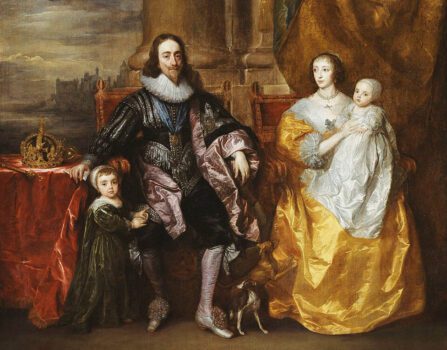
What are Most Famous Paintings by Anthony van Dyck
In the early morning haze of 17th-century Antwerp, a child was born into a world on the cusp of artistic revolution. His name was Anthony van Dyck (1599–1641), and his brush would eventually capture the soul of an empire, the splendor of nobility, and the human vulnerability behind regal veneers. A master of Baroque portraiture, van Dyck’s life was both a canvas of ambition and an enduring masterpiece etched into European history.
The Early Years: A Prodigy’s Brush
Anthony van Dyck was born on March 22, 1599, in Antwerp, then part of the Spanish Netherlands (modern-day Belgium). His father, Frans van Dyck, was a wealthy cloth merchant, which provided the young Anthony with the means to pursue artistic training from an early age. By the time he was ten years old, van Dyck was already painting with remarkable skill.
He became an apprentice to Hendrick van Balen, and later to Peter Paul Rubens, the celebrated master of Flemish Baroque art. Rubens was more than just a teacher to van Dyck, he was a mentor and a model. Under Rubens’ guidance, van Dyck honed his talent for drama, color, and movement, but more importantly, he developed his unique gift for capturing character and nobility in portraiture.
Italy and the Rise of a Court Painter
In 1621, van Dyck left Antwerp for Italy, a rite of passage for many Northern European artists. It was here, among the ruins of antiquity and the grandeur of the Renaissance, that his style matured. He spent time in Genoa, Rome, and Venice, studying the works of Titian, whose influence became a defining element of van Dyck’s aesthetic.
During his Italian sojourn, van Dyck was commissioned by the Genoese aristocracy, painting portraits that blended Northern realism with Venetian grandeur. His figures were elegant and aristocratic, often depicted in luxurious surroundings with a calm yet commanding presence.
Return to the North and Rise to Fame
Van Dyck returned to Flanders in 1627, establishing a successful workshop in Antwerp. Despite his growing fame, his artistic ambitions were greater than what Antwerp could offer. In 1632, he received an invitation that would change his life, and his place in history: he was summoned to the court of King Charles I of England.
King Charles, a connoisseur and avid collector of art, was searching for an official court painter who could rival the greatest masters of Europe. Van Dyck quickly impressed the monarch and the royal family with his refined, flattering style. In recognition of his talents, van Dyck was knighted and given the title of “Principal Painter in Ordinary to Their Majesties.”
What Is Anthony van Dyck Known For?
Anthony van Dyck is most renowned for his portraits, especially those of English aristocracy and royalty. His ability to capture the nobility and grace of his subjects, while also infusing them with psychological depth, set a new standard for portraiture in Europe.
He developed what became known as the “van Dyck style”, elegant poses, elongated limbs, and dignified, serene expressions. His sitters were not just portrayed as they were; they were elevated, idealized, yet still unmistakably human.
His influence extended beyond his paintings; he revolutionized fashion and posture among the British nobility. Even today, people refer to “Van Dyck dress” or “Van Dyck collar,” referring to the style he popularized through his portraits.
Most Famous Paintings by Anthony van Dyck
Van Dyck created hundreds of paintings, but several stand out as his most iconic and influential works.
1. Charles I in Three Positions (1635–36)
One of van Dyck’s most celebrated works, this portrait shows King Charles I from three angles, full face, profile, and three-quarter view. It was painted as a reference for the Italian sculptor Bernini, who was to sculpt a bust of the king.
This work is not just a technical triumph; it is a deeply psychological portrayal of Charles as both regal and introspective. Today, it resides in the Royal Collection in the UK.
2. Charles I at the Hunt (c. 1635)
This portrait of the king in civilian clothing, relaxed yet regal, set against a wooded background, reflects Charles’s desire to be seen as both a monarch and a refined gentleman. The painting is now housed in the Louvre Museum in Paris.
3. Portrait of Elena Grimaldi, Marchesa Cattaneo (1623)
Painted during his time in Italy, this portrait is a dazzling example of van Dyck’s Genoese period. Elena stands beneath a dramatic red curtain with a black servant beside her, a sign of wealth and status. Her poise and elegance remain unmatched.
4. Self-Portrait with a Sunflower (c. 1632–33)
One of van Dyck’s most introspective and symbolic paintings. The sunflower is believed to represent loyalty to the king or to God, and van Dyck, dressed richly, shows himself as a gentleman-artist rather than a mere craftsman. This painting is in the British Royal Collection.
5. The Five Eldest Children of Charles I (1637)
A moving portrait of innocence and the future of the monarchy. Each child is rendered with distinct character and grace. The painting resides in the Royal Collection.
How Many Paintings Did Anthony van Dyck Create?
The exact number of paintings van Dyck completed is difficult to pinpoint due to lost works and the number of studio replicas, but art historians estimate he produced over 750 works, including:
Over 400 oil paintings
Numerous drawings and sketches
Several religious altarpieces and mythological scenes
His studio was known for being extremely productive, and he often relied on assistants to complete backgrounds and less significant elements while focusing on the faces and hands himself.
The Most Expensive Anthony van Dyck Painting Ever Sold
While many of van Dyck’s works are housed in national collections and never enter the art market, a few have surfaced in auctions with extraordinary price tags.
The most expensive painting attributed to Anthony van Dyck is likely “Portrait of Princess Henrietta of Lorraine”, which sold for over $13 million at Sotheby’s in 2009.
Another notable sale was “Portrait of a Genovese Noblewoman,” which fetched over $6 million.
However, it’s worth noting that the true value of van Dyck’s legacy lies beyond auction records, it rests in his enduring influence and timeless depictions of humanity.
Where Are Anthony van Dyck’s Paintings Located Today?
Van Dyck’s paintings are found in prestigious collections and museums across the globe. Some key locations include:
1. The Royal Collection (UK)
Home to some of his most famous works, including portraits of Charles I and his family.
2. The National Gallery, London
Houses several major van Dyck paintings, including religious scenes and noble portraits.
3. The Louvre Museum, Paris
Owns “Charles I at the Hunt,” among other masterpieces.
4. The Prado Museum, Madrid
Contains works from his earlier period, including religious and mythological scenes.
5. The Hermitage Museum, St. Petersburg
One of the largest collections of van Dyck paintings in the world.
6. The Metropolitan Museum of Art, New York
Features notable portraits and drawings by van Dyck.
7. The Getty Museum, Los Angeles
Houses exquisite full-length portraits from his English period.
8. The Frick Collection, New York
Includes a renowned portrait of James Stuart, Duke of Lennox.
Legacy: Van Dyck’s Enduring Influence
Anthony van Dyck died young, just 42 years old, in 1641, succumbing to illness during an outbreak of plague in London. Yet, in just two decades of work, he revolutionized portraiture in England and across Europe.
His influence on British art is incalculable. Artists like Thomas Gainsborough, Joshua Reynolds, and even John Singer Sargent in the 19th century looked to van Dyck for inspiration. He elevated the status of the portrait to a form of narrative, one that could speak volumes about power, personality, and inner life.
Moreover, his impact wasn’t just visual. Van Dyck shaped how the English court saw itself and how it wished to be remembered. His paintings became icons of divine kingship, courtly elegance, and romantic melancholy, especially poignant given the tragic fate of Charles I during the English Civil War.
In modern times, van Dyck’s art continues to captivate. His works feature prominently in exhibitions, his style is studied in art schools, and his legacy lives on in the visual language of portraiture. Few artists have achieved such refinement, grace, and empathy in depicting the powerful, and none have done it with such poetic beauty.
A Life Painted in Majesty
Anthony van Dyck’s journey from Antwerp prodigy to court painter of England is a story of genius, ambition, and refinement. His canvases captured not only the likenesses of kings and queens but also the spirit of an age. In every elongated figure, in every noble gaze, there remains a whisper of van Dyck’s own story, a story that speaks of art as a mirror of grace, dignity, and the eternal dance between power and vulnerability.
As long as there are museums, collectors, and lovers of fine art, the name Anthony van Dyck will remain brush-stroked into history.