Botticelli’s Story for Art Collectors, Antique Art Lovers and Renaissance Enthusiasts
Few painters embody the poetic soul of the Renaissance as fully as Sandro Botticelli, the Florentine master whose visions of beauty have captivated the world for over five centuries. To modern viewers, especially art collectors, historians, and antique painting lovers, Botticelli represents more than technique or style. He symbolizes an era of mythic imagination, humanist philosophy, spiritual introspection, and delicate craftsmanship.
In today’s bustling art market, where rediscovered Renaissance treasures continue to command staggering prices, Botticelli stands as one of the most studied, collected, and admired old masters of all time. But to appreciate his genius fully, one must step back into the world that shaped him: the courts of Florence, the patronage of the Medici family, the shifting tides of religion, and the poetically charged environment of 15th-century Italy.
This long-form guide, optimized for collectors, historians, and enthusiasts, explores who Botticelli was, his most famous artworks, his style, his controversies, the current whereabouts of his masterpieces, and his enduring legacy in both art history and the modern collectors’ market.
The Story of Sandro Botticelli: From Goldsmith’s Apprentice to Renaissance Icon
Born Alessandro di Mariano di Vanni Filipepi around 1445 in Florence, Botticelli’s childhood was rooted in the bustling artisan district of the city. His nickname “Botticelli,” meaning “little barrel,” originally belonged to his brother but affectionately transferred to Sandro, eventually becoming the name the world would remember.
He began his artistic training under a goldsmith, a detail that would eventually inform his delicate linework and ornamental precision. Soon after, Botticelli joined the workshop of Fra Filippo Lippi, one of Florence’s greatest painters, from whom he absorbed:
graceful figures
ethereal expressions
fluid contours
elegant compositions
By the 1470s, Botticelli had established his own workshop and quickly gained the patronage of the powerful Medici family, aligning his career with the intellectual and cultural heart of Renaissance Florence.
His studio became one of the most active in the city, producing portraits, altarpieces, mythological scenes, and private commissions for wealthy patrons.
What Sandro Botticelli Is Known For
Botticelli’s art is renowned for its lyricism, refined beauty, humanist themes, and expressive linework. Unlike other Renaissance masters focused on anatomical accuracy or perspective innovations, Botticelli prioritized:
flowing outlines
emotional resonance
mythological symbolism
poetic storytelling
His figures appear light, graceful, and dreamlike, almost as if floating. Botticelli merged the physical world with metaphysical longing, making his works feel timeless, romantic, and deeply symbolic.
Today, art historians and collectors celebrate him for:
Mythological masterpieces like The Birth of Venus and Primavera
Innovations in narrative painting
Delicate tempera technique
Late-Renaissance spiritual works
Influence on Pre-Raphaelite and modern art movements
Botticelli’s Most Famous Paintings (Must-Know for Collectors)
Below are the masterpieces that define his career and appear in every collector’s lexicon.
The Birth of Venus (c. 1484–1486)
Location: Uffizi Gallery, Florence
Medium: Tempera on canvas
Arguably Botticelli’s most iconic painting, The Birth of Venus depicts the goddess emerging from the sea on a shell, blown ashore by the winds. Its beauty lies in:
the elongated, graceful body of Venus
flowing lines simulating movement
mythological symbolism of purity, love, and divine beauty
This artwork became a universal symbol of Renaissance humanism and feminine grace.
Primavera (c. 1482)
Location: Uffizi Gallery, Florence
A lush celebration of springtime and fertility, Primavera features nine mythological figures. Scholars still debate its exact meaning, making it one of the most studied works in art history. Collectors value this painting for its:
rich symbolism
classical allegory
detailed botany (over 500 identifiable plant species)
Adoration of the Magi (c. 1475–1476)
Location: Uffizi Gallery
This masterpiece includes portraits of the Medici family, demonstrating Botticelli’s skill in merging biblical narrative with contemporary figures. Its precise drawing and emotionally resonant expressions show Botticelli at his narrative best.
Venus and Mars (c. 1483)
Location: National Gallery, London
A whimsical depiction of Mars asleep and Venus awake, symbolizing love conquering war. For collectors, this painting illustrates Botticelli’s elegant composition and mastery of storytelling.
The Mystic Nativity (1500)
Location: National Gallery, London
A deeply spiritual painting created during Florence’s religious transformation under the preacher Savonarola. This late work reveals Botticelli’s emotional complexity and evolving style.
The Map of Hell (Illustration for Dante’s Divine Comedy)
Location: Vatican Library
Part of a rare illustrated series that cemented Botticelli as one of Dante’s greatest interpreters.
How Many Paintings Did Botticelli Create?
Art historians estimate Botticelli produced around 50–70 surviving paintings, though the exact number is debated. His workshop also produced numerous collaborative works and variations.
Many pieces have been lost, misattributed, or remain in private collections.
The Most Expensive Sandro Botticelli Painting Ever Sold
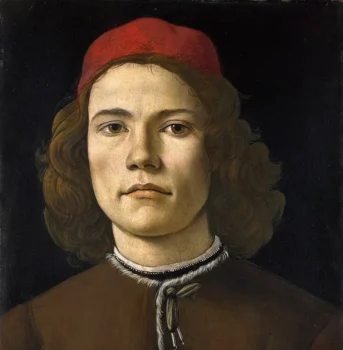
One of the most remarkable events in the modern art market was the sale of “Portrait of a Young Man Holding a Roundel” at Sotheby’s in 2021.
Price: $92.2 million USD
This made it:
the most expensive Botticelli painting ever sold
one of the highest prices for any Old Master painting in history
The sale confirmed Botticelli’s immense value in the global collectors’ market, especially for rare portraits.
Criticism, Controversy, and the Turbulent Times of Botticelli
Though Botticelli is beloved today, his career was not without controversy.
1. Savonarola’s Influence
In the 1490s, Florence was shaken by the apocalyptic sermons of Girolamo Savonarola, a Dominican friar who condemned luxury, vanity, and pagan art. Botticelli, influenced by the political and spiritual tension, shifted dramatically toward religious, apocalyptic themes.
This period caused:
a decline in mythological commissions
accusations that Botticelli participated in the Bonfire of the Vanities
a distancing from the Medici family
Whether he burned his own works is still debated.
2. Falling Out of Fashion
After his death in 1510, Botticelli was overshadowed by Michelangelo, Raphael, and Leonardo. Critics considered his style “old-fashioned,” too linear, too decorative, or insufficiently anatomical.
For nearly 300 years, Botticelli remained undervalued.
Only in the 19th century, thanks to the Pre-Raphaelites, was his genius rediscovered.
3. Attribution Controversies
Because Botticelli ran a workshop, scholars continue debating:
which works were fully painted by Botticelli
which are studio collaborations
which are later copies or misattributions
This makes provenance research crucial for collectors.
Where Are Botticelli’s Paintings Located Today?
Most of Botticelli’s masterpieces are found in prestigious European museums. A helpful list:
Italy
Uffizi Gallery, Florence , largest collection (Primavera, Birth of Venus, Adoration of the Magi, more)
Museo Nazionale di Capodimonte, Naples
Palazzo Barberini, Rome
United Kingdom
National Gallery, London , Venus and Mars, Mystic Nativity
Germany
Gemäldegalerie, Berlin
Städel Museum, Frankfurt
France
Musée du Louvre, Paris , smaller works and workshop pieces
United States
Metropolitan Museum of Art, New York
National Gallery of Art, Washington D.C.
Vatican City
Vatican Library , Dante illustrations
Private Collections
High-value portraits and sketches continue to surface in private collections and auctions.
Botticelli’s Enduring Legacy
Botticelli’s influence extends across centuries, shaping artists and movements worldwide.
1. Revival Through the Pre-Raphaelites
In the 1800s, artists like Dante Gabriel Rossetti rediscovered his poetic linework and spiritual beauty.
2. Modern Fashion and Pop Culture
His works appear in:
fashion magazines
luxury branding
film and photography
contemporary advertising
The Birth of Venus alone has become a global cultural icon.
3. Growing Collector Demand
Old Master markets fluctuate, but Botticelli’s rare works are among the most prized. With only a handful of authentic paintings held privately, demand greatly exceeds supply.
4. Academic Reverence
Botticelli is widely studied in:
Renaissance art programs
humanist philosophy courses
gender and mythology studies
His symbolic complexity makes him one of the most researched painters of all time.
A Narrative Journey: Botticelli’s Life as a Story
Imagine Florence at the height of the Renaissance: musicians playing in the piazzas, scholars debating Plato, sculptors chiseling marble, and the Medici palace humming with ideas.
In this world, Botticelli worked quietly with brush and pigment, weaving myth and metaphor onto canvases that would outlive empires.
He painted Venus as the spirit of divine beauty, stepping ashore with winds swirling in poetic motion. He captured the Medici as kings in Adoration of the Magi. He illustrated the deepest fears and hopes of humanity in his Dante series.
Then the city changed. Flames rose in public squares, pagan art was condemned, and Botticelli felt the tension between beauty and moral strictness. His lines tightened, his themes darkened, his mythic world receded.
Yet his vision endured.
Centuries later, collectors would rediscover him. Museums would compete for his masterpieces. Auction houses would drum up global excitement. And art lovers around the world, perhaps like you, would fall in love with the lyrical, dreamlike world he left behind.
Thoughts for Art Collectors and Antique Painting Lovers
Sandro Botticelli remains one of the most treasured and mysterious figures of the Renaissance. For collectors, his works represent:
a pinnacle of artistic beauty
extremely rare acquisition opportunities
deep symbolic value
enduring cultural power
Whether you’re visiting the Uffizi, researching old master works at auction, or simply immersing yourself in the beauty of myth and line, Botticelli stands as a guiding star in the world of fine art.