Most Famous Female Old Masters
For centuries, the history of art has been dominated by a male-centered narrative, one that overshadowed or entirely erased the contributions of female artists who worked with extraordinary skill, innovation, and courage. Today, however, this long-standing imbalance is finally shifting. Auction houses, museums, and private collectors have turned their attention toward Female Old Masters, women painters active between the 16th and 18th centuries, whose oeuvre not only challenges the traditional canon but also enriches our understanding of European cultural development.
This comprehensive collector’s guide explores the women who shaped Europe’s visual culture, defied systemic oppression, and created masterpieces now recognized for their technical brilliance, emotional depth, and historical significance. From Renaissance pioneers to Baroque revolutionaries, we examine how their works continue to gain momentum, both artistically and financially.
Women and the Canon of the Old Masters
The term “Old Masters” traditionally refers to European artists active before roughly 1800, especially those working during the Renaissance, Baroque, and early Enlightenment periods. For centuries, this category was implicitly male. Art history textbooks, museum collections, and academic narratives long reinforced the idea that artistic genius in this era belonged almost exclusively to men. Yet women were always present, painting, drawing, and shaping visual culture even as their access to training, patronage, and professional recognition was severely restricted.
Female Old Masters faced obstacles that went far beyond stylistic rivalry. They were often barred from formal academies, denied life-drawing classes that included nude models, and expected to abandon professional ambitions for marriage and domestic responsibilities. Despite these constraints, a number of women not only practiced art at the highest level but also achieved international fame during their lifetimes. Their stories are not footnotes to art history; they are essential chapters that reveal how talent persisted under pressure and how artistic excellence emerged even in unequal conditions.
This article examines several of the most famous female Old Masters, focusing on their biographies, historical environments, and artistic achievements. Rather than presenting them as isolated exceptions, it situates them within broader cultural and social frameworks, showing how they shaped and expanded the visual language of their time.
Sofonisba Anguissola: The Renaissance Portraitist Who Redefined Female Genius
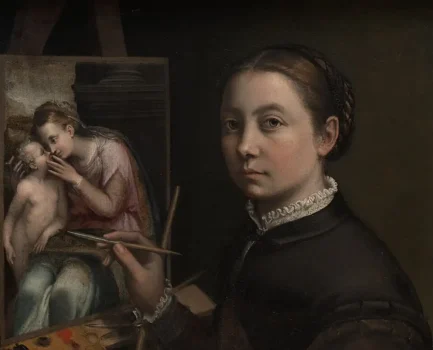
Sofonisba Anguissola was born around 1532 in Cremona, Italy, into a noble but not wealthy family. Her father, Amilcare Anguissola, played a crucial role in her artistic development. Unlike many men of his class, he believed that his daughters’ education could include intellectual and artistic pursuits. He arranged for Sofonisba and her sisters to study painting under respected local masters, an extraordinary opportunity for women in sixteenth-century Italy.
Anguissola’s early work already demonstrated an exceptional sensitivity to expression and character. Rather than focusing on grand historical or religious scenes, she excelled in portraiture, particularly informal family portraits that conveyed psychological intimacy. Paintings such as The Chess Game reveal a nuanced understanding of gesture, emotion, and interpersonal dynamics that distinguished her from many contemporaries.
Her reputation spread beyond Italy, eventually reaching the Spanish court. In 1559, Sofonisba was invited to serve as a lady-in-waiting and court painter to Queen Elisabeth of Valois, the third wife of King Philip II of Spain. While her official position limited her ability to sell paintings independently, it placed her at the heart of one of Europe’s most powerful courts. There, she painted members of the royal family and became a cultural figure admired for both her talent and intellect.
Anguissola’s influence extended far beyond her own production. She became a model for later women artists, demonstrating that intellectual seriousness and artistic mastery were compatible with female virtue, a crucial concern in Renaissance culture. Michelangelo himself is said to have admired her work, offering critiques and encouragement. By the time of her death in 1625, Sofonisba Anguissola was widely respected, yet later centuries would largely forget her contributions until feminist art historians revived interest in her legacy.
Lavinia Fontana: Professional Painter and Mother in Counter-Reformation Italy
Lavinia Fontana, born in Bologna in 1552, represents a different model of female artistic success. Unlike Anguissola, whose noble status shaped her career, Fontana emerged from a family of professional artists. Her father, Prospero Fontana, was an established painter who trained her in his workshop. Bologna, with its relatively progressive attitudes toward women’s education, provided a more supportive environment for female artists than many other Italian cities.
Fontana distinguished herself by pursuing painting not as a courtly accomplishment but as a profession. She accepted commissions, negotiated payments, and maintained a large studio. Her marriage to Gian Paolo Zappi was unusually egalitarian; Zappi supported her career and managed household affairs, allowing Lavinia to focus on painting while raising eleven children.
Artistically, Fontana was remarkably versatile. She painted portraits, religious altarpieces, mythological scenes, and even female nudes, a subject rarely attempted by women at the time due to restrictions on studying the nude form. Her portraits are particularly notable for their attention to costume and material detail, reflecting the social aspirations and identities of her sitters. At the same time, her religious works demonstrate compositional ambition and theological sophistication.
Fontana’s success challenged prevailing assumptions about women’s roles. She was admitted to the Academy of Saint Luke in Rome, a rare honor for a woman, and received commissions from popes and cardinals. Her career complicates the narrative that professional artistic life was incompatible with marriage and motherhood, showing instead that structural support and social negotiation could create space for female achievement.
Artemisia Gentileschi: Trauma, Tenacity, and Baroque Power
No female Old Master has attracted more modern attention than Artemisia Gentileschi. Born in Rome in 1593, she was the daughter of Orazio Gentileschi, a painter influenced by Caravaggio. Artemisia trained in her father’s workshop, absorbing the dramatic chiaroscuro and naturalism that defined the Baroque style.
Her early life was marked by a traumatic event that would later shape interpretations of her art. In 1611, she was raped by Agostino Tassi, a fellow artist and associate of her father. The subsequent trial was a public ordeal in which Artemisia was subjected to invasive questioning and physical torture to verify her testimony. Although Tassi was convicted, the social consequences fell largely on Artemisia.
For centuries, art historians either ignored this episode or used it to sensationalize her work. More recent scholarship has sought a more balanced understanding, acknowledging the trauma without reducing her artistic identity to it. Artemisia’s paintings are powerful not simply because of her biography, but because of her command of composition, narrative, and emotional intensity.
Works such as Judith Slaying Holofernes exemplify her approach. The painting’s visceral realism and physical strength challenge traditional depictions of biblical women as passive or decorative. Artemisia repeatedly returned to stories of female protagonists from history and mythology, portraying them as active agents rather than symbolic figures.
Her career was unusually mobile. She worked in Rome, Florence, Venice, Naples, and even London, enjoying the patronage of powerful collectors, including the Medici family. In Florence, she became the first woman admitted to the Accademia del Disegno. Artemisia Gentileschi’s legacy lies not only in her extraordinary paintings but also in her demonstration that women could master and redefine the most dramatic visual language of their time.
Judith Leyster: Authorship, Attribution, and Rediscovery
Judith Leyster was born in Haarlem in 1609 and worked during the Dutch Golden Age, a period celebrated for its genre scenes, portraits, and still lifes. During her lifetime, Leyster was a respected artist and a member of the Guild of Saint Luke, an essential credential for professional painters in the Netherlands.
Leyster specialized in lively genre scenes depicting musicians, drinkers, and everyday social interactions. Her brushwork was energetic and confident, and her compositions conveyed a sense of immediacy and joy. Stylistically, her work was close to that of Frans Hals, one of the most famous painters of the period.
After her death, however, Leyster’s reputation vanished. Many of her paintings were misattributed to Hals or other male contemporaries, a fate that underscores how easily women’s authorship could be erased. It was not until the late nineteenth century that scholars rediscovered her signature and reconstructed her oeuvre.
The reassessment of Judith Leyster has had broader implications for art history. It has prompted renewed scrutiny of attribution practices and raised questions about how market value, gender bias, and historical narrative interact. Today, Leyster is recognized not as a follower of Hals but as an innovative artist in her own right, whose work contributed significantly to the visual culture of seventeenth-century Holland.
Clara Peeters: Still Life and the Art of Subtle Assertion
Clara Peeters, active in the early seventeenth century, is one of the earliest known women to specialize in still life painting. Working primarily in Antwerp, she focused on meticulously rendered arrangements of food, tableware, and luxury objects. At first glance, still life may appear less ambitious than history painting, but Peeters transformed the genre into a site of technical brilliance and quiet self-assertion.
Her paintings demonstrate extraordinary control over texture, reflection, and composition. Metal goblets, polished knives, and glass vessels capture light with astonishing realism. In several works, Peeters included tiny reflections of herself in the surfaces of objects, a subtle but powerful assertion of authorship in a genre often dismissed as decorative.
Still life painting was one of the few areas where women could work relatively freely, as it did not require access to nude models or public commissions. Peeters used this space to establish a successful career, selling her works internationally. Her paintings were collected in Spain and other parts of Europe, indicating a level of recognition that contradicts assumptions about women’s marginality in the art market.
Clara Peeters’ legacy lies in her elevation of still life to a form of intellectual and aesthetic exploration. Her work invites viewers to consider themes of abundance, transience, and perception while also acknowledging the presence of the artist behind the image.
Élisabeth Vigée Le Brun: Portraiture, Politics, and Survival Through Revolution
Although often associated with the late eighteenth century rather than the traditional Old Masters, Élisabeth Vigée Le Brun belongs firmly within the pre-modern artistic canon. Born in Paris in 1755, she showed prodigious talent from an early age and built a career as a portraitist in Ancien Régime France.
Vigée Le Brun became the favored portrait painter of Queen Marie Antoinette, producing images that shaped the queen’s public persona. Her portraits emphasized elegance, warmth, and approachability, qualities that were politically significant in an era of growing social unrest. At the height of her success, she was admitted to the Royal Academy, despite institutional resistance to women members.
The French Revolution dramatically altered her life. Associated with the royal court, Vigée Le Brun fled France and spent years working across Europe, including Italy, Austria, Russia, and England. Remarkably, she maintained her career throughout exile, securing commissions from aristocratic patrons wherever she went.
Her memoirs, written later in life, provide valuable insight into the artistic and social worlds of her time. Vigée Le Brun’s ability to adapt to political upheaval while sustaining artistic excellence marks her as one of the most resilient figures in art history. Her work bridges the worlds of Old Regime court culture and the emerging modern era.
Rewriting the Narrative of the Old Masters
The female Old Masters discussed in this article were not anomalies or isolated prodigies. They were part of a broader, though often obscured, tradition of women who engaged seriously with art as a profession and an intellectual pursuit. Their lives reveal the complex interplay between talent, social structures, and historical circumstance.
Recovering their stories does more than correct an imbalance in representation. It enriches our understanding of artistic development itself. When we include women like Anguissola, Fontana, Gentileschi, Leyster, Peeters, and Vigée Le Brun in the narrative, the history of art becomes more nuanced, more accurate, and more human.
Today, museums and scholars continue to reassess collections, attributions, and canons. This process is not about retroactive inclusion for its own sake, but about acknowledging excellence wherever it appears. The most famous female Old Masters earned their place through skill, perseverance, and vision. Their achievements remind us that artistic greatness has never belonged to one gender alone, even when history tried to tell us otherwise.
Why Female Old Masters Matter More Than Ever
The art market has entered a new era, one in which historical gaps are being repaired, and long-ignored female voices finally receive recognition. The significance of Female Old Masters reaches far beyond price appreciation; it reflects a cultural realignment.
Several key forces are driving this renewed attention:
Major museums, including the Prado, the Uffizi, and the National Gallery, have launched initiatives dedicated to researching and re-attributing works by women. Previously misattributed paintings are being correctly identified, fueling academic and market interest.
As collectors seek undervalued artists with strong museum representation, Female Old Masters have emerged as some of the most promising opportunities. Their works remain significantly underpriced compared to male contemporaries of similar skill.
Museums are aggressively acquiring works by historical women to correct the absence of female representation in their permanent collections. Institutional validation translates to stronger market performance.
The global emphasis on diversity and gender equity has caused art institutions to revisit historical biases, prompting expanded exhibitions, scholarship, and acquisition budgets. The extremely limited supply of surviving works, often fewer than twenty in a lifetime for some artists, creates scarcity that naturally drives long-term value.
A New Chapter for Female Old Masters
The art world is finally beginning to recognize what collectors who study the field already know: the Female Old Masters of the 16th to 18th centuries were brilliant, innovative, and foundational to the evolution of Western art. Their rediscovery is not a trend, it is a long-overdue correction that enriches our understanding of history while opening exciting opportunities for collectors.
As scholarship deepens and market demand accelerates, these remarkable women, Artemisia Gentileschi, Judith Leyster, Sofonisba Anguissola, Lavinia Fontana, Clara Peeters, Rosalba Carriera, Elisabetta Sirani, and Angelica Kauffman, stand poised to claim their rightful place in the artistic canon.