Meaning of Filippo Lippi’s Madonna and Child with Two Angels
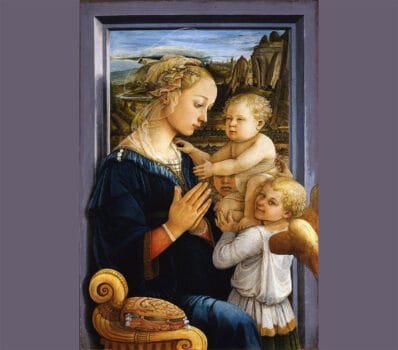
When we step into Florence’s Uffizi Gallery, surrounded by masterpieces from the Italian Renaissance, one painting often manages to draw people closer, not with overwhelming drama or sheer scale, but with a quiet intimacy. Filippo Lippi’s Madonna and Child with Two Angels (circa 1465) is a tender and enchanting work that has fascinated viewers for centuries. Unlike some grandiose altarpieces that command awe through majesty and theological weight, this painting captures the human side of divinity: a mother, her child, and the soft, playful presence of angels.
But behind this seemingly simple and heartwarming scene lies a wealth of symbolism, cultural history, and artistic innovation that reveals much about Renaissance Florence, Filippo Lippi himself, and the spiritual imagination of the 15th century. Let’s take a journey into this painting, its story, its maker, its meaning, and why it continues to matter today.
Who Was Filippo Lippi?
Before diving into the painting itself, it’s important to understand the man behind the brush. Fra Filippo Lippi (1406–1469) was one of the most colorful figures in Renaissance art. Born in Florence, he was left an orphan at a young age and grew up in the Carmelite convent of Santa Maria del Carmine, where he was exposed to frescoes by Masaccio, works that transformed Renaissance painting with their realism and sense of perspective.
Though Lippi became a friar, he was never particularly obedient to monastic discipline. Giorgio Vasari, the famous Renaissance biographer, recounts stories of Lippi’s love affairs, his debts, and even his daring escapes from captivity. He is often remembered as much for his adventurous, rebellious personality as for his art. Yet despite his turbulent life, Lippi produced works of extraordinary beauty and tenderness, becoming one of the most influential painters of the mid-15th century and inspiring later masters, including his own student, Sandro Botticelli.
Madonna and Child with Two Angels is considered one of his greatest achievements, a work that bridges the devotional traditions of the Middle Ages with the humanism and naturalism of the Renaissance.
How Madonna and Child with Two Angels Was Painted
Created around 1465, this painting is executed in tempera on wood, a common medium before the widespread adoption of oil paint in Italy. Tempera, made from pigment mixed with egg yolk, allowed for brilliant, lasting colors, though it required precision and speed from the artist.
The painting depicts the Virgin Mary and the Christ Child, accompanied by two angels who hold the child up as if presenting him to the world. Behind them is a softly painted landscape with rolling hills and distant mountains, a hallmark of Renaissance painting, where landscapes often symbolized the harmony of creation.
Unlike many religious paintings intended for altars, Madonna and Child with Two Angels was likely made for private devotion, perhaps commissioned by a wealthy Florentine family. This intimacy shows in its size (slightly over 3 feet tall) and in the emotional tone of the work, it feels more like a personal meditation on divine love than a grand public statement.
What Is Madonna and Child with Two Angels All About?
At first glance, the painting appears to be a simple portrayal of the Virgin Mary and Jesus. But in Renaissance art, nothing was ever just a portrait, every gesture, expression, and background detail carried layers of meaning.
The Virgin Mary is shown as a youthful, graceful woman with downcast eyes and a serene expression. She is not depicted as a distant queen of heaven, but as a gentle, earthly mother. Her face is soft, human, and relatable. Her veil and robe signal her purity and divine role, yet she could easily be mistaken for a Florentine woman of the time.
The Christ Child sits in front of her, supported by angels. What makes this depiction unique is the playful, almost mischievous expression of the angel on the left (from the viewer’s perspective), who looks outward with a sly smile. This subtle touch of humor and liveliness was unusual in religious art of the time and gives the painting a sense of warmth and humanity.
The background, with its atmospheric perspective and delicate landscape, places the holy figures in a natural world rather than an abstract golden heaven. This was a deliberate Renaissance move, placing the divine within the realm of human experience.
Symbolism and Meaning
Filippo Lippi layered the painting with symbolism, much of it rooted in Christian theology but expressed with Renaissance naturalism.
1. Mary’s Veil and Garments
The veil symbolizes Mary’s purity and virginity. Her blue robe, often seen in Marian imagery, represents both her heavenly role and the expense of ultramarine pigment, a costly material made from lapis lazuli. Wealthy patrons who commissioned such works wanted to show their devotion, but also their ability to afford the finest materials.
2. Christ Child
The Child’s pose, leaning forward, almost slipping from Mary’s arms, suggests both playfulness and foreshadowing. Some scholars argue that his posture anticipates the sacrifice of the cross: he leans away from his mother, symbolizing the eventual separation through death. At the same time, the support of the angels suggests divine protection and the inevitability of Christ’s mission.
3. The Angels
The two angels play distinct roles. One holds the Child and looks upward in reverence, while the other gazes outward with a mischievous smile. This duality may represent both reverence for divinity and recognition of Christ’s humanity. The smiling angel, especially, embodies the Renaissance delight in depicting natural human expressions, even in sacred art.
4. The Landscape
The distant hills and calm sky symbolize peace and harmony, but also serve as a reminder of God’s creation. The use of perspective reflects Renaissance interest in science, geometry, and the natural world as reflections of divine order.
5. Mary’s Downcast Eyes
Mary’s lowered gaze suggests humility, contemplation, and perhaps sorrow. Many interpretations suggest that she is meditating on her son’s future suffering, even as she cradles him as an infant. This emotional depth turns the painting into more than a simple mother-and-child portrait, it becomes a meditation on love, sacrifice, and destiny.
What Is Happening in the Painting?
On a narrative level, the scene captures a moment of stillness. Mary, serene and contemplative, gazes downward. The Christ Child, full of life, leans forward, supported by angels. The angels themselves embody two emotional registers, one reverent, one playful.
Nothing dramatic is happening; there are no kings or shepherds, no dramatic annunciations or crucifixions. Instead, the painting focuses on the intimate, everyday humanity of the Holy Family. The sacred is brought into the realm of the ordinary, reminding viewers that divinity dwells even in small, tender moments.
What Type of Art Is Madonna and Child with Two Angels?
This painting belongs to the category of Renaissance religious art, specifically a sacra conversazione (sacred conversation) style devotional image, though here the figures are fewer and more intimate. It is a tempera painting on wood panel, typical of the Italian Renaissance before oil paint dominated.
Stylistically, it blends Gothic traditions (delicate lines, spiritual symbolism) with Renaissance innovations (linear perspective, naturalistic figures, human emotion). Filippo Lippi’s mastery lay in bridging these two worlds, paving the way for later artists like Botticelli to fully embrace Renaissance ideals of beauty, grace, and humanism.
Where Is Madonna and Child with Two Angels Located Today?
Today, Madonna and Child with Two Angels is housed in the Uffizi Gallery in Florence, Italy. The Uffizi, one of the world’s greatest art museums, holds countless treasures of the Renaissance, and Lippi’s work is among its most beloved pieces.
Visitors often find themselves lingering before this painting longer than expected. Its relatively modest scale compared to monumental altarpieces makes it approachable, while its warmth and humanity speak across centuries. It remains one of the highlights of the museum’s collection, embodying the heart of Renaissance spirituality and artistry.
Why This Painting Still Matters
What makes Madonna and Child with Two Angels so powerful is its balance of the divine and the human. Filippo Lippi, with his own complex life full of struggles between discipline and desire, captured something essential about the human condition: that holiness and humanity are intertwined.
For Renaissance viewers, this painting reminded them that Christ and Mary were not distant, otherworldly figures but close and relatable. For modern viewers, the painting continues to speak through its tenderness, its beauty, and its subtle emotional depth.
It also serves as a bridge in art history, showing how Renaissance artists moved away from symbolic abstraction toward naturalism, individuality, and emotion, paving the way for the masterpieces of Botticelli, Leonardo, and Raphael.
Filippo Lippi’s Madonna and Child with Two Angels is not simply a religious painting. It is a meditation on love, motherhood, playfulness, sacrifice, and the meeting of heaven and earth. It captures the Renaissance spirit of blending faith with human experience, theology with emotion, and symbolism with naturalism.
When we look at it today in the Uffizi Gallery, we don’t just see Mary, Jesus, and two angels. We see the heart of Renaissance Florence, the brushwork of a rebellious friar who found holiness in beauty, and the timeless reminder that the divine can be found in the most tender human moments.