10 Famous Greek Mythology Paintings For Art Collectors
Why Greek Mythology Art Continues to Dominate Luxury Collections
Greek mythology has long served as one of the richest sources of artistic inspiration. Its gods, heroes, tragedies, and moral complexities have shaped Western art for more than two millennia. For modern luxury collectors, Greek mythology paintings occupy a special category of prestige because they represent not only narrative grandeur but also the highest achievements of artistic technique, from Renaissance realism to Neoclassical refinement and Romantic emotional intensity.
Collecting artwork rooted in Greek mythology merges the legacy of classical antiquity with the cultural prestige of master painters who interpreted these ancient stories onto canvas. Their works capture universal themes: power, beauty, desire, betrayal, heroism, and divine intervention. Today, such paintings remain highly desirable not simply for their aesthetic arresting visuals but for their historical importance, rarity, and the timeless fascination of myth.
The following sections explore ten of the most famous Greek mythology paintings, masterpieces that continue to attract connoisseurs, museum curators, and luxury collectors worldwide. Each piece offers its own story, symbolism, and artistic innovations that make it enduringly valuable.
1. “The Birth of Venus” , Sandro Botticelli (c. 1484–1486)
Botticelli’s The Birth of Venus is arguably the most iconic representation of Greek mythology in Western art. It depicts Aphrodite (Roman: Venus) emerging fully grown from the sea, standing atop a scallop shell, blown ashore by Zephyrus, the god of the west wind.
Mythological Background
According to Hesiod’s Theogony, Aphrodite was born from sea foam after Uranus was overthrown. She emerged as a divine embodiment of beauty, love, and sensuality. Botticelli’s interpretation places her at the moment of arrival on land, symbolizing purity, divine love, and the birth of aesthetic harmony.
Historical and Artistic Importance
Painted during the early Renaissance, The Birth of Venus is notable for its elegant contours, graceful movement, and ethereal palette. Unlike the realism that dominated the era, Botticelli embraced stylized beauty, elongated limbs, soft outlines, and symbolic rather than literal space.
Appeal to Luxury Collectors
Universally recognizable cultural icon
Embodies ideal beauty and classical elegance
Historically significant for bridging medieval symbolism and Renaissance humanism
The original, housed in Florence’s Uffizi Gallery, is priceless; however, period copies and inspired works remain highly sought after by elite collectors.
2. “Leda and the Swan” , Leonardo da Vinci (Lost Original, c. 1503–1510)
Although the original painting has been lost, Leda and the Swan remains one of Leonardo’s most enigmatic mythological works, known today through contemporary copies.
Mythological Background
The myth recounts the seduction of Leda by Zeus, who transforms into a swan. Their union produces legendary offspring such as Helen of Troy and the Dioscuri twins, figures central to later Greek epics and tragedies.
Artistic Features
Leonardo’s composition showcased:
The anatomical precision for which he is renowned
A sensuous yet controlled depiction of femininity
Symbolism around duality, seduction, and creation
His use of sfumato imbued the scene with soft atmospheric blending, making it both intimate and dreamlike.
Collector Appeal
Even without the original, paintings based on Leonardo’s lost masterpiece command substantial attention. Works attributed to his pupils or later masters inspired by the composition regularly reach significant valuations at auction due to:
Their connection to Leonardo’s legacy
The myth’s sensual and dramatic narrative
The rarity of surviving authentic copies
3. “The Triumph of Galatea” , Raphael (1511–1512)
Raphael’s The Triumph of Galatea adorns the Villa Farnesina in Rome and stands as one of the High Renaissance’s great mythological frescoes.
Mythological Background
Galatea is a sea nymph from Greek legend. In the myth, she is tragically loved by the cyclops Polyphemus, yet her heart belongs to the mortal Acis. While Raphael’s fresco leaves out the tragic parts, it glorifies her divine beauty.
Historical and Artistic Features
Raphael’s mastery is evident in:
Rich anatomical detail
Harmonious composition echoing classical ideals
A dynamic and joyful depiction of myth, more celebratory than tragic
The painting is filled with playful putti, swirling dolphins, and divine figures lifting Galatea in triumph.
Why Luxury Collectors Admire It
Represents Raphael’s peak artistic period
Exemplifies Renaissance admiration for Greek classical ideals
Exudes movement, sensuality, and elegance
Collectible replicas, sketches, and studio pieces inspired by Galatea circle in elite markets due to Raphael’s enduring prestige.
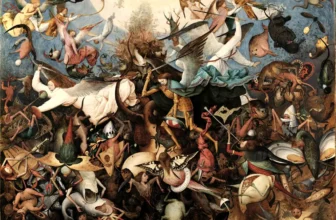
4. “The Fall of Icarus” , Pieter Bruegel the Elder (c. 1558)
Bruegel’s Fall of Icarus delivers one of the most poignant interpretations of Greek mythology ever painted.
Mythological Background
Icarus, attempting to escape Crete with wings crafted by his father Daedalus, flies too close to the sun. The wax melts, he falls into the sea, and the world continues without noticing.
Artistic Interpretation
Instead of dramatizing the fall, Bruegel minimizes Icarus to emphasize how human tragedy often goes unnoticed. The farmer plows; the shepherd gazes upward; commerce moves on. Only Icarus’s legs, disappearing beneath the water, reveal the myth.
Collector Significance
Luxury collectors admire the painting because:
It offers rare philosophical depth
It merges everyday life with mythic allegory
It belongs to a master of Northern Renaissance innovation
Originals are rare and priceless, but period works inspired by Bruegel’s composition are highly collectible.
5. “The Rape of Europa” , Titian (1560–1562)
Titian’s masterpiece, commissioned by King Philip II of Spain, is one of the most dramatic mythological paintings ever created.
Mythological Background
Europa is abducted by Zeus, who appears as a bull and carries her across the sea. The myth symbolizes power, desire, and divine intervention, while also giving Europe its name.
Artistic Features
Titian’s Venetian style shines through:
Deep, rich color known as colorito
Vivid emotion captured in Europa’s expression
Dynamic motion demonstrated through billowing drapery and crashing waves
Collector Appeal
Titian’s mythological works, known as the poesie, are treasured by collectors for their rarity, aristocratic provenance, and sensual power.
Works inspired by The Rape of Europa remain among the most coveted mythological subjects in private collections worldwide.
6. “The Judgment of Paris” , Peter Paul Rubens (c. 1636)
The Baroque master Peter Paul Rubens created several versions of this myth, all celebrating dramatic motion and sensual grandeur.
Mythological Background
Paris, a Trojan prince, must decide which goddess, Hera, Athena, or Aphrodite, is most beautiful. Aphrodite wins by offering him Helen of Sparta, ultimately sparking the Trojan War.
Artistic Contributions
Rubens’s version is lavish:
Voluptuous figures rendered with vigorous brushstrokes
Sensual interplay between divine beauty and mortal desire
A dynamic, dramatic Baroque composition full of tension
Why Collectors Value It
Rubens is one of the most market-resilient Old Masters
The myth carries themes of beauty, temptation, and world-altering decisions
The painting embodies Baroque splendor suitable for luxury interiors
Original Rubens mythological canvases achieve among the highest valuations in Old Master sales.
7. “Perseus and Andromeda” , Frederic Leighton (1891)
Leighton, a leading figure of Victorian classicism, produced a dramatic Romantic interpretation of this heroic myth.
Mythological Background
After slaying Medusa, the hero Perseus discovers Andromeda chained to a rock as sacrifice to a sea monster. He rescues her, leading to one of mythology’s most romantic unions.
Artistic Highlights
Leighton’s work features:
A luminous palette typical of Victorian classicism
An heroic, idealized portrayal of masculinity and femininity
A striking vertical composition emphasizing Andromeda’s vulnerability
Collector Appeal
Late-19th-century classical revival paintings have surged in desirability among collectors seeking elegance and drama without the overt religious themes of earlier periods. Leighton’s works, in particular, are celebrated for their polish, beauty, and monumental quality.
8. “The Apotheosis of Hercules” , François Lemoyne (1733–1736)
Housed in the Palace of Versailles, this monumental ceiling painting celebrates the deification of Hercules.
Mythological Background
After completing the Twelve Labors and dying a mortal death, Hercules ascends to Mount Olympus and becomes a god. The myth symbolizes endurance, transformation, and divine reward.
Artistic and Historical Importance
Lemoyne’s Rococo masterpiece includes:
Hundreds of swirling divine figures
Grand celestial light and color
A theatrical spectacle echoing French royal grandeur
Collector Relevance
Although the original ceiling cannot be collected, preparatory sketches, workshop studies, and period interpretations are treasured by collectors who value:
Large-scale mythological themes
Royal French provenance
The fusion of mythology with political power
9. “Venus and Adonis” , Titian (c. 1554) and Its Variants
One of Titian’s most emotionally layered mythological compositions, Venus and Adonis exists in several versions created by the master and his workshop.
Mythological Background
The goddess Aphrodite falls in love with the mortal Adonis. Despite her pleas, he goes hunting and is fatally injured by a boar. The myth explores themes of desire, mortality, and fate’s inevitability.
Artistic Innovations
Titian’s vision switches the classical roles:
Venus desperately clings to Adonis, reversing gendered power norms
Adonis’s muscular body is turning away, foreshadowing tragedy
The painting’s emotional intensity is heightened by Titian’s mastery of color
Why Collectors Prize This Work
One of Titian’s most celebrated mythological narratives
Embodies eroticism, tension, and emotional depth
Shares pedigree with royal collections across Europe
Copies and authenticated workshop variants are valuable assets in elite collections.
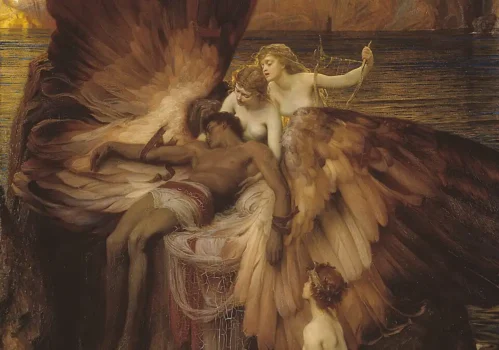
10. The Lament for Icarus (1898) by Herbert James Draper
The Lament for Icarus remains one of the most emotionally charged and visually sumptuous paintings inspired by Greek mythology. Completed at the height of the Victorian era’s renewed fascination with classical themes, the work captures a poignant moment after the fall of Icarus, the ill-fated son of Daedalus who flew too close to the sun. Draper imagines three sea nymphs mourning over the lifeless body of Icarus, transforming a brief mythological episode into a dramatic meditation on beauty, ambition, and loss.
From a historical standpoint, the painting debuted at the Royal Academy in 1898, earning Draper the Gold Medal and the Chantrey Bequest purchase prize. This recognition cemented his reputation as one of the era’s great mythological painters. Draper, influenced by the Pre-Raphaelites and academic classicism, infused the canvas with a luminous palette, intricate anatomical detail, and a strong sense of emotional narrative. His Icarus is not just a fallen youth but an icon of tragic heroism, rendered in gold, bronze, and sun-kissed hues that echo both the triumph and ruin of his flight.
For luxury collectors, The Lament for Icarus holds particular appeal. Though the original resides in the Tate Britain, its presence in the art market persists through limited-edition prints, rare studies, and period reproductions. Draper’s work embodies the qualities connoisseurs value: impeccable craftsmanship, mythic storytelling, and the prestige of late-Victorian classicism. Its lush aesthetic and timeless subject make it a centerpiece for curated interiors, private galleries, or collections that celebrate the intersection of mythology and fine art.
As both a cultural artifact and a symbol of refined taste, Draper’s masterpiece offers collectors a way to own a piece of myth transformed into radiant visual poetry, a reminder that even in tragedy, beauty endures.
“Apollo and Daphne” , Gian Lorenzo Bernini (1622–1625) (Sculptural Masterpiece Included for Its Iconic Status)
Although not a painting, Bernini’s Apollo and Daphne is one of the most influential representations of Greek mythology and is frequently discussed alongside painted masterpieces due to its overwhelming artistic significance.
Mythological Background
After being struck by Cupid’s arrow, Apollo falls obsessively in love with Daphne. She, struck by an opposing arrow, rejects him. As he pursues her, she transforms into a laurel tree to escape his desire.
Artistic Significance
Bernini captures the exact instant of transformation, fingers becoming leaves, toes turning to roots, limbs hardening into bark. The sculpture showcases:
Technical brilliance
Emotional intensity
Mastery of motion frozen in marble
Collector Interest
While the original in Rome is untouchable, drawings, bronze reductions, and later interpretations inspired by the sculpture attract high-value collectors who appreciate:
Baroque dynamism
Myth as psychological drama
The merging of beauty, tragedy, and metamorphosis
Why Greek Mythology Paintings Remain a Cornerstone of Luxury Collections
Luxury collectors continue to pursue Greek mythology artworks for several reasons:
1. Universal Symbolism
Myths address timeless concepts, love, ambition, morality, fate, making them emotionally and philosophically rich investments.
2. Historical Prestige
Many of history’s greatest painters, Titian, Rubens, Raphael, Botticelli, used mythological subjects to showcase their technical skill and intellectual sophistication.
3. Visual and Decorative Impact
Mythology paintings combine grandeur, sensuality, and drama, making them ideal centerpieces for luxury interiors, galleries, estates, and private museums.
4. Strong Market Demand
Old Masters featuring Greek mythology consistently achieve strong auction results due to scarcity, cultural significance, and collector prestige.
5. Cross-Cultural Relevance
Greek myths permeate literature, film, psychology, and modern storytelling, enhancing the contemporary relevance of classical artworks.
The Enduring Allure of Myth in the Luxury Art World
Greek mythology paintings remain among the most desirable acquisitions for sophisticated collectors. Their blend of dramatic storytelling, artistic innovation, and historical relevance ensures they remain evergreen in value, culturally and financially. Whether capturing the birth of beauty, the downfall of ambition, or the divine complexities of gods and mortals, these masterpieces continue to speak to audiences centuries after their creation.
For collectors seeking artworks with emotional depth, intellectual resonance, and timeless aesthetic power, Greek mythology remains an unparalleled subject, one that the world’s greatest artists have immortalized across generations.