Jan van Goyen: The Dutch Master of Tonal Landscape Painting
Keywords: Jan van Goyen, Dutch Golden Age, landscape painter, Jan van Goyen paintings, Jan van Goyen artwork value, 17th-century art, Dutch painter biography, tonal landscape, Jan van Goyen most famous work, art auction prices, Dutch Golden Age painters.
The Dutch Golden Age of painting, which spanned the 17th century, was a remarkable era that produced an astonishing number of artistic geniuses, Rembrandt van Rijn, Johannes Vermeer, Jacob van Ruisdael, and many more. Yet among these names, one artist stands out for transforming how the natural world was depicted: Jan van Goyen. Known for his atmospheric and monochromatic landscapes, van Goyen captured the Dutch countryside with poetic realism and simplicity.
In this in-depth article, we will explore who Jan van Goyen was, analyze his unique artistic style, discuss his most famous artworks, and evaluate how much Jan van Goyen’s paintings are worth today in the art market.
Whether you are an art history enthusiast, collector, or student of Dutch Golden Age painting, this guide offers a comprehensive look at the life and legacy of one of the Netherlands’ most influential landscape painters.
Who Was Jan van Goyen?
Early Life and Education
Jan Josephsz van Goyen was born on January 13, 1596, in Leiden, the Netherlands. His father, a shoemaker, recognized his son’s early artistic talent and arranged apprenticeships for him with several painters in Leiden and Haarlem.
As a young student, van Goyen trained under Esaias van de Velde, one of the earliest pioneers of realistic Dutch landscape painting. Under van de Velde’s influence, the young artist learned to observe and depict the Dutch countryside in its true light , not as an idealized paradise, but as a real environment filled with windmills, rivers, cloudy skies, and humble peasants.
By the age of 19, van Goyen had completed his apprenticeship and began traveling through the Netherlands and neighboring countries, sketching riverbanks, towns, and coastal scenes. These travels would profoundly shape his approach to landscape art.
Career and Artistic Development
Van Goyen’s career began around 1617, when he started producing paintings influenced by his teacher’s colorful and detailed style. However, by the late 1620s, his art underwent a dramatic transformation. He began developing what would later be known as tonal landscape painting , a style defined by a limited color palette, soft tonal harmonies, and an emphasis on atmosphere over detail.
In 1632, van Goyen moved to The Hague, where he would spend most of his life. He joined the Guild of Saint Luke, married Annetje Willems van Raelst, and established himself as a leading painter of landscapes. The Hague at that time was a hub of cultural activity, attracting artists, diplomats, and wealthy patrons.
Despite his artistic success, van Goyen often faced financial difficulties due to unsuccessful real estate investments and business ventures. He even worked as an art appraiser and dealer to supplement his income.
Death and Legacy
Jan van Goyen died on April 27, 1656, in The Hague. Though he left behind debts, his artistic legacy was profound. His tonal approach to landscape painting influenced a whole generation of Dutch artists, including Salomon van Ruysdael, Jacob van Ruisdael, and Meindert Hobbema.
Today, art historians recognize van Goyen as one of the founders of the realistic Dutch landscape tradition, a movement that shaped European art for centuries.
The Style of Jan van Goyen: Tonal Landscapes and Atmospheric Harmony
Jan van Goyen’s art represented a radical departure from the colorful and detailed landscapes of earlier Dutch painters. Instead of painting heroic scenes or idealized countryside views, van Goyen focused on the quiet beauty of everyday life in the Netherlands.
Characteristics of Van Goyen’s Style
Limited Color Palette
Van Goyen often used a restricted range of earthy tones , grays, browns, ochres, and muted greens. This restrained palette created a harmonious and unified atmosphere, giving his paintings a subtle and poetic feel.Focus on Light and Atmosphere
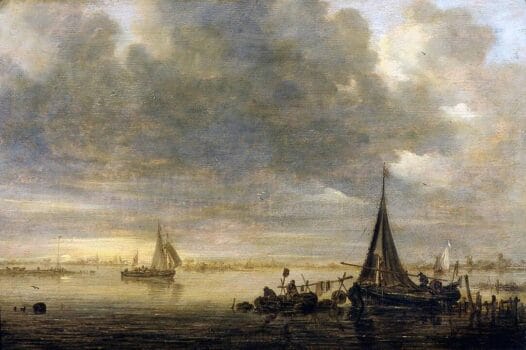
Rather than emphasizing precise details, van Goyen captured the shifting light and weather conditions of the Dutch landscape. His skies often occupy more than half the canvas, filled with soft, rolling clouds that mirror the water below.Low Horizons
A hallmark of his composition style is the low horizon line, which draws the viewer’s attention to the vastness of the sky , a key element of Dutch landscape identity.Depiction of Everyday Life
Van Goyen’s scenes frequently feature modest rural activity , fishermen along a river, boats sailing in calm waters, peasants walking near cottages, or travelers crossing a bridge. These small human elements add a narrative touch without distracting from the overall mood.Monochromatic Harmony
Art historians refer to his work as “tonal painting” because he used variations of one dominant color tone to unify the entire scene. This technique made his landscapes look natural and cohesive, anticipating later developments in European landscape painting.
Jan van Goyen’s Most Famous Artworks
Jan van Goyen was an extraordinarily prolific artist. Scholars estimate that he produced over 1,200 paintings and 800 drawings during his lifetime. His output was immense, yet remarkably consistent in quality and mood. Below are some of his most renowned works that best represent his style and vision.
1. View of The Hague (1647)
One of van Goyen’s best-known works, View of The Hague, captures the city from across the River Rhine. The painting is celebrated for its realistic depiction of light and air, as well as its subtle tonal variations. The gray clouds, calm water, and muted palette create a tranquil, almost meditative atmosphere.
This artwork exemplifies van Goyen’s mastery of the tonal landscape, where the emphasis lies not on dramatic contrast but on the quiet interplay between earth, water, and sky.
2. View of Dordrecht (1644)
In View of Dordrecht, van Goyen painted one of the Netherlands’ oldest cities from a distance, showing ships and small boats sailing across the river. The piece demonstrates his remarkable skill in depicting reflections on water, as well as his ability to convey weather and light changes.
This painting is frequently cited as a masterpiece of Dutch realism, and it remains one of van Goyen’s most admired works by museums and collectors alike.
3. River Landscape with Boats (1643)
Another celebrated example of van Goyen’s artistry, River Landscape with Boats features a calm waterway with several vessels under a cloudy sky. The soft tonal harmony between sky and water demonstrates his fascination with atmospheric perspective , creating depth and distance through subtle tonal shifts rather than linear perspective.
4. Winter Landscape (1644)
Van Goyen’s Winter Landscape paintings are among his most beloved works, capturing Dutch life during the cold months. In these scenes, people skate or walk on frozen rivers, while gray skies and bare trees evoke a peaceful stillness.
These paintings are remarkable for their emotional restraint , a kind of quiet realism that became a hallmark of 17th-century Dutch art.
5. The Skaters Near Haarlem (circa 1645)
In this composition, van Goyen depicts a typical winter pastime: skating on frozen canals. The earthy tones, minimalistic color palette, and atmospheric depth create a poetic balance between human life and nature.
This painting is also a testament to his interest in ordinary moments, elevating them to subjects worthy of fine art.
6. The Pelgrims Ferry on the Rhine near Rhenen (1647)
This painting, now in the Rijksmuseum, is one of van Goyen’s technical triumphs. The soft transition between sky, land, and water reveals his command of tonal gradation. The ferry in the foreground and the distant church spire offer a sense of depth and human activity within a vast natural landscape.
Jan van Goyen’s Influence on Dutch and European Art
Jan van Goyen’s influence was immense. His approach to painting landscapes using tonal harmony inspired many contemporaries and followers.
Artists such as Salomon van Ruysdael and Jacob van Ruisdael built upon his ideas, introducing more dramatic compositions and contrasts. Moreover, van Goyen’s minimalist and atmospheric techniques anticipated later artistic movements like Impressionism, where the focus shifted toward light, color, and perception rather than narrative or symbolism.
Even in modern times, van Goyen’s subtlety and restraint are admired for their modern sensibility, proving that simplicity and harmony can convey as much beauty as grandeur.
How Much Is Jan van Goyen’s Artwork Worth Today?
One of the most intriguing questions for collectors and art enthusiasts is: How much are Jan van Goyen’s paintings worth today?
The art market for Dutch Golden Age paintings remains strong, and Jan van Goyen’s works are frequently sold at prestigious auction houses like Sotheby’s, Christie’s, and Bonhams. His market value has steadily increased due to renewed interest in 17th-century landscape art.
Factors That Influence the Value of Van Goyen’s Paintings
Provenance (Ownership History)
Paintings with clear provenance or those previously held in royal or museum collections tend to fetch higher prices.Condition and Authenticity
Works that have survived in excellent condition or have undergone professional restoration maintain higher value.Subject Matter
Paintings featuring rivers, cities like The Hague or Dordrecht, or winter scenes are often more sought after.Size and Medium
Larger oil paintings generally command higher prices than small sketches or drawings, although van Goyen’s pen-and-ink works also hold value for collectors.
Recent Auction Results and Current Market Prices
In recent years, Jan van Goyen’s artworks have achieved impressive results at auction:
“A River Landscape with Fishermen in Boats” (1639) sold at Sotheby’s London for approximately £350,000 (around $430,000 USD).
“A View of Leiden” realized €420,000 at Christie’s Amsterdam, reflecting growing demand among European collectors.
Smaller oil paintings and sketches typically range between $50,000 and $200,000, depending on quality and provenance.
Meanwhile, exceptional pieces , especially those with strong museum or historical significance , can reach prices up to $500,000 or more.
Van Goyen’s drawings, which display his delicate linework and compositional mastery, are also highly collectible. Many of his drawings sell between $10,000 and $40,000 depending on their rarity and condition.
Why Van Goyen’s Art Holds Long-Term Value
Collectors and investors value van Goyen’s paintings for several reasons:
Historical Importance: As a foundational figure in Dutch landscape painting, his work holds permanent historical relevance.
Timeless Aesthetic: His tonal harmony and atmospheric effects appeal to modern tastes.
Museum Presence: Major institutions like the Rijksmuseum (Amsterdam), Louvre (Paris), National Gallery (London), and Metropolitan Museum of Art (New York) hold his works, reinforcing his prestige.
Scarcity: Despite his prolific output, many of his works remain in museum collections, making high-quality pieces increasingly rare in the private market.
Where to See Jan van Goyen’s Paintings Today
Art lovers can view Jan van Goyen’s masterpieces in some of the world’s leading museums:
Rijksmuseum, Amsterdam – Houses several iconic landscapes including View of Dordrecht and The Pelgrims Ferry near Rhenen.
Mauritshuis, The Hague – Displays some of his finest cityscapes and river views.
The National Gallery, London – Contains A View of Dordrecht from the North, showcasing his tonal mastery.
The Louvre, Paris – Exhibits select landscapes highlighting his influence on European painting.
The Metropolitan Museum of Art, New York – Holds a collection of his sketches and oil paintings.
Jan van Goyen stands as one of the most influential Dutch painters of the 17th century, a master who reshaped how landscapes were seen, painted, and understood. His restrained palette, atmospheric subtlety, and focus on everyday scenery introduced a poetic realism that deeply influenced generations of artists.
From his early days in Leiden to his mature years in The Hague, van Goyen remained committed to capturing the essence of the Dutch landscape , the endless skies, winding rivers, and fleeting light that define the Netherlands.
Today, his artworks are prized by collectors and institutions alike. With auction prices often reaching hundreds of thousands of dollars, Jan van Goyen’s legacy continues not only in art history but also in the modern art market.
Ultimately, Jan van Goyen reminds us that true artistic beauty lies in simplicity, mood, and truth to nature , values that remain timeless across centuries.