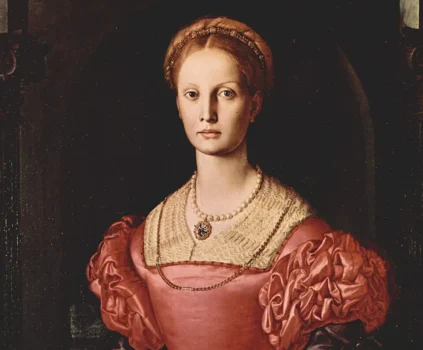
Who was Lucrezia Panciatichi
Agnolo Bronzino, one of the leading painters of the Florentine Mannerist school, created some of the most refined, enigmatic, and psychologically complex portraits of the 16th century. Among them, the Portrait of Lucrezia Panciatichi (c. 1540) stands as a masterpiece of elegance, mystery, and intellectual symbolism, an artwork that continues to fascinate art historians and collectors alike. Today housed in the Uffizi Gallery in Florence, the portrait is both a window into the life of a Florentine noblewoman and a showcase of Bronzino’s precision-oriented style that helped define court portraiture during the rule of Cosimo I de’ Medici.
This article provides a deep, collector-focused exploration of the work, covering its origin, the identity of Lucrezia Panciatichi, historical controversies, symbolic vocabulary, condition, critical reception, and the market value context regarding Bronzino’s surviving paintings.
Who Was Lucrezia Panciatichi?
To understand the portrait, one must begin with its subject. Lucrezia di Sigismondo Pucci Panciatichi (c. 1512–1551) belonged to the Pucci family, a respected Florentine noble lineage. Through her marriage to the cultured and politically active Bartolomeo Panciatichi, Lucrezia became part of a sophisticated humanist circle.
Her Social Status
The Panciatichi family was wealthy but not among the most powerful Florentine dynasties. Their prominence derived from:
involvement in the Florentine Republic,
connections to intellectual and humanist communities,
patronage of the arts,
strong literary interests.
Her husband Bartolomeo was a well-known intellectual, manuscript collector, and friend of many literary thinkers. He served as a diplomat and was known for his refined tastes and slightly unconventional religious views, something that later became embroiled in controversy.
Lucrezia Herself
Historical documentation portrays Lucrezia as:
highly educated for a woman of her time,
cultured and literate,
associated with devotional and intellectual circles,
a patron of religious literature,
admired for her dignity and poise.
Bronzino’s portrait reflects these qualities, representing her as an elegant, reserved, and deeply thoughtful woman. Her clothing and jewelry signal high social standing, while her composure conveys both confidence and restraint, hallmarks of elite Florentine portraiture.
Historical Context: Florence, the Medici Court, and Mannerism
The portrait was made around 1540, during the rise of Cosimo I de’ Medici. Bronzino was the prince’s favorite portrait painter, famed for his:
jewel-like precision,
sculptural solidity,
porcelain-like flesh tones,
meticulously rendered fabrics.
The works he produced catered to an aristocracy eager to project stability, intelligence, and moral virtue, especially after years of political turbulence in Florence.
Lucrezia and her husband moved within these elite circles, and commissioning a portrait from Bronzino was not merely an artistic luxury; it was a statement of:
prestige,
cultural refinement,
allegiance to Medici-era social ideals.
Description of the Painting
Bronzino’s Portrait of Lucrezia Panciatichi is a half-length depiction of the sitter against a dark, neutral background. The artist employs his trademark smooth, hyperrealistic technique with almost alchemical expertise.
Key Visual Features
Elegant pink gown with complex folds and expertly rendered satin.
Elaborate gold necklace featuring a pendant inscribed with “AMOR” (“love”), one of the most debated elements in the portrait.
Refined hand gesture, touching a book, possibly a devotional or literary text.
Incredibly detailed sleeves, jewelry, and lacework.
Controlled, introspective expression with slightly parted lips, giving a sense of psychological depth.
Bronzino’s portraits are known for their idealized, almost cold perfection, yet this one captures an air of inner life and emotional subtlety that makes it exceptional even within the artist’s oeuvre.
The “Amor” Pendant and the Most Famous Controversy
One of the most frequently discussed elements in the painting is the gold pendant worn by Lucrezia. It reads:
“AMOR”
(“Love”)
For centuries, speculative scholars mistakenly associated this pendant with erotic love, suggesting Lucrezia was signaling a romantic or adulterous connection. This interpretation was later proven unfounded and is now considered an example of over-imaginative Victorian-era scholarship.
Actual Meaning
The pendant likely references:
Christian love (charity), or
marital fidelity, or
Neoplatonic love, valued by Florentine intellectual circles.
Given the Panciatichi family’s interest in religious reform circles, the pendant may further symbolize:
spiritual devotion,
intellectual love,
or literary affection (as Bartolomeo was a bibliophile).
Thus, the “Amor” inscription is not scandalous, it is symbolic of the sitter’s virtue, education, and piety.
Religious Controversy Surrounding the Panciatichi Family
In the mid-16th century, Florence was under scrutiny by the Inquisition, which sought out heterodox religious affiliations. The Panciatichis were accused of association with:
reform-minded intellectuals,
discussions around the writings of Juan de Valdés,
private study of scripture.
Although not convicted, the investigation tarnished their reputation.
This adds interpretive layers to the portrait:
Lucrezia is shown with a book, possibly representing private devotion, which was controversial.
Her refined, solemn pose may hint at meditative or spiritual introspection.
Some scholars speculate that Bronzino painted her in a manner suggesting humility and moral fortitude during a time when scrutiny was intense.
The portrait, therefore, reflects not only beauty but also the tensions and intellectual movements of Florentine society.
Symbolism and Meaning in the Portrait
Collectors and scholars have long appreciated the rich network of symbolism in Bronzino’s portrait.
1. The Pendant (“AMOR”)
As described, likely signifies:
divine love,
marital virtue,
or intellectual devotion.
2. The Book
Books in Renaissance portraiture often symbolize:
literacy,
learning,
patronage of the arts,
spiritual meditation.
Lucrezia’s hand gently resting on the book suggests:
her identity as a cultivated woman,
the Panciatichis’ engagement with humanist scholarship.
3. The Clothing
Her luxurious gown indicates:
wealth and refined taste,
adherence to Medici-court style,
a desire to display moral order through outward dignity.
The exacting detail also reinforces Bronzino’s artistic power, the garments become symbolic of craftsmanship, status, and discipline.
4. The Composed Expression
Florentine portraits valued:
restraint,
decorum,
intellectual clarity.
Lucrezia’s enigmatic expression has been compared to that of Mona Lisa, cool, composed, and psychologically complex.
5. Mannerist Aesthetics
Mannerism is characterized by:
elongated forms,
elegance,
artificial perfection,
refined emotional subtlety.
Bronzino’s style represents the height of Florentine Mannerism, making the painting not only a portrait but also a manifesto of the movement.
Artistic Analysis: Bronzino’s Technique
Bronzino is renowned for his nearly crystalline precision, often described as:
smooth as marble,
coldly elegant,
technically immaculate.
In this portrait:
Skin appears porcelain-like.
Fabrics shine with a near-photographic realism.
Shadows are minimal and controlled.
The background is simplified to emphasize the sitter.
Bronzino’s ability to express texture, gold, silk, skin, lace, is unmatched in his era.
This portrait is often cited as one of the finest examples of his artistic maturity.
Reception Over Time
16th Century
At the time of its creation, Bronzino was widely admired by aristocratic patrons, though some critics found his work overly refined or artificial.
The Panciatichi portraits (Lucrezia and the companion portrait of Bartolomeo) were admired for their elegance and were considered prestige symbols.
17th–18th Centuries
Bronzino’s reputation declined due to changing tastes. Baroque critics found his style:
cold,
unemotional,
overly polished.
The portrait lost some prominence during this era.
19th Century Revival
Victorian scholars rediscovered Bronzino, drawn to:
his precision,
his moral symbolism,
the romanticized mystery of Lucrezia herself.
Renewed attention also gave rise to the pendant-related myths and misinterpretations.
20th Century to Present
Modern scholars praise the painting as:
a masterpiece of Mannerist portraiture,
psychologically complex,
technically extraordinary.
Today, it is considered one of Bronzino’s greatest works and a highlight of the Uffizi’s Renaissance collection.
Where Is “Portrait of Lucrezia Panciatichi” Located Today?
The painting is housed in:
The Uffizi Gallery
Florence, Italy
It is typically displayed near its companion portrait:
Portrait of Bartolomeo Panciatichi
Together, the pair forms one of the most admired Renaissance husband-and-wife portrait sets in Europe.
How Much Would a Bronzino Cost Today?
While Portrait of Lucrezia Panciatichi is not for sale and held as a national treasure by Italy, collectors often ask: What would it be worth if it came to market?
Factors Influencing Value
rarity: very few Bronzino portraits are in private hands
condition: this portrait is exceptionally preserved
cultural significance: among Bronzino’s greatest masterpieces
institutional importance: essential to the Uffizi identity
provenance: tied to a prominent Florentine family
artistic quality: exceptional even within Bronzino’s oeuvre
Market Comparisons
Actual Bronzino portraits almost never appear on the market. However:
Lesser Mannerist works by Bronzino’s circle can fetch $2–5 million.
A confirmed Bronzino portrait of elite quality could reach $40–70+ million.
A museum-grade, iconic masterpiece (like this one) would exceed $100 million, possibly approaching the upper tier of Old Master valuations ($150–250 million).
Given its prominence, location, and condition, if hypothetically offered, it could be valued similarly to:
Raphael portraits
Titian portraits
Leonardo school works
In reality, it is culturally priceless and effectively unmarketable.
Why the Painting Matters to Antique Art Collectors
Collectors and scholars value the portrait for several reasons:
1. Technical Mastery
Bronzino’s level of finish is awe-inspiring, making this an essential study for anyone interested in:
Mannerist technique,
Florentine court art,
Renaissance portraiture.
2. Historical Insight
The painting opens windows into:
Florentine intellectual culture,
humanist circles,
the role of women in Renaissance society,
the intersection of art and religious tensions.
3. Symbolic Depth
The portrait invites deep analysis of:
marital symbolism,
spiritual meaning,
identity construction,
aristocratic fashion.
4. Influence on Later Portraiture
Bronzino helped establish conventions that later shaped:
court portraiture across Europe,
the 17th-century French style,
Neoclassical portrait techniques.
5. Cultural Legacy
The painting’s aura of mystery, the pendant, the book, the expression, continues to draw both academic and collector interest.
Is the Portrait Part of a Pair?
Yes. Lucrezia’s portrait forms a celebrated matched pair with her husband’s, created by Bronzino around the same time. The pair demonstrates:
equality within marriage,
intellectual partnership,
shared social ideals.
Collectors value paired portraits for the richness of narrative they provide. While the paintings cannot be separated from their museum context today, understanding them as a set enriches their interpretation.
Conservation and Condition
The Portrait of Lucrezia Panciatichi is in excellent condition, especially considering its age.
Key points:
minimal pigment loss,
no major structural damage,
original paint layers largely intact,
previous restorations were conservative and well documented.
For collectors studying historical conservation practices, this painting is an excellent reference case.
Critical Themes and Modern Interpretations
1. Identity and Performance
Lucrezia is presented as a cultivated, virtuous woman, an image carefully crafted to reflect family values and social expectations. Modern gender studies explore how elite women used portraiture to negotiate visibility and power.
2. Mannerism’s Aesthetic Philosophy
The painting exemplifies:
stylized refinement,
intellectualized beauty,
emotional restraint.
It shows how Mannerism departed from the High Renaissance’s pursuit of naturalism in favor of elegance and artifice.
3. Psychological Interpretation
Even within Bronzino’s famously “cool” style, Lucrezia’s eyes convey:
intelligence,
focus,
introspection.
This has inspired psychological and literary analysis, seeing the portrait as a silent biography of its sitter.
Why This Painting Attracts Ongoing Debate
Despite the vast scholarship surrounding it, certain aspects remain unresolved:
the exact identity of the book,
the intended meaning of “AMOR,”
the psychological state conveyed,
the portrait’s role during Inquisition scrutiny.
These ongoing questions keep the portrait at the forefront of Renaissance art studies.
An Enduring Masterpiece of Renaissance Portraiture
Bronzino’s Portrait of Lucrezia Panciatichi endures as a masterpiece of artistic technique, symbolic depth, and historical richness. For collectors, scholars, and Renaissance enthusiasts, it offers:
unparalleled insight into Florentine elite culture,
exquisite technical perfection,
layers of meaning still debated today,
and a rare glimpse into the private world of a remarkable woman.
Its current home in the Uffizi Gallery ensures its preservation for future generations, while its mystery continues to spark fascination among art lovers worldwide.
For the antique art collector, understanding this painting means understanding a crucial intersection of beauty, intellect, and Renaissance humanism, an artistic achievement that remains timeless.