Stillness and Devotion: Rogier van der Weyden’s Magdalen Reading
Rogier van der Weyden’s Magdalen Reading stands as one of the most intimate and spiritually resonant images of the Early Netherlandish Renaissance. Painted around the mid-15th century, this small panel depicts Mary Magdalene seated quietly, absorbed in a book. Though modest in scale, the work carries remarkable emotional depth and theological significance. It reflects van der Weyden’s mastery of detail, his sensitivity to inner life, and his pivotal role in shaping devotional art in Northern Europe.
The painting is believed to be a fragment of a larger altarpiece, likely depicting a sacred narrative such as the Descent from the Cross or a group of holy figures. Cut down at an unknown date, Magdalen Reading survives as an independent image, and its fragmentary state paradoxically heightens its sense of intimacy. Rather than presenting a dramatic biblical event, van der Weyden offers a moment of stillness, private, contemplative, and deeply human. This focus aligns with 15th-century devotional practices, which encouraged believers to meditate personally on sacred figures and scenes.
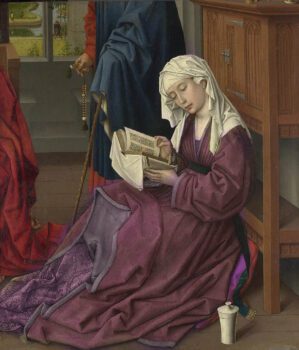
Mary Magdalene is shown seated on the ground, slightly apart from others who would have appeared in the original composition. She wears a richly colored gown of deep red, a hue traditionally associated with both passion and penitence. Her clothing is luxurious yet restrained, suggesting not vanity but dignity and seriousness. Van der Weyden’s meticulous rendering of fabric, its folds, weight, and texture, demonstrates the Northern fascination with material realism. Yet this realism never overwhelms the spiritual message; instead, it grounds the sacred in the tangible world of the viewer.
The book in Magdalene’s hands is central to the painting’s meaning. In medieval and early Renaissance art, books often symbolized wisdom, learning, and devotion. Mary Magdalene, long associated with repentance and love for Christ, is here presented not as an emotional penitent but as an intellectual and spiritual participant in faith. Her reading suggests meditation on scripture and an interiorized relationship with God. This portrayal subtly elevates her status, emphasizing thoughtful devotion rather than dramatic conversion.
Van der Weyden’s handling of Magdalene’s expression is especially striking. Her face is calm, focused, and introspective. She does not look outward toward the viewer but inward, absorbed in her reading. This psychological realism, conveying a believable inner life, was one of van der Weyden’s greatest contributions to European art. Unlike the idealized figures of earlier traditions, his saints feel emotionally accessible. The viewer is invited not merely to observe but to share in Magdalene’s quiet contemplation.
The spatial arrangement of the figure further reinforces this intimacy. Magdalene sits close to the picture plane, occupying a shallow, enclosed space. There is little background detail to distract from her presence. This compression of space, combined with the figure’s inward focus, creates a meditative atmosphere. It mirrors the spiritual exercise of focused prayer, guiding the viewer toward a similar state of concentration.
Symbolically, Magdalen Reading also reflects changing attitudes toward women and piety in the 15th century. While medieval tradition often emphasized Magdalene’s sinful past, van der Weyden presents her as learned, composed, and spiritually mature. The act of reading, still a relatively elite skill at the time, suggests education and intellectual agency. For contemporary viewers, especially women engaging in private devotion, Magdalene could serve as a powerful model of reflective faith.
Artistically, the painting exemplifies the hallmarks of Early Netherlandish art: precise detail, luminous color, and emotional subtlety. Van der Weyden, a contemporary of Jan van Eyck, shared the Northern commitment to realism but pursued a more expressive and devotional path. Where van Eyck often dazzled with optical brilliance, van der Weyden prioritized emotional clarity and moral gravity. Magdalen Reading encapsulates this approach, blending technical refinement with spiritual purpose.
Despite its fragmentary nature, the painting’s influence has endured. It has shaped later representations of Mary Magdalene and contributed to the broader tradition of depicting saints in moments of quiet reflection rather than overt action. Today, Magdalen Reading is admired not only as a masterpiece of Northern Renaissance art but also as a timeless meditation on attention, learning, and inner life.
In its silence, the painting speaks volumes. Rogier van der Weyden transforms a simple act, reading, into a profound spiritual gesture. Through careful composition, symbolic richness, and psychological insight, Magdalen Reading invites viewers across centuries to pause, reflect, and enter the stillness of devotion alongside Mary Magdalene herself.
Meaning of The Magdalen Reading by Rogier van der Weyden
In the canon of Northern Renaissance art, few painters captured the emotional depth and meticulous detail of Rogier van der Weyden. His painting The Magdalen Reading stands as a testament to his technical brilliance and spiritual insight. This small yet profoundly moving panel offers a serene and intimate portrayal of Mary Magdalene, a figure of penitent reflection and spiritual transformation in Christian tradition. More than just a portrait, The Magdalen Reading is a sophisticated narrative encapsulating themes of devotion, introspection, and salvation.
Who Painted The Magdalen Reading and How?
Rogier van der Weyden, one of the most influential painters of the Northern Renaissance, created The Magdalen Reading around 1435–1438. Born in Tournai (modern-day Belgium), van der Weyden trained under Robert Campin (sometimes identified with the Master of Flémalle), where he developed a style marked by emotional expressiveness, religious intensity, and meticulous detail. He later became the official painter of Brussels and earned wide acclaim across Europe.
Van der Weyden’s works often focused on religious subjects, infused with deep emotion and symbolic resonance. His paintings were not just artistic but theological, tools of meditation and moral teaching. He painted The Magdalen Reading using oil on oak panel, a medium popularized in the Low Countries during the early 15th century. This technique allowed for fine detail, subtle gradations of light, and luminous color, all of which are evident in this work.
The painting is thought to be a fragment of a larger altarpiece, perhaps a triptych. The truncation of figures beside Magdalene, visible at the panel’s edges, suggests that this work once formed part of a broader narrative ensemble.
What Is Happening in the Painting?
In The Magdalen Reading, Mary Magdalene is depicted absorbed in a book, presumably a religious text. She sits indoors, enveloped in quiet concentration, her head lowered over the pages, a slight frown of contemplation on her face. She is clad in a richly textured green gown with a white underdress, and her long, golden hair tumbles over her shoulders in carefully rendered waves, a traditional attribute linking her to her biblical identity.
Next to her, on the floor, lies a small alabaster jar, her iconographic attribute, referencing the ointment with which she anointed Christ’s feet. The positioning of the jar, close but unintrusive, subtly alludes to her past, even as her present is absorbed in spiritual study.
Behind her, partially visible, are other figures. One is likely the Virgin Mary, and the other could be Joseph of Arimathea or another male biblical figure. Their presence supports the theory that this panel was part of a larger narrative composition, possibly depicting the Lamentation or another Passion scene. However, van der Weyden focuses on Mary Magdalene, isolating her in a moment of introspective quiet that transcends the original context.
What Type of Art Is It?
The Magdalen Reading is a prime example of Early Netherlandish painting, a regional variant of Northern Renaissance art characterized by:
Oil painting techniques that allowed for greater depth, color, and realism;
Hyper-detailed realism, especially in texture, fabric, and expression;
Religious subject matter rendered with emotional depth and symbolic weight;
Compositional intimacy, often bringing the viewer close to the sacred figure.
This painting combines the spiritual intensity of medieval devotional art with the observational precision of Renaissance realism. It is also a genre painting in the sense that it portrays a moment of daily, human activity, reading, within a sacred context, thereby bridging the divine and the earthly.
Symbolism and Meaning
Van der Weyden’s painting is deeply symbolic, rich in iconographic and theological meaning.
1. Mary Magdalene Herself
Mary Magdalene is a complex biblical figure, both sinner and saint, witness to Christ’s resurrection, and a symbol of penitence and redemption. In medieval and Renaissance iconography, she was often conflated with Mary of Bethany and the unnamed sinful woman in Luke’s Gospel, forming a composite identity.
In this image, Magdalene is not portrayed as a wild penitent in the wilderness nor as the sinner at Christ’s feet but as a learned and contemplative woman. Her act of reading implies literacy and spiritual engagement. She becomes a symbol not only of penitence but also of intellectual devotion and divine love.
2. The Book
The book in her lap likely represents the Gospels or a devotional text such as a Book of Hours. Her reading is not casual, it’s a meditative act. During the Renaissance, reading, especially for women, was associated with piety, reflection, and status. By depicting Magdalene in the act of reading, van der Weyden elevates her status as a spiritual and intellectual authority.
3. The Alabaster Jar
Traditionally associated with her role in anointing Jesus, the jar links Magdalene to her earlier identity as a repentant sinner. In this painting, the jar is discreet and secondary, suggesting a shift from her past to her transformed self.
4. Her Clothing
Magdalene’s garments are luxurious, with flowing velvet and fine underlayers. Rather than contradicting her penitence, these clothes may reflect her transformed beauty and inner richness. The green of her gown may symbolize rebirth, growth, and new life.
5. The Interior Setting
The domestic interior, with its window and tiled floor, suggests a comfortable, quiet space for contemplation. The use of light is subtle but significant, it highlights her face and book, emphasizing the spiritual illumination that reading imparts.
What the Magdalen Reading Painting Represents
At its core, The Magdalen Reading represents the theme of spiritual transformation through knowledge and devotion. It portrays a woman once known for sin, now devoted to scripture and inner reflection. In a period where images served as instruments for meditation and moral instruction, this painting would have encouraged viewers to contemplate their own path toward redemption.
It also reflects a broader shift in how women, especially biblical women, were portrayed in art. Magdalene is not eroticized or sensationalized. She is deeply human, dignified, and spiritually focused. Her portrayal elevates both her character and the role of introspection in the Christian life.
The Value and Price of the Painting
As a work by Rogier van der Weyden, one of the greatest Flemish painters, The Magdalen Reading holds immense art historical and monetary value. While it is difficult to assign a definitive market price to a work housed in a national collection (and unlikely to ever be sold), comparable pieces by van der Weyden, were they to appear on the open market, would command tens of millions of dollars.
The rarity of standalone works by van der Weyden, especially those in such pristine condition, further elevates its worth. It is not merely a painting, it is a surviving fragment of an artist’s philosophical and devotional worldview.
The Magdalen Reading Painting Current Location
Today, The Magdalen Reading resides in the National Gallery, London, where it is part of the permanent collection. Acquired in 1860, the painting has since become a highlight of the gallery’s Early Netherlandish holdings.
It is displayed with appropriate reverence and scholarly context, offering visitors a chance to study its fine brushwork and immerse themselves in its spiritual aura. The gallery provides magnified digital imagery that reveals van der Weyden’s minute detailing, the stitching of fabric, the curl of Magdalene’s hair, the text in her book, all testaments to the artist’s extraordinary skill.
The Magdalen Reading Legacy and Influence
Rogier van der Weyden’s work, including The Magdalen Reading, had a profound influence on later artists such as Hans Memling and even Albrecht Dürer. His approach to human emotion and religious sentiment laid the groundwork for a more introspective, psychologically complex type of religious art.
This painting, in particular, shaped how Mary Magdalene would be represented for centuries, as a figure of reflection, scholarship, and sanctity. In contrast to earlier portrayals emphasizing her sexuality or suffering, van der Weyden’s Magdalene is a quiet revolutionary, asserting the sacredness of thought and the redemptive power of learning.
The Magdalen Reading by Rogier van der Weyden is far more than a beautiful painting, it is a visual sermon on the themes of redemption, introspection, and divine love. It invites viewers into a quiet, sacred space where spiritual transformation takes place not through dramatic acts, but through contemplation and humility.
Through its symbolism, technique, and emotional resonance, the painting continues to speak across centuries, reminding us that salvation lies not in dramatic gestures, but in the quiet turning of the page and the stillness of a reading soul. As a cornerstone of early Northern Renaissance art, it remains one of the most moving and intellectually rich representations of Mary Magdalene in Western art history.