Peggy Guggenheim’s Father and Daughter Tragic Death
Her Father’s Death Into The Titanic
Marguerite “Peggy” Guggenheim was born in 1898 into a family whose name would become synonymous with modern art and immense wealth. Yet her life began not with security but with a defining absence. Her father, Benjamin Guggenheim, died aboard the RMS Titanic in 1912 when Peggy was only thirteen.
Benjamin Guggenheim was born in 1865 into one of America’s most prominent industrial families, the Guggenheims, whose wealth was built through mining and metals. As the son of Meyer Guggenheim, Benjamin inherited immense privilege, but unlike some members of his family who focused relentlessly on business expansion, he lived a more socially visible and cosmopolitan life. He married Florette Seligman, a member of the influential Seligman banking family, and together they had three daughters, including Marguerite “Peggy” Guggenheim, born in 1898.
Benjamin’s relationship with his children, particularly Peggy, was affectionate but constrained by the conventions of elite society at the turn of the twentieth century. He traveled frequently and maintained residences in Europe and the United States, meaning his presence in Peggy’s daily life was intermittent. Nevertheless, family accounts suggest that Peggy admired her father deeply and felt emotionally secure in his attention when he was present. His warmth contrasted with the more reserved social expectations of her mother, leaving a lasting impression on Peggy’s emotional memory of him.
In April 1912, Benjamin Guggenheim was traveling aboard the RMS Titanic, accompanied by his secretary, Victor Giglio, and his companion, Léontine Aubart. When the ship struck an iceberg, Benjamin reportedly refused a seat in the lifeboats, insisting that women and children be saved first. According to survivor accounts, he changed into formal evening wear and declared his readiness to meet his fate with dignity. While later retellings may have romanticized the moment, his death became emblematic of the era’s ideals of masculine honor and sacrifice.
For thirteen-year-old Peggy, her father’s death was a defining trauma. The loss was sudden, public, and irreversible, amplified by the global attention surrounding the Titanic disaster. Peggy later recalled the emotional distance that followed, as grief was absorbed into formal mourning rather than openly processed. Benjamin’s absence left a psychological void that shaped her lifelong fear of abandonment and her relentless pursuit of attachment, affection, and recognition.
Benjamin Guggenheim’s death also affected Peggy materially. Although he was immensely wealthy, much of his fortune was tied to family trusts and business structures that delayed or limited Peggy’s direct inheritance. She would not gain full access to significant wealth until adulthood, a circumstance that fostered both independence and resentment. This delayed inheritance pushed Peggy to seek her own path before fully assuming the role of an heiress.
His disappearance aboard the Titanic became the first great tragedy in her life, shaping the emotional contours of a daughter who would spend decades navigating freedom, grief, and the complicated inheritance of wealth. The loss was public, catastrophic, and permanent. Benjamin’s death was reported with a romantic fatalism, he was said to have dressed formally and accepted his fate, but for Peggy the mythology masked a simpler reality: a beloved parent vanished, leaving a young girl to grow up in the long shadow of disaster.
That absence shaped Peggy’s character and choices. She inherited money later than other Guggenheim heirs and without the steady guidance that might have accompanied it. More importantly, she inherited a sense that stability could be withdrawn without warning. Biographers have long noted that Peggy’s independence, her restlessness, and her appetite for experience can be traced to this early rupture. The Titanic was not merely a historical event in her story; it was the emotional ground zero from which much else radiated.
The Guggenheim Name and the Weight of Expectation
The Guggenheim family represented a distinctly American arc of immigrant success. Solomon R. Guggenheim, Peggy’s uncle, would later establish the foundation that bears his name and fund museums that reshaped the presentation of modern art. The family’s wealth came primarily from mining and industrial ventures, and by the early twentieth century it conferred both privilege and constraint. Peggy was expected to conform to social norms, marry suitably, and manage her inheritance discreetly.
She resisted. When Peggy came of age, she moved to Europe, working briefly in a bookstore and immersing herself in avant-garde circles in Paris and London. This was not an obvious path for a Guggenheim. The choice signaled a desire to author her own life rather than serve as a custodian of inherited respectability. The tension between the family name and Peggy’s personal freedom would remain unresolved, and it would exact costs.
Love, Loss, and the Pattern of Disappearance
Peggy Guggenheim’s romantic life has often been summarized crudely, but it is better understood as a sequence of intense attachments repeatedly interrupted by loss. She married the writer and artist Laurence Vail, a union marked by volatility and creativity in equal measure. The marriage produced two children, Sindbad and Pegeen, and ended in divorce. Peggy’s subsequent relationships included artists and intellectuals whose lives were often precarious, particularly during the interwar years and the Second World War.
Several of Peggy’s lovers died young or suffered psychological collapse. Others drifted away as careers faltered or circumstances changed. The cumulative effect reinforced a pattern Peggy had learned early: intimacy did not guarantee permanence. Critics have sometimes read her continued pursuit of love as hedonism, but an alternative reading is more persuasive. Peggy sought connection with urgency because she understood, from experience, how fragile connection could be.
The Sexual Myth and Its Origins
One of the most persistent claims about Peggy Guggenheim is that she slept with “1000 men.” The figure circulates widely, often stripped of context and deployed to reduce her life to provocation. The number appears to originate in Peggy’s own provocative statements and autobiographical framing, offered with a mixture of irony, bravado, and defiance. It was a way of confronting a society that judged women’s sexuality harshly while celebrating men’s excesses.
There is no reliable evidence that the number is literal. What matters more than its accuracy is why Peggy embraced the myth. Sexual freedom was, for her, an assertion of agency in a world that sought to constrain her choices. It was also entangled with her artistic milieu, where boundaries were deliberately tested and conventional morality rejected. Peggy’s openness about her sex life challenged the norms of her time and ensured that her personal behavior would overshadow, in some accounts, her cultural achievements.
To reduce Peggy Guggenheim to a tally of lovers is to miss the point. Her relationships were not merely physical; they were intellectual and creative exchanges that shaped her eye as a collector. Many of the artists she supported, sometimes as lovers, sometimes as friends, benefited from her willingness to invest emotionally as well as financially. The myth persists because it is sensational, but it obscures more than it reveals.
War, Exile, and the Burden of Survival
The outbreak of the Second World War forced Peggy to confront danger on a continental scale. As a Jewish woman in Europe, she faced escalating risk. She fled Paris with her art collection, ultimately reaching the United States. During this period, Peggy did more than save herself; she saved artworks that might otherwise have been lost or destroyed. Her collection included pieces by artists who would later define modernism.
Survival, however, brought its own burdens. Peggy returned to Europe after the war, settling in Venice, where she lived among her collection in the Palazzo Venier dei Leoni. The city became her refuge and her stage. Yet the war years intensified her sense of displacement. She belonged everywhere and nowhere, a benefactor to many and fully understood by few.
Motherhood and the daughter Suicide
Peggy Guggenheim’s public life was dramatic, but some of her deepest struggles unfolded privately. Her children bore the weight of her choices and the instability that accompanied them. Sindbad Guggenheim, her son, lived largely outside the public eye and died in 1983. His life, while less documented, reflected the complexities of growing up adjacent to fame and controversy.
Her daughter, Pegeen Vail Guggenheim, suffered profoundly. Pegeen struggled with depression for much of her life and felt overshadowed by her mother’s reputation. In 1967, she died by suicide in Paris, a loss that devastated Peggy. The tragedy exposed the limits of wealth and cultural capital as protections against mental illness. Peggy carried this grief for the remainder of her life, and those close to her noted a hardening sadness beneath her flamboyant exterior.
Pegeen Vail Guggenheim, born in 1925 in Paris, lived a life shaped by privilege, artistic intensity, and persistent emotional struggle. She was the daughter of Peggy Guggenheim, one of the most influential modern art collectors of the twentieth century, and the writer and artist Laurence Vail. From the beginning, Pegeen grew up in an atmosphere saturated with creativity, intellectual ambition, and instability. Her childhood unfolded across Europe and the United States, marked by her parents’ volatile marriage, their eventual divorce, and her mother’s highly unconventional lifestyle.
Although surrounded by artists and cultural elites, Pegeen often felt emotionally isolated. Biographers and family acquaintances have described her as sensitive, introspective, and deeply affected by the absence of consistency in her early years. Peggy Guggenheim was a devoted patron of artists but an erratic parent, frequently absorbed by her relationships, social life, and collecting activities. As a result, Pegeen struggled to establish a stable sense of self, particularly while growing up under the shadow of a famous and controversial mother.
Pegeen showed artistic talent of her own, especially as a painter. However, her work was frequently compared, unfairly, to the achievements of artists her mother championed. Rather than benefiting from the Guggenheim name, she often experienced it as a burden. This sense of being overshadowed contributed to longstanding depression, which worsened as she entered adulthood. Friends later recalled that Pegeen felt caught between worlds: never fully independent of her mother’s influence, yet never comfortably embraced by the art establishment.
Her mental health deteriorated over time. Pegeen experienced recurring depressive episodes, compounded by difficulties in relationships and a lack of sustained recognition for her work. During the 1960s, she lived primarily in Paris, increasingly withdrawn and emotionally fragile. Mental health resources at the time were limited, and depression was still widely misunderstood, particularly among women whose suffering was often dismissed as emotional instability rather than illness.
In 1967, at the age of forty-one, Pegeen Vail Guggenheim died by suicide in Paris. Her death devastated Peggy Guggenheim, who rarely spoke publicly about it but was deeply affected for the remainder of her life. Those close to Peggy noted that the loss intensified her grief, guilt, and sense of failure as a mother.
Pegeen’s life and death stand as a quiet tragedy within the larger Guggenheim story. Her experience illustrates that wealth, cultural access, and artistic surroundings offer no immunity from depression. Remembering Pegeen Vail Guggenheim is not only an act of historical completeness but also a reminder of the human cost that can exist behind famous names and celebrated legacies.
Pegeen’s death has been discussed cautiously by historians, and rightly so. It was not an isolated event but the culmination of long-standing mental health challenges. Peggy’s own writings suggest guilt and regret, emotions that complicated her already fraught relationship with motherhood.
The Collector as Creator
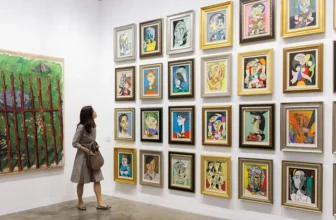
Despite the tragedies, Peggy Guggenheim’s legacy rests decisively on her work as a collector and patron. She did not simply buy art; she identified emerging talent and took risks that institutions would not. Her gallery, Art of This Century, introduced American audiences to European modernists and championed American artists at critical moments.
Peggy’s eye was intuitive rather than academic. She trusted her responses and acted decisively. This approach allowed her to assemble a collection of extraordinary coherence and influence. The Venice museum that bears her name today reflects this vision and remains one of the most visited modern art collections in the world.
What Peggy Guggenheim Died Of
Peggy Guggenheim died in 1979 in Italy at the age of eighty-one. The cause of death was a stroke, following a period of declining health. Her passing was relatively quiet compared to the spectacle that had surrounded much of her life. She was buried in Venice, in the garden of her palazzo, alongside her beloved dogs, a final gesture that captured both her eccentricity and her desire for a chosen family.
The Fate of the Guggenheim Wealth
The Guggenheim fortune evolved significantly over the twentieth century. While the family’s industrial wealth diminished over time, its cultural capital expanded. The Solomon R. Guggenheim Foundation became the primary steward of the family legacy, operating museums in New York, Venice, and elsewhere. Peggy’s own collection was bequeathed to the foundation, ensuring its public accessibility.
Peggy did not control the entirety of the Guggenheim wealth, nor did she seek to. Her contribution was curatorial rather than financial dominance. By transferring her collection to the foundation, she converted private passion into public institution, a decision that has shaped art history for generations.
Descendants and the Living Legacy
Today, the Guggenheim family includes descendants from various branches, though few are public figures. Peggy’s direct line continued through her son Sindbad, whose children and grandchildren have largely remained private. The family name is now more closely associated with the foundation and its museums than with individual heirs.
This diffusion of identity may be fitting. Peggy Guggenheim spent her life resisting confinement, including the confinement of lineage. Her legacy is not a dynasty of personalities but a network of institutions and artworks that continue to provoke, inspire, and challenge.
Mystery, Tragedy, and the Measure of a Life
Peggy Guggenheim’s life resists simple moral accounting. She was neither merely a scandalous socialite nor a flawless patron saint of modern art. She was a woman shaped by early loss, driven by desire, wounded by tragedy, and animated by a fierce commitment to creative freedom. The mysteries that surround her, her motivations, her contradictions, are inseparable from the tragedies she endured.
In confronting her story honestly, without reducing it to rumor or reverence, a more human figure emerges. Peggy Guggenheim lived intensely and paid for that intensity. The art she preserved and promoted endures as evidence that, for all the suffering, her life changed the cultural landscape irrevocably.