René Magritte: The Surrealist Visionary Who Redefined Reality
René Magritte (1898–1967) is one of the most influential figures in 20th-century art, renowned for his surrealist paintings that challenge viewers’ perception of reality. Born in Lessines, Belgium, Magritte’s early life was marked by tragedy and introspection, experiences that would later influence his distinctive approach to art. His mother’s suicide when he was just 14 had a profound impact on him, shaping his fascination with the subconscious, hidden truths, and the eerie interplay between appearance and reality.
Magritte’s artistic journey began at the Académie Royale des Beaux-Arts in Brussels, where he studied from 1916 to 1918. Initially influenced by impressionism and cubism, he soon gravitated toward surrealism in the 1920s, inspired by the works of Giorgio de Chirico and the writings of André Breton. Unlike some surrealists, who embraced abstract, dreamlike imagery, Magritte sought to juxtapose ordinary objects in extraordinary contexts, creating a sense of mystery and cognitive dissonance in his viewers.
A hallmark of Magritte’s work is his ability to make the familiar strange. He often painted everyday objects, pipes, bowler hats, apples, and clouds, but placed them in unusual combinations or contexts that defy logic. One of his most famous paintings, The Treachery of Images (1929), depicts a realistic pipe with the caption “Ceci n’est pas une pipe” (“This is not a pipe”). This work exemplifies Magritte’s central philosophical concern: the tension between objects and their representations, questioning the reliability of perception and the nature of reality itself.
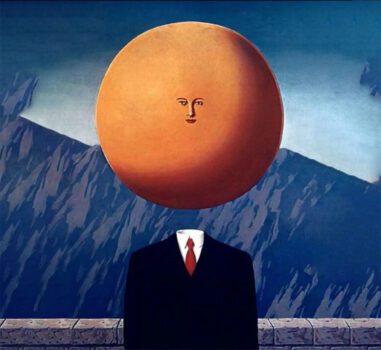
Another iconic work, The Son of Man (1964), features a man in a suit with his face obscured by a floating green apple. The image has become emblematic of Magritte’s career, representing themes of concealment, identity, and the hidden aspects of human experience. Similarly, The Lovers (1928), in which two figures embrace with their faces covered in cloth, evokes a sense of mystery, isolation, and the limits of human understanding. Through these works, Magritte explored psychological and philosophical questions, making the invisible forces of thought, desire, and fear visible on canvas.
Magritte’s style is characterized by precise, realistic techniques that heighten the surreal impact of his compositions. His use of clean lines, muted colors, and careful lighting contrasts sharply with the dreamlike or absurd scenarios he presents. By combining traditional painting methods with imaginative, paradoxical concepts, he created images that are instantly recognizable yet endlessly perplexing. This tension between realism and fantasy became his signature approach and distinguished him within the surrealist movement.
In addition to his paintings, Magritte produced commercial artwork, illustrations, and public commissions. He designed posters, book covers, and advertisements, blending commercial and fine art in innovative ways. His influence extended beyond painting into literature, film, and popular culture. Directors, designers, and other artists drew inspiration from his work, employing his visual paradoxes and whimsical imagery to challenge conventional ideas and inspire new creative expressions.
Magritte’s personal life was marked by both stability and intellectual rigor. In 1922, he married Georgette Berger, who became a constant support throughout his career. Together, they moved frequently within Belgium, but Magritte maintained a disciplined approach to his art, producing a prolific body of work over four decades. Despite periods of financial struggle, his reputation grew steadily, particularly after World War II, when his art began to reach international audiences. Exhibitions in Paris, London, and New York cemented his position as a leading surrealist, and his influence continues to resonate in contemporary art.
The philosophical underpinnings of Magritte’s work were influenced not only by surrealist ideals but also by broader inquiries into language, semiotics, and perception. He challenged the assumption that objects have fixed meanings and explored how context, labeling, and imagination shape human understanding. This intellectual depth distinguishes him from many contemporaries; his paintings are not merely visual puzzles but meditations on reality, representation, and the limits of human knowledge.
Magritte’s legacy is enduring. His works are housed in major museums worldwide, including the Museum of Modern Art in New York, the Art Institute of Chicago, and the Magritte Museum in Brussels. Exhibitions continue to attract new generations of viewers who find his images both visually striking and intellectually stimulating. Artists across media, from painters and sculptors to filmmakers and fashion designers, continue to draw inspiration from his playful yet profound approach to reality.
René Magritte was more than a surrealist painter; he was a philosopher of the visual world. Through his masterful manipulation of ordinary objects, meticulous technique, and exploration of perception, he invited viewers to question the nature of reality and the reliability of their own senses. His art remains as provocative and relevant today as it was in the early 20th century, bridging the gap between imagination and intellect, and forever redefining how we see the world.
What Was Rene Magritte Known For
In the world of art, few figures are as enigmatic, imaginative, and thought-provoking as Rene Magritte, the Belgian surrealist who defied logic and reshaped the meaning of visual art. Best known for his paradoxical juxtapositions, clever use of imagery, and philosophical underpinnings, Magritte’s work continues to captivate collectors, scholars, and casual admirers alike. But beyond the iconic bowler hats and clouds lies a rich story of a man who asked not only “What do we see?”, but more importantly, “What do we believe we see?”
Who Was Rene Magritte?
Rene François Ghislain Magritte was born in Lessines, Belgium, on November 21, 1898. His early life was marked by tragedy when his mother died by suicide when he was just 14 years old. The image of her body, allegedly found with her face covered by her nightgown, would later echo in his work, where faces are often obscured or concealed.
Magritte studied at the Royal Academy of Fine Arts in Brussels, but formal education never quite satisfied his thirst for innovation. He was drawn instead to avant-garde movements and developed a passion for surrealism, which would define his legacy. Unlike some of his contemporaries who leaned toward abstraction, Magritte was a representational surrealist. His paintings looked like reality, but twisted in ways that made you question that reality altogether.
Magritte is known for his surrealist paintings that blend the ordinary with the extraordinary, using realistic imagery to represent abstract concepts. He wasn’t interested in dreamscapes like Dalí or automatism like Andre Breton. Instead, Magritte explored the tension between objects and their representation.
He often played with:
Visual puns
Unexpected juxtapositions
Word-image contradictions
The obscured face
Repetition and variation
One of his defining traits was his use of familiar objects in unfamiliar contexts, leading viewers to rethink their relationship with reality. He was a visual philosopher, translating metaphysics into paint. His work was not just art, it was a puzzle, a question, a challenge to perception.
Famous Artworks by Rene Magritte
Several of Magritte’s paintings have transcended the art world and entered the public consciousness. Here are some of his most iconic pieces:
1. The Treachery of Images (La Trahison des Images) – 1929
Perhaps his most famous work, this painting features a simple image of a pipe with the caption, “Ceci n’est pas une pipe” (“This is not a pipe”). It challenges the viewer’s assumption, pointing out that this is merely an image of a pipe, not a real one.
2. The Son of Man – 1964
This self-portrait shows a man in a bowler hat with his face obscured by a hovering green apple. It’s one of the most recognized images in art history, often interpreted as a comment on identity, concealment, and the limits of perception.
3. Golconda – 1953
A surreal vision of identical men in bowler hats floating or falling like rain in front of a bland urban backdrop. It evokes themes of conformity and individuality.
4. The Lovers – 1928
Two figures locked in a kiss, but their heads are wrapped in white cloth, obscuring their faces. This painting speaks of intimacy, mystery, and the barriers between people.
5. Time Transfixed – 1938
A steam locomotive emerges from a fireplace in a bourgeois interior. The title and image suggest a moment frozen in contradiction and absurdity.
These works have become foundational pieces not only in surrealism but in the broader dialogue of modern art.
How Much Does a Rene Magritte Artwork Cost?
The cost of a Magritte artwork varies dramatically depending on size, subject, and provenance. However, his paintings have consistently broken records at auctions.
Here are a few notable examples:
“L’empire des lumières” (The Empire of Light) sold at Sotheby’s in 2022 for $79.8 million, setting a new record for Magritte and for any Belgian artist.
“Le principe du plaisir” (The Pleasure Principle) was sold for $26.8 million in 2018.
Smaller works and less iconic pieces can range from $1 million to $10 million, depending on rarity and condition.
Magritte’s market value has skyrocketed in recent years, and collectors see his work as both philosophically rich and financially rewarding.
How Did Rene Magritte Create His Art?
Magritte’s creative process was meticulous. Unlike many surrealists who used automatic drawing or stream-of-consciousness techniques, Magritte planned every detail.
His method included:
Sketching ideas before committing to canvas
Using photography to stage and test visual concepts
Working slowly and precisely, favoring clarity over flamboyance
Frequent use of oil paint on canvas, but also gouache and collage
Magritte was deeply interested in the conceptual foundations of his images. Often, the idea came first, sometimes from a pun, a philosophical inquiry, or a dreamlike notion, and the image followed. He considered himself a thinker as much as a painter.
He once said, “The mind loves the unknown. It loves images whose meaning is unknown, since the meaning of the mind itself is unknown.”
How Many Artworks Did Rene Magritte Create?
Estimates suggest Magritte produced over 1,300 paintings, along with hundreds of drawings, collages, and gouaches. His career spanned more than four decades, during which he remained astonishingly productive.
His artworks are cataloged in the Rene Magritte Catalogue Raisonne, a comprehensive multi-volume resource that scholars use to authenticate and study his body of work.
While many paintings repeat motifs, like apples, bowler hats, clouds, and curtains, each variation explores a different aspect of perception and meaning.
What Art Style Is Rene Magritte Associated With?
Rene Magritte is most famously associated with Surrealism, a movement that emerged in the 1920s aiming to unlock the power of the unconscious mind and challenge traditional norms.
However, Magritte’s take on surrealism was distinct:
He rejected automatic painting in favor of intellectual rigor
His works often feature photorealistic techniques
He is considered a conceptual precursor to Pop Art, Minimalism, and even Postmodernism
Because of this, Magritte is sometimes referred to as a “philosopher-painter.” His clean, almost academic style differs from the more chaotic or dreamlike imagery of other surrealists, like Max Ernst or Salvador Dalí.
What Materials Did Rene Magritte Use?
Magritte primarily used:
Oil on canvas – his most common medium
Gouache – a water-based paint for smaller works and studies
Charcoal and pencil – for drawings and sketches
Photography and collage – especially in his early years and for conceptual experiments
Despite his surrealist sensibilities, Magritte favored traditional materials. He did not innovate through technique, but through concept. His brushwork is often precise, clean, and understated, putting emphasis on the idea rather than the craftsmanship.
Where Can You See Rene Magritte’s Art Today?
Magritte’s works are scattered across the globe, but several major museums and collections house substantial holdings:
1. The Magritte Museum (Musee Magritte), Brussels, Belgium
Located in the heart of his home country, this is the largest collection of Magritte’s works in the world, with over 200 pieces including paintings, drawings, sculptures, and photographs.
2. Museum of Modern Art (MoMA), New York
Houses key pieces like The False Mirror and The Lovers.
3. The Art Institute of Chicago
Owns Time Transfixed, a quintessential example of Magritte’s surreal style.
4. Tate Modern, London
Often features Magritte’s work in surrealist exhibitions.
5. Menil Collection, Houston
Renowned for its surrealist holdings, including several Magritte works.
6. Private collections
Many of Magritte’s masterpieces remain in private hands, appearing at auction or on loan to exhibitions.
Magritte’s Influence and Legacy
Magritte’s impact on modern and contemporary art is immeasurable. He influenced movements such as:
Pop Art – Andy Warhol cited him as a major influence.
Conceptual Art – His exploration of language and imagery anticipated work by artists like Joseph Kosuth.
Advertising and graphic design – His iconic, crisp imagery continues to inspire branding and media.
His visual motifs have appeared in music videos, fashion, literature, and films. Even the Apple logo and surreal scenes in movies like Inception bear traces of Magritte’s legacy.
The Man Who Saw the Invisible
Rene Magritte was not simply an artist, he was a seer, a poet in oil paint, a master illusionist who made us question our most basic assumptions about the world. He took the familiar and made it strange, not through distortion, but through context and contradiction.
His message? What you see is not always what is. And even when it is, should you trust it?
In a world saturated with images, Magritte’s work remains startlingly relevant. He reminds us to look again, and more importantly, to think again. Behind every pipe, apple, or curtain, there’s a deeper truth waiting to be uncovered.
As Magritte once put it: “Everything we see hides another thing, we always want to see what is hidden by what we see.”
And perhaps that is the ultimate magic of Magritte, he painted not what we see, but what lies just beyond it. image/arthive.com