The Meaning and Story of the Stańczyk Jester Painting
Few paintings in Polish art history resonate as powerfully as Jan Matejko’s “Stańczyk” (1862). Although on the surface it portrays a court jester resting alone during a royal ball, its emotional weight and political symbolism have made it one of the most discussed and beloved masterpieces in Central Europe. People admire the painting not only for its technical brilliance but also for its psychological depth and historical message. The figure of Stańczyk, part joker, part philosopher, part tragic prophet, captures the imagination of viewers more than 160 years after Matejko painted him.
Stańczyk is one of the most famous and evocative paintings in Polish art history. Painted in 1862 by Jan Matejko, this masterpiece captures a deeply reflective and melancholic vision of the famous court jester Stańczyk, who served Polish kings during the 16th century. While jesters are typically associated with humor and lighthearted entertainment, Stańczyk presents a stark contrast by portraying the jester in a moment of profound contemplation, seemingly burdened by the weight of historical events. This article explores the meaning, artistic style, and current location of this iconic painting.
Who Is Stańczyk?
Stańczyk (pronounced “Stanch-ik”) was a real historical figure, considered the most famous jester of the Polish Renaissance. He served during the reigns of three kings of the Jagiellonian dynasty: Alexander, Sigismund the Old, and Sigismund Augustus. Far from being a simple entertainer, Stańczyk was known for his sharp wit, biting political insight, and fearless criticism of royal decisions.
Historical accounts describe him as:
Intelligent and outspoken, often the only person at court who dared speak truth to power
A social commentator, using humor and satire to highlight political failures
A beloved cultural figure, frequently appearing in Polish literature, legends, and satire
Stańczyk lived primarily in Kraków, where the royal court resided during his lifetime. Though employed as a jester, his role extended far beyond entertainment. He acted as a conscience of the monarchy, an advisor wrapped in the disguise of a fool.
What Was His Job?
A court jester in Renaissance Europe had several roles:
Entertainment – performing jokes, stories, or physical comedy
Counsel through satire – using humor as a safe channel for political critique
Observing court life – offering shrewd insights on political events
Mediating tensions – diffusing conflict with humor
Stańczyk excelled especially in the second role. His remarks, recorded in chronicles and later retold in literature, show him as a patriot deeply worried about Poland’s political missteps. His “fool’s mask” allowed him to voice truths others feared to speak.
Although little is known with absolute certainty, historians believe Stańczyk was born at the end of the 15th century and died around the mid-16th century. He likely came from a lower-noble or bourgeois family, which gave him the education and literacy uncommon among jesters.
His personality, as presented in historical anecdotes, reflects:
A sharp, almost philosophical mind
Melancholy beneath the humor
Patriotism and a deep sense of responsibility
Matejko’s painting captures these traits perfectly, turning the jester into a symbol of national conscience.
The Story and Meaning of Stańczyk
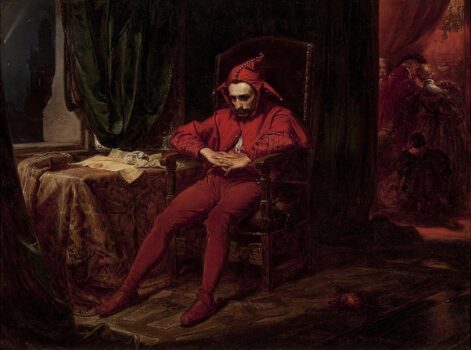
Stańczyk is a portrait of a man dressed in the traditional red attire of a jester, seated alone in a dimly lit chamber. Unlike typical depictions of jesters who are often engaged in merriment, this jester appears deep in thought, his expression somber and weary. A crumpled letter on the floor suggests that he has received troubling news. In the background, through an open door, a lavish ball is taking place, emphasizing the contrast between Stańczyk’s solitude and the oblivious revelry of the Polish nobility.
The painting references a specific historical event: the loss of Smolensk to the Grand Duchy of Moscow in 1514, a major defeat for Poland-Lithuania. The letter on the floor is believed to bear this news, reinforcing the idea that Stańczyk, though a mere jester, understands the gravity of the situation more than the aristocracy. This interpretation aligns with historical accounts of the real-life Stańczyk, who was known for his sharp wit and political insight. His ability to use humor to critique the ruling class made him a figure of great intelligence rather than simple entertainment.
Jan Matejko’s choice to depict the jester as a tragic and contemplative figure reflects a broader theme in Polish history, the burden of patriotism and the frustration of seeing one’s country suffer due to poor leadership. In this way, Stańczyk serves as a symbol of Poland’s struggles and the wisdom of those who truly care for its fate, even if they lack political power.
What Type of Painting is Stańczyk?
Stylistically, Stańczyk belongs to the Romantic school of art, which often emphasizes emotion, historical reflection, and dramatic composition. Jan Matejko, one of Poland’s most renowned painters, was known for his historical paintings that depicted key events and figures in Polish history with great detail and symbolic depth.
The painting is a prime example of Matejko’s use of historical realism. It meticulously captures the texture of the jester’s red garment, the folds in his clothing, and the careful rendering of light and shadow to create a powerful atmosphere. The contrast between Stańczyk’s darkened figure and the bright ballroom in the background highlights the division between those who understand the weight of historical events and those who remain blissfully unaware.
Matejko was also known for his ability to infuse deep storytelling into his paintings. In Stańczyk, every element, the crumpled letter, the empty chair beside him, and the dim candlelight, adds layers of meaning. The painting is not just a portrait but a historical and political commentary, making it one of the most complex and revered works in Polish art.
Public Opinion About the Jester
People generally describe Stańczyk as:
A tragic hero – someone who knows the truth but cannot change it
A philosopher in disguise – a thinker whose humor masks intelligence
A patriot – loyal to Poland even when others are blind to danger
A symbol of conscience – the one honest voice in a world of empty celebrations
Modern viewers often relate him to contemporary figures who speak truth to power but go unheard. This timeless quality keeps public fascination alive.
What People Likes about Matejko’s Stańczyk
1. The Emotion and Solitude
Instead of a laughing clown, Matejko presents Stańczyk sitting alone, slumped in a chair, deep in despair. Behind him, through an open door, a ball is in full swing. The contrast is striking:
The court celebrates.
The jester mourns.
This reversal of expectations draws viewers in. People feel empathy for a character usually portrayed as comic. His sorrow becomes deeply human and relatable.
2. Symbolism and Political Meaning
Matejko often used historical scenes to comment on Poland’s political struggles. In this painting, Stańczyk’s despair reflects the tragic direction the country was taking. A discarded royal document on the table references the loss of Smolensk in 1514, a major defeat for Poland.
The message is clear:
The only person wise enough to understand the gravity of the situation is the jester.
Viewers appreciate the painting not just as art, but as a political statement, subtle, clever, and full of meaning.
3. Psychological Depth
Matejko paints Stańczyk not as a comic buffoon but as a thinker. His eyes convey deep intelligence. His posture suggests the weight of responsibility. People appreciate this human complexity.
The painting invites questions:
What is he thinking?
Why is he alone?
Why does he look more serious than any king or noble?
It is exactly this ambiguity that keeps the painting alive in public imagination.
4. Historical Resonance
Many Poles grew up learning about Matejko’s works in school, especially during periods when Poland faced political struggles. Stańczyk became a symbol of:
Wisdom ignored
Patriotism hidden behind humor
The pain of seeing one’s homeland decline
People admire the painting because it reflects not just historical events, but emotional truths that stretch across generations.
Is the Jester Painting for Sale or Auction?
No.
Jan Matejko’s Stańczyk is not for sale. It has never been auctioned.
It is part of the permanent collection of the National Museum in Warsaw (Muzeum Narodowe w Warszawie) in Poland. As a national treasure, it is protected by cultural heritage laws, making it legally non-transferable.
Paintings of this importance, especially national symbols, rarely, if ever, appear on the art market.
How Much Is the Painting Worth?
Because Stańczyk is not for sale, no official market price exists.
However, art historians and appraisers have estimated that if it did appear at auction, it could be valued in the range of:
$50 million to over $100 million USD
This estimate comes from:
Matejko’s status as the most important Polish historical painter
The painting’s iconic role in national identity
Its international fame
Its size, condition, and subject matter
But again, this number is purely hypothetical. The painting is considered priceless in Poland’s cultural heritage and will not be sold.
Where is the Stańczyk Painting Now?
Today, Stańczyk is housed in the Warsaw National Museum (Muzeum Narodowe w Warszawie), one of Poland’s most important cultural institutions. The museum holds a significant collection of Matejko’s works, alongside other great Polish and European masterpieces. Visitors to the museum can see the painting up close and appreciate its detailed brushwork and evocative composition.
The painting remains one of the most recognized and celebrated works in Poland. It continues to be a powerful symbol of Polish national identity, resilience, and historical awareness. Throughout the years, Stańczyk has been referenced in literature, film, and modern political discourse, further cementing its place as an enduring icon of Polish culture.
Stańczyk by Jan Matejko is much more than a portrait of a court jester. It is a deeply symbolic and historically rich painting that captures the struggles of Poland during a turbulent period. By portraying the jester as a figure of intelligence and sorrow rather than mere amusement, Matejko invites viewers to reflect on the responsibilities of leadership, the importance of national consciousness, and the consequences of ignorance.
Jan Matejko’s Stańczyk captivate audiences because it offers far more than a historical portrait. It is a psychological study, a political commentary, and a cultural symbol all at once. The jester, wise, sad, reflective, stands as a reminder of the costs of ignoring truth and the loneliness of those who see danger before others do.
Stańczyk’s life, full of humor mixed with seriousness, adds depth to the image. People love the painting because it speaks across time: about responsibility, foresight, patriotism, and the human condition.
As a Romantic historical painting, Stańczyk continues to be a masterpiece that resonates with audiences, not only in Poland but around the world. Its presence in the Warsaw National Museum ensures that future generations can appreciate both its artistic brilliance and its profound historical message.