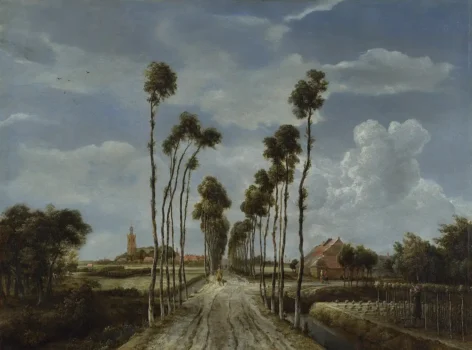
The Avenue at Middelharnis by Meindert Hobbema: Meaning and Symbolism
The Avenue at Middelharnis (1689) by Meindert Hobbema is one of the most celebrated Dutch landscape paintings of the 17th century, a masterpiece that captures the quiet dignity, rational order, and poetic beauty of the Dutch countryside. Today, it stands as Hobbema’s most iconic work, revered for its precise composition, atmospheric perspective, and monumental presentation of a seemingly simple rural road lined with tall, disciplined trees.
But behind its serene façade lies an extraordinary story, one that involves the transformation of Dutch society, the decline and rediscovery of a brilliant artist, and a deep symbolic framework that continues to fascinate art lovers and scholars.
In this long-form article, we will explore the full story, analysis, meaning, symbolism, technique, and cultural reception of The Avenue at Middelharnis, while integrating strong SEO keywords for art history enthusiasts, researchers, and search traffic.
The Story Behind The Avenue at Middelharnis: Why Hobbema Painted It
A painting created at the end of an artist’s career
Meindert Hobbema, a Dutch Golden Age painter, is known for forest scenes, watermills, leafy pathways, and rustic cottages. For most of his career, he painted wooded environments influenced by his mentor, Jacob van Ruisdael. Yet The Avenue at Middelharnis, painted in 1689, stands apart from almost everything else in his oeuvre.
It is his only major work structured around a straight, symmetrical road, an unusual departure from his typical compositions. This painting was created when Hobbema was already retired, working not as a full-time painter but as a wine gauger (tax official) for Amsterdam. Scholars note that his artistic production dropped significantly after 1668, making this 1689 painting a rare late-career revival.
Commission or personal project?
Research suggests that The Avenue at Middelharnis was likely a commissioned piece rather than a personal artistic experiment. The painting depicts a newly designed avenue, located in the small town of Middelharnis on the island of Goeree-Overflakkee in the Netherlands.
Historical records show that in the 1660s and 1670s, local landowners and officials engaged in landscaping projects, straight roads, rectangular fields, and tree planting, symbolizing progress, order, and agricultural development. The painting seems to celebrate these improvements.
A visualization of Dutch civic pride
It is quite possible that the Middelharnis civic authorities, or maybe one of the farmers or landowners, commissioned Hobbema to capture their newly improved avenue as a visual symbol of local pride, prosperity, and agricultural modernization.
What The Avenue at Middelharnis Represents
Order, Control, and Human Mastery Over Nature
The highly structured design, two rigid rows of tall trees forming a perfect corridor, reflects the Dutch tradition of land reclamation, water engineering, and countryside organization. The Netherlands, having battled water for centuries, developed a deep cultural appreciation for geometry, straight lines, and man-made order in their landscape.
Thus, the painting represents:
Human control over nature
Economic progress
Rural redevelopment
Agricultural pride
The Dutch Golden Age belief in order and rationality
The road, stretching straight into the distance, symbolizes an optimistic future, one shaped by planning, discipline, and community effort.
Analysis of The Avenue at Middelharnis
A masterpiece of perspective
Hobbema uses one-point linear perspective to create a powerful visual tunnel. The trees converge toward a single vanishing point slightly right of center, drawing the viewer’s eye into the depth of the painting. This is unusual for Dutch landscapes of the period, which often used oblique angles or asymmetrical compositions.
Balance of geometry and natural life
Although the trees are evenly spaced and meticulously pruned, they still retain organic irregularities. Some bend slightly, others show signs of age. The straight road is softened by the textures of:
plowed fields,
grassy verges,
small fences,
subtle clouds drifting across the sky.
The painting achieves harmony between human-designed geometry and natural, unpredictable growth, a central theme in Dutch culture.
Subtle but lively narrative elements
Small figures are placed in the foreground and mid-distance:
a man and woman walking down the avenue,
a laborer working near the fields,
a distant figure near a cottage.
These details give the scene life without overwhelming the grandeur of the landscape.
Lighting and atmosphere
The sky is bright but slightly overcast, giving the painting the diffused, cool northern light characteristic of Dutch landscapes. Shadows fall gently along the avenue, creating a rhythmic pattern that enhances depth and visual harmony.
The Meaning and Symbolism of The Avenue at Middelharnis
Although at first glance it appears simply an attractive rural scene, the painting is rich with symbolic meaning.
Symbolism 1: Civilization and Order
The straight trees symbolize deliberate human intervention, a celebration of civic organization. This mirrors the Dutch pride in engineering, dike building, and land management.
Symbolism 2: Moral and Spiritual Path
In many Dutch paintings, long roads and pathways symbolize life’s journey, the passage of time, or the moral path one follows.
Here, the central road framed by towering trees resembles a spiritual passage toward clarity and enlightenment.
Symbolism 3: Community and Productivity
The plowed fields on either side show agricultural productivity. They represent:
nourishment,
hard work,
and the prosperity of a self-sufficient community.
Symbolism 4: Transience of Nature
The mix of mature and young trees suggests the cycles of nature, growth, decay, and renewal, an idea common in Northern European painting.
Symbolism 5: Optimism and Direction
The strong vanishing point symbolizes a clear direction toward the future, connecting it with Dutch Enlightenment values.
What Is Happening in The Avenue at Middelharnis?
A quiet moment in a structured landscape
The painting captures a peaceful moment on a country road.
Here’s what the eye observes:
Two small figures walk down the avenue, possibly locals, farmers, or travelers.
A laborer works near the fields, reinforcing the theme of productivity.
The trees tower overhead, guiding the viewer’s gaze toward the distant village.
A church spire or village structures appear faintly at the end of the road, suggesting community and spiritual life.
Fields stretch outward, carefully divided into neat rectangular parcels used for farming.
Nothing dramatic happens, yet the calm and clarity are exactly why the painting is so admired.
How The Avenue at Middelharnis Was Painted: Artistic Technique
Medium and materials
The painting was made with oil on canvas, the standard medium for Dutch Golden Age landscape artists.
The techniques Hobbema used
Detailed underdrawing: Hobbema likely began with careful linear construction to ensure perfect perspective.
Layered glazes: He built color gradually using thin oil glazes to achieve depth and luminosity.
Fine brushwork: The leaves, bark, and textures were applied using meticulous, small strokes.
Atmospheric depth: Cooler tones in the distance and sharper details in the foreground create a convincing sense of space.
Why the painting feels both realistic and idealized
Although based on a real location, Hobbema adjusted the composition to enhance symmetry, clarity, and narrative effect. The result is more perfect than reality, giving it a timeless quality.
What Type of Art Is The Avenue at Middelharnis?
The Avenue at Middelharnis belongs to several artistic categories:
1. Dutch Golden Age Landscape Painting
It exemplifies the Dutch mastery of rural scenes during the 17th century.
2. Realism
The painting depicts real geography, vegetation, and human activity with accurate detail.
3. Naturalism with Idealization
While based on observation, Hobbema idealizes the scene for visual harmony.
4. Perspective Art
The strong vanishing point and symmetrical composition make it a model of linear perspective.
5. Civic Landscape Painting
It may have been created to highlight municipal or agricultural pride.
Opinions and Critical Reception: What Do People Think About The Avenue at Middelharnis?
Praised as Hobbema’s greatest work
Today, most art historians view The Avenue at Middelharnis as Hobbema’s masterpiece, the jewel of his career.
Victorian admiration
In the 19th century, British collectors and critics adored Dutch landscapes, and Hobbema became extremely popular. The painting entered the National Gallery in London, where it became a beloved highlight of the collection.
Modern critical acclaim
Modern critics admire it for:
Its stunning composition,
mathematical precision,
serene mood,
and symbolic depth.
It is often described as:
“One of the most perfect examples of Dutch landscape art.”
“A triumph of order and beauty.”
“A painting that captures the soul of the Dutch countryside.”
Visitor impressions
Museum visitors frequently describe the painting as:
calming
peaceful
symmetrical
uplifting
impressive in scale
Many are struck by how modern the perspective feels, as if it anticipates the photographic eye.
Where Is The Avenue at Middelharnis Located Today?
The Avenue at Middelharnis is part of the permanent collection of:
The National Gallery, London, United Kingdom
It has been one of the highlights of the gallery’s landscape collections since the 19th century. The painting typically hangs in one of the Dutch Golden Age rooms, where it attracts thousands of visitors each year.
Why The Avenue at Middelharnis Remains Timeless
A universal message
Although painted in 1689, the painting remains relevant because it speaks to universal human concerns:
the desire for order,
the relationship between people and nature,
the dignity of work,
the search for direction and purpose,
and the beauty of everyday surroundings.
A triumph of composition
Its use of linear perspective and symmetry makes it visually compelling even for modern viewers accustomed to photography.
A glimpse into Dutch history
It is not only a work of art but also a historical document of land development during the Dutch Golden Age.
The Enduring Magic of The Avenue at Middelharnis
The Avenue at Middelharnis by Meindert Hobbema stands as a masterpiece of Dutch landscape painting, a work that blends realism, idealism, and symbolic meaning into a single, unforgettable image.
It tells the story of a transformed countryside, a community proud of its progress, and an artist who, after years of obscurity, left behind one of the greatest landscapes ever painted.
Today, the painting remains a symbol of:
order and harmony,
human ingenuity,
civic achievement,
and the timeless beauty of nature carefully shaped by human hands.
Standing before it in the National Gallery, one feels the powerful pull of its perspective, inviting you to walk down its long path, enter its quiet world, and follow its road of light and hope into the horizon.