The Feast in the House of Levi, Paolo Veronese
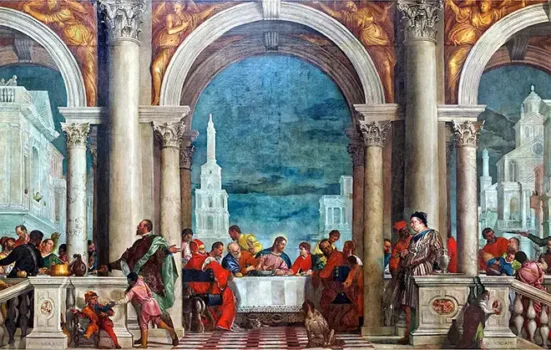
The Feast in the House of Levi is one of the most celebrated and controversial masterpieces of Italian Renaissance art. Painted in 1573 by the Venetian artist Paolo Veronese (1528–1588), the monumental canvas, measuring an astonishing 5.6 × 13 meters (18 ft × 42.6 ft), was originally commissioned as a Last Supper for the Basilica of Santi Giovanni e Paolo in Venice. Shortly after its completion, the painting became the center of an ecclesiastical inquiry due to its unconventional inclusion of buffoons, animals, soldiers, and non-biblical figures. Rather than altering the work, Veronese simply renamed it The Feast in the House of Levi, referencing a banquet scene from the Gospel of Luke.
The Feast in the House of Levi stands as one of the most ambitious and revealing works of late Renaissance Venetian painting. Monumental in scale and theatrical in composition, the painting is celebrated not only for its artistic brilliance but also for the controversy surrounding its creation. Originally conceived as a depiction of the Last Supper, the work became a defining example of how art, religion, and authority intersected during the Counter-Reformation. Through its history, reception, and layered meaning, The Feast in the House of Levi illustrates both Veronese’s creative independence and the cultural tensions of sixteenth-century Venice.
Historical Context and Creation
Paolo Veronese (1528–1588), born Paolo Caliari in Verona, was one of the leading painters of the Venetian Renaissance, alongside Titian and Tintoretto. Known for his vibrant color, grand architectural settings, and sumptuous pageantry, Veronese specialized in large-scale narrative scenes that fused sacred themes with contemporary Venetian life. By the 1570s, he was at the height of his career, frequently commissioned to decorate churches and public buildings.
The Feast in the House of Levi was commissioned in 1573 for the refectory of the Dominican monastery of Santi Giovanni e Paolo (San Zanipolo) in Venice. The painting was intended to replace an earlier Last Supper by Titian that had been destroyed in a fire. As was customary for refectories, the subject of the Last Supper carried both devotional and symbolic significance, reinforcing ideas of communal faith and discipline.
Veronese produced an immense canvas—over 18 feet high and 42 feet wide—depicting Christ seated at a long table within an elaborate architectural setting inspired by classical Roman structures. However, rather than adhering strictly to the biblical narrative, Veronese populated the scene with a multitude of figures: servants, soldiers, jesters, dwarfs, animals, and richly dressed guests. These figures, drawn from everyday Venetian life, gave the scene a festive, worldly atmosphere that departed sharply from traditional representations of the Last Supper.
The Inquisition and the Renaming of the Painting
The unconventional nature of the painting quickly attracted the attention of the Roman Catholic Inquisition, which was actively enforcing doctrinal clarity and moral decorum following the Council of Trent (1545–1563). Religious art was expected to be clear, reverent, and free from elements that could distract or confuse the faithful. Veronese’s inclusion of seemingly irreverent characters—such as drunkards, armed Germans, and comic figures—was seen as inappropriate for such a sacred subject.
In July 1573, Veronese was summoned before the Inquisition in Venice. The surviving transcript of this interrogation provides remarkable insight into artistic practice and artistic freedom during the period. When questioned about the presence of extraneous figures, Veronese defended himself by stating that painters, like poets and madmen, enjoyed creative license. He argued that such figures were included to fill the large space and to enrich the composition visually.
Rather than altering the painting by removing figures, Veronese chose a subtle yet ingenious solution: he changed the title. By renaming the work The Feast in the House of Levi, a biblical episode described in the Gospel of Luke in which Christ dines with tax collectors and sinners, the artist justified the presence of diverse and morally ambiguous characters. This strategic recontextualization satisfied the Inquisition, allowing the painting to remain intact while preserving Veronese’s artistic vision.
Reception and Critical Response
In its own time, The Feast in the House of Levi was admired for its technical mastery, opulent color, and grand scale, even as it provoked controversy. The fact that Veronese was not punished harshly reflects the relatively liberal intellectual climate of Venice compared to Rome. Venetian authorities often balanced religious conformity with civic pride in artistic achievement, and Veronese’s reputation likely protected him.
In later centuries, the painting came to be celebrated as a masterpiece of Renaissance art and as a symbol of resistance to artistic censorship. Art historians have often contrasted Veronese’s approach with that of contemporaries such as Tintoretto, whose Last Suppers are more dramatic and spiritually intense. Veronese’s work, by contrast, emphasizes harmony, splendor, and the integration of sacred narratives into the fabric of everyday life.
Modern critics and scholars view the Inquisition episode as a key moment in the history of artistic freedom. The painting’s survival in its original form has made it a powerful case study in how artists navigated institutional authority. Today, the work is housed in the Gallerie dell’Accademia in Venice, where it remains one of the museum’s most prominent attractions.
Meaning and Interpretation
At its core, The Feast in the House of Levi reflects Veronese’s belief in the compatibility of sacred themes and worldly beauty. The painting does not isolate Christ from human society but instead places him at its center. Christ appears calm and composed, subtly distinguished by his position and gesture, yet he does not dominate the scene. This understated treatment encourages viewers to contemplate the presence of the divine within the ordinary.
The architectural setting, with its grand arches and classical columns, evokes ideals of order, stability, and civic grandeur. It also mirrors Venice’s self-image as a prosperous and harmonious republic. The richly dressed figures, drawn from contemporary Venetian society, suggest that biblical events are not distant historical moments but living realities that resonate in the present.
The diversity of characters—foreign soldiers, servants, the poor, and the grotesque—reinforces the theme of inclusion implied by the subject of Levi’s feast. In this context, the presence of sinners and outsiders is not a distraction but a theological statement: Christ’s message extends beyond social and moral boundaries. What the Inquisition initially perceived as irreverence can thus be understood as a visual expression of Christian universality.
The Feast in the House of Levi occupies a unique place in the history of Western art. Its creation reveals the artistic ambitions of late Renaissance Venice, while its reception exposes the tensions between creative freedom and religious authority during the Counter-Reformation. Through its monumental scale, vibrant color, and complex iconography, the painting challenges rigid interpretations of sacred art and affirms the role of the artist as an imaginative interpreter rather than a mere illustrator of doctrine.
By transforming a moment of potential censorship into an enduring masterpiece, Veronese demonstrated both artistic ingenuity and quiet defiance. Today, The Feast in the House of Levi continues to invite viewers to reflect on the relationship between faith, society, and art, making it not only a historical document but a timeless work of cultural and spiritual significance.
Today, the painting remains one of the largest and most ambitious narrative works ever produced during the Renaissance and is housed in the Gallerie dell’Accademia, Venice, where it continues to attract scholars, art historians, and visitors from around the world.
Historical Background
In the early 1570s, Venice was a flourishing cultural and political hub. Wealth from trade and maritime prowess supported an artistic climate rich in innovation and grandeur. Venetian painters, including Titian, Tintoretto, and Veronese, were renowned for their coloristic brilliance (colorito), theatrical staging, and mastery of large-scale compositions.
In 1573, the Dominican friars of Santi Giovanni e Paolo commissioned Veronese to create a replacement for Titian’s Last Supper, which had been destroyed in a fire in 1571. The Dominicans sought an imposing, uplifting painting that reflected both religious devotion and Venetian magnificence. Veronese, already known for his sumptuous banquet scenes, agreed to design a new representation of the Last Supper that matched the church’s grand architectural interior.
Shift From Idealized Biblical Scene to Contemporary Banquet
Unlike traditional Last Suppers that emphasized solemnity, spirituality, and symbolic restraint, Veronese approached the subject with the full theatricality of Renaissance Venice. He transformed the scene into a lavish banquet populated with contemporary costumes, exotic figures, elaborate architecture, and lively interactions.
This reinterpretation set the stage for controversy, as the Counter-Reformation church was increasingly concerned about artistic decorum in religious imagery. The inclusion of “improper” characters, such as jesters, drunks, and German soldiers, caught the attention of the Holy Office of the Inquisition, initiating one of the few surviving examples of an artist directly interrogated for a painting.
Subject Matter and Narrative
After the Inquisition’s objection to its unconventional interpretation, Veronese defended the work by retitling it The Feast in the House of Levi. This new subject refers to Luke 5:29–32, where Levi (also known as Matthew, the future apostle) hosts a banquet for Christ at his home. Jesus’ presence among tax collectors and sinners prompts criticism from the Pharisees, which Jesus answers by explaining that he has come to call “not the righteous, but sinners to repentance.”
By shifting the subject from a Last Supper to this banquet, Veronese contextualized the presence of diverse social types, sinners, entertainers, foreigners, within the narrative’s moral and theological framework.
The scene is staged on an enormous open-air loggia framed by three monumental arches. Christ sits at the center of a long table, surrounded by apostles. Dynamic groups of figures occupy the foreground, creating a lively and sometimes chaotic atmosphere. Servants carry food and wine, musicians play instruments, soldiers confer, children and animals mingle among the guests, and architectural details recede into deep perspectival space.
The composition reflects not only a biblical meal but also a contemporary Venetian convivio, a grand banquet of the 16th century. This blend of sacred narrative and worldly spectacle exemplifies Veronese’s unique artistic approach.
Composition and Artistic Techniques
The imposing size of The Feast in the House of Levi required Veronese to create a carefully balanced architectural and compositional structure. The three central arches organize the visual field, directing the viewer’s attention toward Christ while accommodating more than fifty secondary figures.
The use of classical architectural motifs, Corinthian columns, balustrades, sculptural niches, draws inspiration from Venetian Renaissance architecture, including works by Andrea Palladio and Jacopo Sansovino.
Veronese was celebrated for his mastery of luminous color. The painting demonstrates his signature palette:
rich Venetian reds,
vivid blues and greens,
warm flesh tones,
gleaming whites,
and golden highlights.
These colors help differentiate figures, emphasize depth, and create a festive yet harmonious atmosphere.
Light floods the composition from the left, illuminating the central table and casting soft shadows across the architecture. This effect enhances the realism of the scene while maintaining a theatrical, almost stage-like quality.
Figures and Gestures
Veronese’s figures exhibit a range of expressive gestures, conveying lively communication and naturalistic movement. Some apostles engage in conversation or look toward Christ, while others respond to the commotion around them. Meanwhile, the foreground figures, including jesters, servants, and foreign dignitaries, enhance the narrative’s dynamism.
In keeping with Venetian artistic tradition, Veronese employed models from everyday life, clothing them in elaborate contemporary garments. Their lifelike poses contribute to the work’s dramatic realism.
Symbolism and Meaning
Despite its celebratory appearance, The Feast in the House of Levi contains layers of symbolic meaning. As in most traditional Last Supper compositions, Christ occupies the central position. His calm demeanor contrasts with the surrounding bustle, symbolizing divine authority and spiritual clarity. The three arches behind Christ are often interpreted as representing the Holy Trinity. Their classical symmetry suggests stability and sanctity amidst the lively scene.
The Dog and the Cat
Animals appear frequently in Veronese’s banquet scenes. In this work:
The dog, commonly associated with loyalty and faith, appears near the apostles.
The cat, often symbolizing independence or unpredictability, occupies the opposite side.
These animals subtly underscore themes of devotion and betrayal within the narrative framework. The presence of Germans, Moors, and other foreigners symbolizes the Church’s universal mission. Their inclusion reflects both Venice’s cosmopolitan identity and Christ’s message of accepting sinners and outsiders. These figures were criticized by the Inquisition as inappropriate for a sacred subject. Under the new title, however, they represent the diversity of individuals present at Levi’s banquet and reinforce the idea that Christ reaches all social strata.
Food and Drink
The abundance of food mirrors the traditional symbolic richness of banquet imagery:
Bread and wine reference the Eucharist.
Other foods convey prosperity, divine generosity, and communal fellowship.
Clothing and Colors
Veronese’s luxurious textiles express wealth, but also serve symbolic purposes:
Red can signify martyrdom or divine love.
Blue represents heavenly grace.
Green suggests renewal and hope.
The Inquisition and the Renaming of the Painting
The Ecclesiastical Investigation
Shortly after completion, the painting came to the attention of the Holy Office of the Inquisition. The Counter-Reformation church sought religious art that upheld decorum and theological clarity, as outlined by the Council of Trent (1545–1563). Veronese’s extravagant inclusion of non-biblical subjects was viewed as potentially disrespectful.
The Inquisition summoned Veronese in July 1573. The surviving transcript provides one of the rare documented instances of an artist defending the content of a painting before ecclesiastical authorities. Veronese explained that artists enjoy a degree of creative freedom, comparing his practice to that of poets and madmen. He argued that the painting’s additional characters were included for compositional balance and to fill the large space, not to convey irreverence. When asked about buffoons, drunkards, armed soldiers, and dwarfs, Veronese maintained they were part of everyday Venetian life and added to the painting’s richness.
Though the Inquisition insisted on modifications, Veronese avoided altering the painting by changing the subject instead of the content. By renaming it The Feast in the House of Levi, he aligned the scene with a biblical episode that accommodated a diverse crowd. This episode underscores the evolving tensions between artistic freedom and religious authority during the late Renaissance.
How the Painting Was Made
Materials and Preparation
Veronese painted The Feast in the House of Levi using oil on canvas, the preferred medium of Venetian artists. Venice’s humid climate made canvas more durable than wood panels, and its flexibility allowed for monumental works.
He likely prepared the surface with a light ground layer, enabling his characteristic luminous colors to shine through. Given the immense size of the canvas, Veronese worked with assistants in his workshop. They would have helped prepare the canvas, block out large areas of architecture, and render secondary figures under the master’s supervision. However, Veronese personally handled the key elements, Christ, the apostles, and many principal figures, ensuring the work maintained his distinctive style.
Techniques
Veronese employed the following techniques:
layering transparent glazes to achieve rich color depth;
wet-on-wet blending for soft transitions in flesh tones;
precise architectural perspective using vanishing points and measured grids;
rapid, confident brushwork in textiles and decorative details.
Completion
Despite its size and complexity, the painting was completed within the same year it was commissioned, demonstrating both Veronese’s efficiency and the well-organized structure of his workshop.
Interpretation and Analysis
A Celebration of Venetian Culture
Although based on a biblical story, the painting also serves as a vibrant display of Venetian civic identity. It reflects:
cosmopolitan trade connections,
multicultural society,
wealth and prosperity,
love of pageantry and spectacle.
By presenting Christ among a wide array of social types, Veronese subtly communicates the inclusivity of Christian salvation, an appropriate theme for the Gospel story of Levi’s conversion. The painting exemplifies the complex relationship between sacred art and secular aesthetics during the Renaissance. While intended for a religious setting, its theatricality and luxuriousness border on the secular, challenging viewers to reconcile spiritual themes with worldly splendor.
Experts praise Veronese’s ability to organize a crowded scene without losing clarity. The architectural framework provides order, while color harmonies guide the eye from foreground to center. The painting influenced generations of artists, particularly in its handling of large-scale narrative scenes. Its blend of architecture, color, and human drama became a model for Baroque spectacle and contributed to the evolution of history painting in Europe.
The Feast in the House of Levi is currently housed in the Gallerie dell’Accademia in Venice, Italy. It occupies a massive wall within the museum, where its size and rich detail can be appreciated at close range.
The painting has undergone conservation treatments to preserve its colors and stability, ensuring its continued display as one of the museum’s most important works.
Paolo Veronese’s The Feast in the House of Levi endures not only as a monumental example of late Renaissance artistry but also as a testament to the dialogue between artistic creativity and institutional authority. Its stunning colors, architectural grandeur, and lively human drama make it a masterpiece that transcends its historical moment. Today, it stands as an emblem of Venetian cultural identity, religious storytelling, and the enduring power of visual art.