The Judgment of Cambyses Painting: A Guide for Antique Art Collectors
The Judgment of Cambyses by Gerard David is one of the most striking works of Northern Renaissance art, visually powerful, morally charged, and artistically ambitious. Painted in 1488 for the city of Bruges, this two-panel masterpiece continues to fascinate collectors, scholars, and curators for its rich symbolism, uncompromising detail, and disturbing depiction of justice carried out in the ancient world. For collectors of antique art, understanding its background is essential not only for cultural literacy but also for assessing the value and rarity of comparable works from the era.
Below is a comprehensive, collector-oriented exploration of the painting’s origins, meaning, composition, controversy, critical reception, symbolism, and place in today’s art world.
Gerard David: A Flemish Master in Transition
Gerard David (c. 1460–1523) was among the last great painters of the Early Netherlandish tradition. His style bridged the gap between artists such as Rogier van der Weyden and the emerging 16th-century painters influenced by the Italian Renaissance. David worked primarily in Bruges, a wealthy and culturally powerful city-state at the time.
His signature characteristics, delicate modeling, luminous color, meticulous detail, and psychological intensity, are central to The Judgment of Cambyses and help explain its lasting influence.
Commission and Purpose
In 1488, the city magistrates of Bruges commissioned David to create a monumental diptych for the town hall. The purpose was explicitly civic, not religious:
The painting was intended to remind judges and city officials of their duty to uphold justice.
It was displayed prominently in the courtroom where legal decisions were made.
The story, taken from Herodotus, served as a vivid warning: corruption would be punished severely.
This context makes the work one of the earliest large-scale European paintings created specifically for secular government use, a rarity of enormous historical value.
The Story from Herodotus
Herodotus recounts that Sisamnes, a corrupt Persian judge under King Cambyses II, accepted a bribe and rendered an unfair verdict. In response, the king had him flayed alive and then appointed the judge’s own son to succeed him, seating him on a chair upholstered with his father’s skin.
The brutality of the tale is not gratuitous, Herodotus used it as a lesson in ideal governance, and the Bruges magistrates adopted it for similar reasons.
What Is Happening in the Painting? A Panel-by-Panel Breakdown
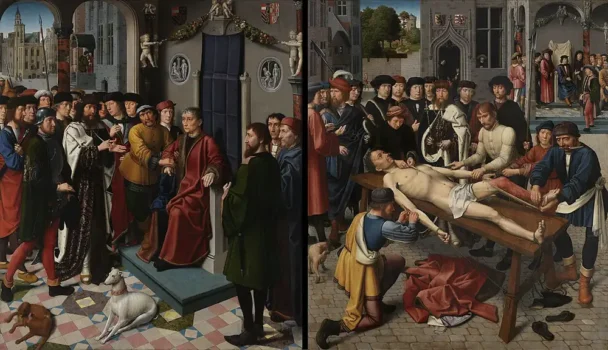
Gerard David structured the work as a diptych: a left panel showing the arrest and flaying of Sisamnes, and a right panel depicting the sentencing of his son.
Left Panel: The Arrest and Execution of Sisamnes
This scene is notoriously graphic, embodying the Flemish taste for realistic anatomy and explicit moralizing.
Key elements include:
Sisamnes bound and being flayed alive
Assistants methodically peel his skin while he writhes in agony, capturing both the physical cruelty and moral severity of ancient justice.King Cambyses presiding over the punishment
Cambyses stands as a symbol of authority and impervious justice, dressed in richly detailed Persian-inspired robes.Surrounding figures
Courtiers, soldiers, and officials watch the execution calmly. Their expressions range from stern approval to detached observance, reinforcing the gravity of judicial wrongdoing.Cityscape and Architectural Detail
David sets the scene in a Flemish-looking environment, not ancient Persia. This anachronism was deliberate, making the warning relatable to contemporary Bruges officials.
Right Panel: The Sentencing of the Son
The second panel portrays the aftermath.
Sisamnes’ son seated on the “Chair of Skin”
In a chilling continuation, the son administers justice on a judge’s seat upholstered with the preserved skin of his father. The message is clear: justice is inescapable and corruption carries generational consequences.Cambyses instructing the new judge
The king gestures emphatically, emphasizing the moral lesson. David captures his expression with a mixture of severity and solemn responsibility.Interior Setting
The architectural interior, arched windows, carved wood, tapestries, resembles a European court, grounding the story once again in the civic environment of the painting’s commissioners.
Symbolism and Deeper Meaning
1. Justice as an uncompromising force
The most prominent symbolic message is the oath of moral responsibility, a warning to officials that justice must be impartial. It served as:
A deterrent against bribery
A visual oath of office
A reminder of civic duty
A moral compass for public life
2. The Skin as a Metaphor
Sisamnes’ flayed skin is both literal and symbolic:
The removal of the skin symbolizes the exposure of corruption.
Upholstering the judge’s chair suggests justice must be built upon the lessons of past transgressions.
The physical transformation of skin into civic furniture connects morality to governance.
3. Father and Son
The succession of the son is a reminder that virtue is not inherited but practiced. It reflects the Renaissance belief in human responsibility and moral choice.
4. Clothing and Setting
The European clothing, rather than Persian garb, turns a foreign historical anecdote into a local political message. David intentionally blurred historical accuracy to maximize visual impact on Bruges officials.
5. Spectators
Each observer in the painting serves as a stand-in for:
Judges
Bureaucrats
Council members
Citizens
Their presence reinforces the community’s role in maintaining justice.
Artistic Techniques: Why Collectors Value David’s Work
1. Northern Renaissance Realism
David’s attention to texture, fabric, skin, metal, architecture, represents the peak of Flemish realism. His method included:
Layered oil glazes
Fine brushwork
Balanced tonality
These techniques give the diptych its luminous, almost sculptural quality.
2. Emotional Expression
Rather than depicting gore simply for shock value, David uses expression and body language to convey moral tension. Sisamnes’ suffering is humanized but not romanticized.
3. Composition
The two-panel format enhances narrative clarity. The left panel shows punishment; the right displays the moral consequence. This structure makes the diptych function like a visual “before and after.”
4. Dramatic Naturalism
David’s precise rendering of the human body, muscle tension, skin folds, gestures, demonstrates his mastery of human anatomy, rare among Northern painters at the time.
5. Legal and Civic Iconography
Collectors specializing in government-commissioned Renaissance works find this painting noteworthy for its direct connection to legal history. Few surviving artworks so clearly depict civic jurisdiction and judicial responsibility.
Controversy Over the Painting
Even during the Renaissance, the work was not universally praised. Its graphic nature sparked debate throughout history.
1. Early Reactions
Some contemporaries considered the painting too brutal for civic environment. However, Bruges officials defended its moral clarity.
2. Later Criticism (18th–19th century)
During the Enlightenment and Victorian eras, tastes shifted:
Some critics saw the flaying as barbaric.
Others considered it an outdated form of moral instruction.
Protestant reformers sometimes rejected it as incompatible with Christian charity.
3. Modern Interpretations
Current art historical debate revolves around:
Whether the brutality is justified as moral allegory
How the work reflects medieval governance versus Renaissance humanism
The role of violence in civic art
Some scholars view it as an early form of “political propaganda,” while others defend it as a legitimate didactic tool.
4. Sensitivity in Exhibitions
Today, museums sometimes display warnings due to the graphic content. However, the painting is considered too historically important to censor or remove from public view.
Reception and Critical Evaluation
1. Scholarly Reception
Art historians praise The Judgment of Cambyses for:
Its narrative composition
Artistic technique
Historical context
Civic function
Gerard David is frequently cited in academic literature for his ability to merge moral instruction with technical brilliance.
2. Influence on Later Artists
The diptych inspired:
Netherlandish civic art traditions
Depictions of legal allegories
Renaissance cycles on justice and governance
Though few painters imitated its explicit violence, many adopted its narrative clarity and moral directness.
3. Collector Interest
Collectors of Renaissance and Early Netherlandish art view David’s work as:
Technically masterful
Historically significant
Rare (few works survive with clear civic commissioning history)
Because the painting itself is not for sale, interest often shifts to related works, drawings, contemporary engravings, workshop pieces, or thematically similar civic art.
Current Location
Today, The Judgment of Cambyses is housed in:
**Groeningemuseum, Bruges, Belgium
It remains one of the museum’s most visited and studied works. The painting is well preserved and displayed with contextual information about its civic role in the medieval city hall.
The original location was the Bruges City Hall courtroom, where it hung for centuries until its eventual transfer to the museum for conservation purposes.
Market Value and Price Considerations for Collectors
The painting itself is not on the market and is considered priceless, a protected heritage artwork belonging to the city of Bruges.
However, collectors often ask how one might evaluate comparable pieces.
1. Gerard David’s Works at Auction
David’s surviving works are extremely rare. When they appear, prices vary widely depending on:
Provenance
Condition
Attribution strength (autograph vs. workshop)
Subject matter
Size
Panel vs. drawing
Paintings firmly attributed to Gerard David have historically sold in the range of $4 million to over $10 million, though this varies greatly.
Small devotional panels attributed to his workshop often sell for $200,000–$1 million.
2. Related Works (Engravings & Drawings)
Prints or engravings inspired by The Judgment of Cambyses or Herodotean themes from the 16th–17th century can range from $5,000 to $75,000 depending on rarity.
3. Influence on Collector Trends
Many collectors seek:
Civic-legal allegory paintings
Flemish Renaissance moral narratives
Works by David’s contemporaries (Memling, van der Weyden, Bosch)
Though you cannot purchase The Judgment of Cambyses, its existence increases interest in the broader category of Flemish civic-commission artwork, boosting market value for pieces from similar contexts.
Why This Painting Still Matters Today
For antique art collectors, The Judgment of Cambyses stands out for several reasons:
1. Historical significance
It is a rare example of purely civic Renaissance art with a documented commission and a didactic legal purpose.
2. Extreme craftsmanship
The diptych represents the pinnacle of Flemish technical achievement.
3. Cultural relevance
Its themes, judicial ethics, corruption, the role of government, remain strikingly modern.
4. Scarcity
Gerard David’s major works are few; none have the scale or civic authority of this diptych.
5. Research value
Collectors who own related works benefit from the ongoing scholarly attention surrounding David.
The Judgment of Cambyses by Gerard David is more than a moral tale from Herodotus: it is one of the most complex and culturally important works of the Northern Renaissance. Its graphic imagery continues to provoke debate, but its purpose, as a visual manifesto of justice, remains clear. For antique art collectors, understanding this painting enhances appreciation of Flemish civic art, informs acquisition of related works, and deepens knowledge of the Renaissance as a period where morality, politics, and artistic mastery converged.
Whether you approach the painting for its historical value, its symbolism, its controversy, or its technical beauty, it stands as one of the most unforgettable expressions of justice ever committed to panel.
If you need a shorter version, SEO-optimized keywords, or a version formatted for WordPress, I can prepare that next.