Mystery, Faith, and Genius: Inside the Ghent Altarpiece
The Ghent Altarpiece, officially titled The Adoration of the Mystic Lamb, is widely regarded as one of the foundational masterpieces of Western art. Completed in 1432 for St. Bavo’s Cathedral in Ghent, Belgium, the monumental polyptych was created by the brothers Hubert and Jan van Eyck and represents a defining achievement of Early Netherlandish painting. Renowned for its technical innovation, theological complexity, and extraordinary state of preservation, the altarpiece has played a central role in the history of European art for nearly six centuries.
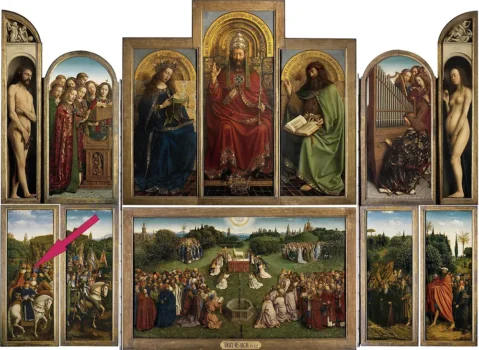
The work consists of 12 panels arranged on two levels, with additional panels painted on the reverse, allowing the altarpiece to be opened and closed according to the liturgical calendar. When closed, the exterior presents a restrained palette and sober tone, depicting the Annunciation, donor portraits, and figures painted in grisaille to resemble sculpture. When opened, the interior reveals a vivid, expansive vision of salvation history centered on the worship of the Mystic Lamb, an image derived from the Book of Revelation symbolizing Christ’s sacrificial redemption of humanity.
At the heart of the open altarpiece is the central lower panel, The Adoration of the Mystic Lamb, which shows crowds of saints, prophets, martyrs, and pilgrims converging on an altar where the Lamb stands, bleeding into a chalice. Above this scene, a majestic enthroned figure, interpreted variously as God the Father or Christ the King, is flanked by the Virgin Mary and Saint John the Baptist, forming a celestial court. Surrounding panels depict angels, Adam and Eve, and groups representing the righteous, the apostles, and the defenders of the faith. Together, the panels form a comprehensive visual theology that integrates Old and New Testament imagery into a unified narrative of divine redemption.
One of the altarpiece’s most significant contributions to art history is its unprecedented realism and technical sophistication. Jan van Eyck, in particular, is credited with advancing oil painting techniques to a level of precision and luminosity previously unseen. The panels display meticulous attention to texture, light, and detail: jewels sparkle with convincing depth, fabrics appear tactile, and landscapes recede into atmospheric distance. Human figures are individualized, with distinct facial features and emotional presence, marking a decisive break from the more stylized forms of medieval art.
Beyond its artistic innovations, the Ghent Altarpiece is also notable for its intellectual ambition. The iconography is dense and multilayered, reflecting the theological scholarship of the fifteenth century. Latin inscriptions, symbolic gestures, and carefully orchestrated compositions reward close study and suggest that the work was intended not merely for aesthetic appreciation but for meditation and doctrinal instruction. The altarpiece thus functioned as both a visual sermon and a statement of faith, aligned with the devotional practices of the late medieval church.
The history of the Ghent Altarpiece is almost as remarkable as the work itself. Over the centuries, it has been threatened by iconoclasts during the Protestant Reformation, dismembered and sold during the Napoleonic era, hidden to protect it during both World Wars, and repeatedly targeted by thieves. Portions of the altarpiece were seized by Nazi forces during World War II and later recovered by Allied troops in a salt mine in Austria. These dramatic episodes have contributed to the altarpiece’s reputation as one of the most “traveled” and imperiled artworks in history.
Conservation has been an ongoing concern, given the altarpiece’s age and turbulent past. Modern restoration campaigns, particularly those undertaken in the twenty-first century, have revealed the brilliance of the original colors and the subtlety of van Eyck’s technique, much of which had been obscured by later overpainting and varnish. These efforts have also deepened scholarly understanding of the artists’ methods and the original appearance of the panels.
Today, the Ghent Altarpiece is regarded not only as a pinnacle of Early Netherlandish art but as a cornerstone of Western visual culture. It stands at the threshold between medieval symbolism and Renaissance naturalism, embodying a moment when artistic technique, religious devotion, and intellectual inquiry converged with extraordinary force. Displayed once again in St. Bavo’s Cathedral, the altarpiece continues to inspire awe, scholarship, and debate, affirming its enduring significance as one of humanity’s greatest artistic achievements.
The Unsolved Mystery of the Stolen “Ghent Altarpiece” Panels
The Ghent Altarpiece, also known as the Adoration of the Mystic Lamb, is one of the most celebrated works of European art. Created in the 15th century by brothers Hubert and Jan van Eyck, it is not just admired for its technical mastery but also shrouded in intrigue. Few paintings in history have been the subject of as much fascination, theft, and mystery as the Ghent Altarpiece.
From Nazi looting during World War II to the still-unsolved disappearance of one of its panels, the altarpiece has a history that reads more like a detective novel than an art history lecture. In this article, we’ll dive into the unsolved mystery of the stolen panels, why the Ghent Altarpiece is considered such an enigma, what makes it so special, common misconceptions, public opinions, and where it resides today.
Why is the Ghent Altarpiece a Mystery?
The Ghent Altarpiece is mysterious not only for its artistic symbolism but also for its turbulent history. Since its unveiling in 1432 in Saint Bavo’s Cathedral in Ghent, Belgium, the masterpiece has been stolen, hidden, sold, dismantled, and recovered numerous times. The most puzzling element of its story, however, is the theft of one particular panel: “The Just Judges.”
On the night of April 10, 1934, two panels of the altarpiece were stolen from Saint Bavo’s Cathedral. One was later returned under mysterious circumstances, but the second, “The Just Judges,” vanished without a trace. Despite decades of investigations, international searches, and countless theories, the missing panel has never been recovered.
This unsolved disappearance continues to captivate historians, art detectives, and the general public. Some believe it was destroyed, while others are convinced it remains hidden somewhere in Belgium or beyond. Its absence leaves the masterpiece forever incomplete,and the mystery alive.
What is So Special About the Ghent Altarpiece?
Art historians often describe the Ghent Altarpiece as one of the most influential and important paintings ever made. Here’s why:
1. Revolutionary Use of Oil Paint
Jan van Eyck is often credited as one of the pioneers of oil painting. The Ghent Altarpiece showcases the medium’s potential for luminous color, fine detail, and realistic textures. From the gleam of jewels to the shimmer of angelic wings, the level of precision was unprecedented for its time.
2. Scale and Complexity
The altarpiece is a polyptych,a large, multi-panel work. When opened, it measures about 11.5 feet tall and 15 feet wide. Its scale alone made it extraordinary, but the complexity of its design, with multiple scenes and hundreds of figures, elevated it into a category of its own.
3. Theological Symbolism
The central panel, the “Adoration of the Mystic Lamb,” depicts Christ as a sacrificial lamb on an altar, symbolizing salvation. Surrounding panels show prophets, apostles, saints, angels, and historical figures converging on the lamb. The painting is a grand meditation on redemption and the divine.
4. Realism and Human Emotion
Unlike many medieval religious works, the Ghent Altarpiece brings a lifelike humanity to its figures. Faces show genuine emotion, garments are richly textured, and landscapes stretch into believable horizons. This realism was groundbreaking and helped usher in the Northern Renaissance.
5. A Survivor of Wars and Theft
The Ghent Altarpiece has survived more thefts than perhaps any other artwork in history. Napoleon looted it, Nazis targeted it, and individuals have attempted to steal it. Each time, the painting’s survival only enhanced its reputation as a priceless treasure.
Which is Not True of the Ghent Altarpiece?
There are many misconceptions surrounding the Ghent Altarpiece, and separating fact from myth is essential for anyone researching it. Let’s clear up some common misunderstandings:
It was painted solely by Jan van Eyck.
While Jan van Eyck is often credited, his older brother Hubert van Eyck is believed to have started the work. Jan completed it after Hubert’s death.The missing panel was destroyed in World War II.
Although some speculate this, no evidence confirms it. Many historians believe “The Just Judges” panel still exists, hidden somewhere.It has never left Ghent.
In reality, parts of the altarpiece were sold, stolen, and moved across Europe, including France and Germany.It is a single painting.
The Ghent Altarpiece is not one painting but a polyptych made up of 12 panels that open and close to reveal different scenes.
These clarifications are vital because misinformation often clouds the already mysterious aura surrounding the masterpiece.
The Stolen Panels: The Heart of the Mystery
The theft of 1934 remains one of the greatest unsolved art crimes in history. Here’s a closer look at what happened:
The Crime: On April 10, 1934, thieves removed two panels: “The Just Judges” and “Saint John the Baptist.”
The Ransom Note: The thieves left a ransom note demanding one million Belgian francs. The Bishop of Ghent refused to pay.
The Return of One Panel: In May 1934, “Saint John the Baptist” was mysteriously returned, left at the door of a Brussels railway station.
The Confession: A stockbroker named Arsène Goedertier confessed on his deathbed that he alone knew where “The Just Judges” was hidden. He died before revealing the location.
Since then, countless searches, excavations, and investigations have taken place, but the missing panel has never resurfaced.
Peoples’ Opinions About the Ghent Altarpiece
Public opinion about the Ghent Altarpiece varies, but admiration is nearly universal. Here are some common perspectives:
1. Art Historians and Scholars
Experts hail it as a turning point in Western art. Many consider it as important as the Mona Lisa or The Last Supper. Scholars emphasize its influence on generations of painters, particularly in Northern Europe.
2. Belgians and Local Pride
For the people of Ghent and Belgium, the altarpiece is more than just a painting,it is a national treasure. It symbolizes resilience, having survived centuries of turmoil, and its mystery adds to its cultural identity.
3. Tourists and Casual Viewers
Visitors are often struck by its scale and detail. Many express awe at the realism achieved nearly 600 years ago. Tourists also find the story of its thefts and survival thrilling, making it more than just an art object but a living mystery.
4. Conspiracy Theorists
Some believe the missing panel is hidden in secret vaults, monasteries, or even buried beneath Ghent. These theories keep public interest alive and turn the altarpiece into an endless source of speculation.
Where is the Ghent Altarpiece Now?
Today, the Ghent Altarpiece resides in Saint Bavo’s Cathedral in Ghent, Belgium, where it was originally installed in 1432. To protect it from theft and damage, it is now displayed inside a state-of-the-art glass enclosure with climate control and security systems.
The missing panel, “The Just Judges,” remains absent. In its place is a modern copy painted by Jef Van der Veken in 1945, which allows visitors to see the altarpiece in its entirety.
Recent conservation efforts, completed in phases from 2012 to 2020, restored the masterpiece to much of its original glory, revealing brighter colors and hidden details that had been obscured by centuries of overpainting and dirt.
The Enduring Legacy of the Mystery
The story of the Ghent Altarpiece is more than an art history lesson,it’s a tale of resilience, intrigue, and enduring mystery. Every generation rediscovers it, not only for its beauty but also for its puzzles:
Who stole “The Just Judges” in 1934?
Where is the missing panel today?
Will it ever be recovered, or is it lost forever?
Until these questions are answered, the Ghent Altarpiece will remain both a masterpiece of the Northern Renaissance and one of the world’s greatest unsolved mysteries.
The Ghent Altarpiece stands at the crossroads of art, religion, and mystery. Its extraordinary artistic qualities make it a cornerstone of Renaissance painting, while its turbulent history ensures it will never fade from public fascination.
The unsolved theft of “The Just Judges” panel adds a layer of intrigue that keeps historians, detectives, and everyday admirers engaged. While some aspects of its story may be clouded by myths, what remains certain is its significance: a masterpiece that changed art forever, survived centuries of conflict, and continues to inspire awe.
Today, as it rests once again in Saint Bavo’s Cathedral, the Ghent Altarpiece is not only a treasure of Belgium but of the entire world. Whether the missing panel is ever recovered or not, its legacy as both an artistic triumph and a mystery without end is secure.