The Timeless Beauty of Rubens’ The Three Graces
Peter Paul Rubens’ The Three Graces (1630–1635) stands as one of the most celebrated and emblematic works of the Baroque period. Painted toward the end of Rubens’ life, the work encapsulates his mature artistic vision and serves as a powerful synthesis of classical mythology, Renaissance ideals, and Baroque dynamism. Today housed in the Museo del Prado in Madrid, The Three Graces remains a defining representation of Rubens’ approach to beauty, movement, and human sensuality.
The subject of The Three Graces derives from classical mythology. The Graces—Aglaea, Euphrosyne, and Thalia—were minor goddesses associated with beauty, charm, joy, fertility, and abundance. Traditionally, they were depicted as attendants of Aphrodite (Venus) and symbolized the harmonious balance of generosity, pleasure, and grace that underpinned classical ideals of beauty and social order.
In art, the Three Graces were often portrayed nude, standing closely together, emphasizing unity and reciprocity. Rubens adheres to this iconographic tradition but expands it through his distinct Baroque sensibility. Rather than presenting idealized, ethereal figures, Rubens imbues the Graces with corporeal vitality, warmth, and tangible physical presence, transforming mythological abstraction into lived, sensuous reality.
The Three Graces Composition and Visual Structure
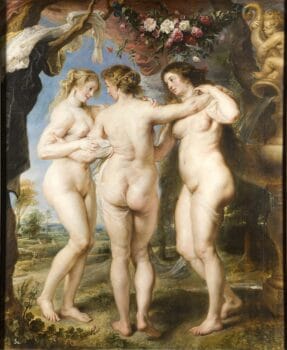
Rubens’ composition is carefully balanced yet animated. The three female figures are arranged in a loose circular formation, their intertwined arms and overlapping bodies creating a continuous flow of movement. This circularity encourages the viewer’s eye to move rhythmically across the canvas, reinforcing the sense of harmony and unity that the Graces embody.
The central figure faces the viewer, while the two flanking figures turn inward, creating both visual variety and compositional cohesion. This arrangement, often referred to as the “Graces pose,” had been used by earlier artists, including Raphael, but Rubens reinterprets it with greater physicality and emotional immediacy. The figures appear engaged with one another rather than performing for the viewer, lending the scene an intimate, almost private quality.
Use of Color, Light, and Texture
Rubens’ mastery of color and light is a defining feature of the painting. The flesh tones are warm, luminous, and richly modulated, achieved through layers of translucent glazes. These tones contrast gently with the darker, natural background, allowing the figures to emerge vividly from their surroundings.
Light plays a crucial role in shaping the bodies, accentuating curves, softness, and volume. Rather than dramatic chiaroscuro, Rubens employs a diffused, enveloping light that enhances sensuality and emphasizes the tactile qualities of skin. This treatment underscores the Baroque emphasis on realism and sensory engagement, inviting the viewer to experience the figures as physically present.
Texture is equally important. Rubens renders skin, hair, fabric, and foliage with remarkable sensitivity, demonstrating his technical virtuosity. The subtle variations in surface contribute to the overall sense of abundance and vitality that defines the painting.
Rubens’ Ideal of Beauty
One of the most discussed aspects of The Three Graces is its embodiment of Rubens’ ideal of feminine beauty. The figures are voluptuous, full-bodied, and unapologetically sensual. In contrast to later neoclassical ideals of restraint and linear perfection, Rubens celebrates softness, fertility, and naturalism.
This ideal was informed by multiple influences: classical sculpture, Renaissance masters such as Titian, and Rubens’ own personal preferences. Notably, scholars often observe that the figures resemble Rubens’ second wife, Hélène Fourment, whom he married in 1630. This personal dimension lends the painting an additional layer of intimacy and suggests that the work may reflect Rubens’ private appreciation of love, marriage, and physical beauty rather than a purely academic exercise in mythological painting.
Beyond their mythological identity, the Graces function symbolically as embodiments of harmony, generosity, and the cyclical nature of giving and receiving. Their nudity, far from being merely erotic, symbolizes truth, naturalness, and the absence of artifice.
The surrounding natural elements—lush vegetation, flowing water, and open sky—reinforce themes of fertility and abundance. Together, these symbols align the painting with broader Baroque concerns, particularly the celebration of life, sensual experience, and the interconnectedness of humanity and nature.
Place Within Rubens’ Career
The Three Graces was painted late in Rubens’ career, during a period when he was increasingly selective about commissions and often painted for personal enjoyment. Unlike many of his large-scale altarpieces and political allegories, this work was not created for a specific patron. This autonomy allowed Rubens to work with exceptional freedom, resulting in a composition that feels both confident and deeply personal.
The painting reflects the culmination of Rubens’ lifelong engagement with classical antiquity, Renaissance humanism, and Baroque innovation. It demonstrates his ability to synthesize these influences into a cohesive visual language that is immediately recognizable and profoundly influential.
The Three Graces Legacy and Influence
The impact of The Three Graces extends far beyond Rubens’ lifetime. The painting has shaped subsequent representations of the female nude and has influenced generations of artists who grappled with questions of beauty, realism, and sensuality. While later periods sometimes criticized Rubens’ figures as excessive or overly indulgent, modern scholarship increasingly recognizes the work as a sophisticated exploration of form, movement, and meaning.
Today, The Three Graces is widely regarded as a masterpiece of Western art. It exemplifies the Baroque ideal of engaging the viewer emotionally and sensorially, while also demonstrating a deep intellectual engagement with classical tradition.
Peter Paul Rubens’ The Three Graces is more than a mythological scene; it is a profound statement on beauty, humanity, and artistic freedom. Through its dynamic composition, luminous color, and sensuous realism, the painting captures the essence of Rubens’ artistic philosophy. As a culmination of his mature style, it remains a vital work for understanding both the Baroque period and the enduring power of classical myth reimagined through a deeply personal and expressive lens.
Meaning of The Three Graces Painting
Amid the great tides of Baroque art and the golden legacy of 17th-century European painting, Peter Paul Rubens stands as a master whose brush gave life to myth, sensuality, and divine beauty. Among his many celebrated masterpieces, “The Three Graces”, completed between 1635–1639, remains one of the most iconic representations of classical femininity and mythological harmony ever painted. Now housed in the Museo del Prado in Madrid, this painting is more than just an aesthetic marvel, it is a rich tapestry of symbolism, cultural ideals, personal expression, and Renaissance inspiration.
This story dives deep into the meaning, artistic elements, historical background, and symbolism embedded in Rubens’ “The Three Graces”, exploring why this painting continues to captivate audiences nearly 400 years after its creation.
Who Was Peter Paul Rubens?
To understand “The Three Graces,” one must first understand its creator. Peter Paul Rubens (1577–1640) was a Flemish artist of extraordinary talent, revered during his lifetime for his dynamic, exuberant style and his intellectual depth. A master of the Baroque style, Rubens infused his paintings with movement, drama, and sensual energy, drawing from the legacies of the Italian Renaissance, especially the works of Titian, Michelangelo, and Raphael.
Rubens wasn’t just a painter; he was also a diplomat, humanist, and scholar, fluent in several languages and highly respected in both political and artistic circles. His studio in Antwerp was one of the most productive in Europe, often working with apprentices and assistants to fulfill commissions across the continent. Despite his public success, Rubens’ art was also deeply personal, and “The Three Graces” offers a glimpse into that intimacy.
The Creation of The Three Graces
Painted between 1635 and 1639, during the final years of Rubens’ life, “The Three Graces” was likely intended not as a commissioned work but as a private painting for Rubens’ own collection. This is evident in the intimacy of its style and the warmth of its composition. It is believed Rubens kept the painting in his home, displaying it as a cherished reflection of beauty and harmony.
Oil on panel, the painting measures 221 cm × 181 cm (approximately 87 in × 71 in). It depicts three nude women, mythological daughters of Zeus, set against a lush and serene natural background. These are Euphrosyne (joy), Aglaea (splendor), and Thalia (good cheer), collectively known in Greek and Roman mythology as The Three Graces.
What Is The Three Graces All About?
At its surface, “The Three Graces” appears to be a celebration of feminine beauty and sensuality. But like most mythologically themed Baroque artworks, it offers layers of deeper meaning. In classical mythology, the Three Graces were often associated with love, beauty, fertility, and joy, serving as attendants to Venus, the goddess of love.
In Rubens’ interpretation, the Graces represent more than allegorical figures, they embody the ideals of natural, earthly beauty. Each figure exudes a distinct presence while remaining united in their gentle connection. Their poses form a continuous, circular motion, creating an unbroken chain of harmony and intimacy.
Unlike other idealized Renaissance versions of the Graces (e.g., Botticelli’s or Raphael’s), Rubens’ Graces are voluptuous and realistic, not ethereal or overly stylized. Their soft curves, warm skin tones, and the tactile quality of their flesh highlight Rubens’ unique aesthetic: the celebration of the natural female form, unashamed and full of life.
Symbolism and Allegorical Meaning
Rubens was steeped in classical knowledge, and “The Three Graces” is rich in symbolism that reflects not only mythology but also philosophical and artistic ideals.
1. Triadic Harmony
The number three has long been symbolic in art, religion, and mythology, representing balance, unity, and completeness. In “The Three Graces,” Rubens arranges the women in a circular composition that reflects eternal unity and continuity, emphasizing the cyclical nature of beauty, joy, and creation.
2. Embodiment of Humanist Ideals
Each Grace is individual yet united in purpose, a concept rooted in Renaissance humanism, where harmony among different elements was seen as an ideal of perfection. Rubens’ portrayal is both sensual and spiritual, uniting the earthly pleasures of the flesh with the divine beauty of the soul.
3. Celebration of Fertility and Femininity
The full-figured nudity of the women is not erotic in a modern sense, but rather celebratory, of fertility, maternity, and the life-giving nature of womanhood. Rubens, who had recently remarried the much younger Hélène Fourment, is thought to have modeled one or more of the Graces on her. Hélène, with whom Rubens had children, was a symbol of youthful vitality and sensual love in his later works.
4. Connection with Nature
The Graces are surrounded by a lush, idyllic landscape, suggesting their closeness to nature, purity, and innocence. This reinforces the idea that beauty, joy, and goodness are natural forces, inherently part of the world rather than supernatural abstractions.
What Is Happening in the Painting?
At first glance, the scene appears still, even serene, but upon closer observation, a gentle dance unfolds. The three figures are engaged in a timeless, sacred ritual of beauty and intimacy.
Two of the Graces face outward, toward the viewer, while the central figure shows her back. Their arms intertwine, hands gently clasping, suggesting not only sisterly affection but also the continuous flow of grace between them. There is no external narrative or action; instead, the focus is entirely on their form, gesture, and unity.
This composition draws from classical sculptures and paintings, particularly Roman sarcophagi and Pompeian frescoes, where the Graces often appeared in similar poses. Rubens updates this with his unique touch: lush texture, lifelike presence, and glowing flesh tones that breathe life into these mythic figures.
High Baroque and Rubenesque Beauty
“The Three Graces” is a quintessential example of High Baroque art, characterized by dramatic realism, rich color palettes, and dynamic composition. Yet it is also intensely personal, setting it apart from the grandeur and theatricality typical of Baroque history painting.
Rubens’ unique contribution to Western art was the “Rubenesque” style, a celebration of fuller, sensuous bodies, expressive movement, and radiant color. In “The Three Graces,” this style is evident in:
The glowing, pearlescent skin tones, carefully modeled with subtle gradations of light and shadow.
The soft, dimpled flesh, conveying warmth, touch, and humanity.
The natural poses, free of stiffness, expressing ease and gentle sensuality.
Through these techniques, Rubens elevates the nude from mere anatomical study to a celebration of life itself.
Comparison to Other Versions
Rubens was known to revisit and reinterpret themes throughout his life. The theme of the Three Graces appears in several of his works, but the Prado version is considered the most mature, personal, and accomplished.
Unlike the earlier depictions, which were often more stylized and constrained by commission requirements, this painting flows with personal emotion and artistic freedom. It reflects not just classical beauty but Rubens’ own emotional world, particularly his joy in his second marriage and his appreciation of domestic harmony.
Current Location of The Three Graces Painting
Today, “The Three Graces” is part of the permanent collection of the Museo del Prado in Madrid, Spain. It arrived there in the early 19th century after being acquired by the Spanish monarchy. In 1836, it became part of the Prado’s royal collection, where it has since been one of the museum’s most beloved pieces.
The Prado houses several other Rubens works, but “The Three Graces” holds a special place, both for its beauty and for its deep connection to classical and humanist traditions.
Why The Three Graces Still Matters
In today’s world, dominated by modern aesthetics, digital media, and evolving beauty standards, Rubens’ “The Three Graces” continues to provoke dialogue about the meaning of beauty, femininity, and representation.
1. Feminine Ideals and Body Positivity
While some critics in the past dismissed Rubens’ full-figured women as “overweight” by modern fashion standards, the painting has been re-embraced by contemporary movements celebrating body diversity and realism. Rubens shows us that beauty is timeless, full-bodied, and rich in character, not bound by societal conventions or commercial ideals.
2. Human Connection and Joy
At its heart, “The Three Graces” is about joy, generosity, and human warmth. These qualities remain deeply relevant in a world often preoccupied with efficiency, technology, and speed. Rubens reminds us of the importance of tactile presence, emotional bonds, and timeless myths.
3. Art as Personal Expression
Because “The Three Graces” was likely painted for Rubens’ personal collection, it offers a rare glimpse into the inner world of a Baroque master, his loves, his values, and his connection to beauty. In doing so, it becomes a powerful example of how art can serve not just a public function, but also a deeply personal and emotional one.
The Enduring Grace of Rubens’ Masterpiece
Rubens’ “The Three Graces” is more than just a mythological painting. It is a hymn to human beauty, an ode to classical wisdom, and a celebration of love and sensuality. In it, Rubens masterfully blends mythology with realism, intellect with emotion, and private expression with universal themes.
Even centuries after its creation, the painting continues to resonate, reminding us of the timeless allure of the human form, the importance of harmony, and the eternal dance of grace, beauty, and joy.
For those lucky enough to stand before it in the Museo del Prado, the painting offers not just visual pleasure but a connection across time, to the artist, to antiquity, and to the eternal ideals that inspire us still.