The Three Philosophers: Mystery and Renaissance Thought
The Three Philosophers is one of the most enigmatic and intellectually compelling paintings of the Italian Renaissance. Created around 1508–1509 by the Venetian master Giorgione, the work is now housed in the Kunsthistorisches Museum in Vienna. Like much of Giorgione’s oeuvre, the painting resists definitive interpretation, combining poetic atmosphere, philosophical ambiguity, and symbolic depth. Its importance lies not only in its subject matter but also in how it exemplifies a new Renaissance approach to painting—one that privileges mood, intellect, and suggestion over explicit narrative clarity.
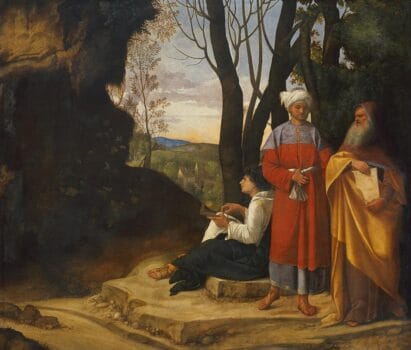
The painting depicts three male figures standing or seated in a rocky landscape near a cave. The figures differ markedly in age, dress, and apparent ethnicity. On the left stands an elderly man with a long white beard, wearing an Eastern-style robe and turban. In the center is a middle-aged man dressed in more contemporary Renaissance attire, holding a sheet of paper or diagram. On the right sits a younger man, casually posed, gazing outward while holding a compass or measuring instrument. Behind them is a dark cave, while beyond the cave opens a luminous landscape, rendered with Giorgione’s signature tonal softness.
At first glance, the scene appears calm and contemplative, yet its meaning has been debated for centuries. No contemporary documents identify the painting’s subject with certainty, and Giorgione left no written explanation. As a result, art historians have proposed multiple interpretations, each reflecting broader Renaissance concerns with philosophy, science, religion, and history.
One of the most influential interpretations identifies the figures as representatives of three stages in the development of human knowledge. The elderly man is often associated with ancient philosophy, possibly Aristotle or another Greek thinker, symbolizing classical wisdom. The middle-aged figure is seen as representing medieval or Islamic scholarship, reflecting the transmission of ancient knowledge through Arab philosophers such as Avicenna or Averroes. The youthful figure, equipped with scientific instruments, is commonly interpreted as embodying Renaissance humanism and the emerging modern scientific worldview. In this reading, the painting becomes a visual allegory of intellectual progress across time.
A related interpretation frames the figures as embodying the three ages of man: youth, maturity, and old age. This perspective emphasizes the human life cycle rather than historical chronology. The philosophical dimension remains, but the painting is understood more broadly as a meditation on time, experience, and the accumulation of wisdom. The cave behind the figures reinforces this reading, serving as a metaphor for the unknown or for hidden truth, echoing Platonic philosophy, particularly the Allegory of the Cave.
Other scholars suggest that the painting represents specific religious or historical figures. One longstanding theory identifies the men as the Three Magi, portrayed not at the moment of adoration but in contemplation, perhaps before encountering the Christ child. This interpretation draws on the Eastern dress of the oldest figure and the theme of philosophical searching. However, the absence of overt Christian iconography makes this reading less widely accepted.
Regardless of the exact subject, what distinguishes The Three Philosophers is Giorgione’s innovative approach to painting. Unlike earlier Renaissance artists who emphasized linear perspective and clear narrative structure, Giorgione prioritized atmosphere, color harmony, and emotional resonance. The figures are integrated into the landscape rather than dominating it, suggesting a unity between humanity and nature. The soft transitions of light and shadow, known as sfumato, contribute to the painting’s dreamlike quality and reinforce its contemplative mood.
The landscape itself plays a crucial symbolic role. The contrast between the dark cave and the sunlit background has been interpreted as a metaphor for ignorance and enlightenment, uncertainty and knowledge. The natural setting does not merely serve as a backdrop; it actively participates in the painting’s philosophical message. This approach was highly influential in Venetian painting and helped shape the work of later artists, most notably Titian, who is believed to have completed parts of the painting after Giorgione’s early death in 1510.
In the broader context of Renaissance art, The Three Philosophers exemplifies the period’s fascination with synthesis—between ancient and modern, East and West, science and philosophy. It reflects a moment when artists were not simply illustrators of religious doctrine but thinkers engaged with complex intellectual currents. Giorgione’s refusal to provide clear answers invites viewers into an active process of interpretation, making the painting perpetually relevant.
The Three Philosophers stands as one of the most important and intriguing works of the High Renaissance. Its enduring significance lies in its ambiguity, its philosophical ambition, and its pioneering visual language. Rather than offering a single, fixed meaning, the painting functions as a meditation on knowledge itself—how it is sought, transmitted, and transformed across generations. Through this masterpiece, Giorgione affirms art’s power not merely to depict the world, but to question and deepen our understanding of it.
Who Painted “The Three Philosophers”?
Though universally attributed to Giorgione, the painting’s authorship has not been without contention. Giorgio Vasari, the famed 16th-century biographer of Renaissance artists, credited Giorgione with the composition but also noted that Sebastiano del Piombo, Giorgione’s contemporary, may have assisted in its execution. Whether this was a collaborative effort or solely Giorgione’s hand is uncertain, but what is irrefutable is the painting’s Giorgionesque qualities: dreamy naturalism, enigmatic expressions, and deeply embedded symbolism.
Commissioned by Taddeo Contarini, a wealthy Venetian merchant and humanist, the work was meant to provoke thought more than devotion. It is not a biblical scene, nor a straightforward portrait. Instead, it is a cerebral tableau, layered, ambiguous, and timeless.
The Scene Unveiled: What Do We See?
“The Three Philosophers” depicts three men of different ages situated near a dark cave at the edge of a sunlit landscape. The figures, an elderly man with a long white beard, a middle-aged turbaned figure dressed in Eastern robes, and a youthful man clad in contemporary Renaissance attire, appear to be engaged in quiet contemplation rather than conversation.
Behind them, nature pulses with serenity: a luminous hill, gentle trees, and distant valleys. But the focal point remains the interaction, or lack thereof, between the three men and the cave. The dark aperture into the mountain behind them adds a layer of visual and metaphorical mystery. What are they studying? Why do they appear disconnected yet unified in their positioning?
Who Are the Three Philosophers?
Scholars have debated the identities of these figures for centuries. While no conclusive documentation defines who they are, the general consensus interprets them as allegories of the three ages of man, or more significantly, the three stages of human knowledge and philosophical tradition.
The Elder Philosopher (Greek Antiquity)
This figure is often interpreted as representing Classical Greek philosophy, perhaps even Pythagoras or Plato. His aged appearance, long beard, and solemn demeanor link him to the ancient world’s wisdom. He is usually seen as the embodiment of rational thought and metaphysical inquiry, the thinkers who first posed the fundamental questions of existence.The Middle-Aged Philosopher (Islamic/Arab World)
Wearing Eastern robes and a turban, this man symbolizes the Arab transmission of ancient knowledge during the Middle Ages. He may represent the great Muslim philosophers like Avicenna (Ibn Sina) or Averroes (Ibn Rushd), who preserved and expanded upon Greek ideas during the Islamic Golden Age. This figure stands for interpretation, synthesis, and preservation of classical thought, the bridge between antiquity and the Renaissance.The Young Philosopher (Renaissance Europe)
Clad in contemporary Renaissance dress, this figure likely embodies the rebirth of knowledge in the West, the Renaissance itself. His youth symbolizes a new dawn, not just of learning but of empirical observation, individual thought, and humanist values.
Together, the three stand for a lineage of human knowledge: its birth in Greece, preservation in the Islamic world, and rebirth in Renaissance Europe.
Symbolism and Meaning: What Does the Painting Represent?
1. The Cave: Ignorance or Enlightenment?
The most compelling feature of the painting is perhaps not the philosophers themselves but the dark cave behind them. This has been variously interpreted as:
The Cave of Plato, from the famous allegory in The Republic, where humans are shackled inside a cave, seeing only shadows of reality. The cave symbolizes ignorance, and emerging from it represents enlightenment. Thus, the painting could be visualizing humanity’s journey from darkness (ignorance) to light (knowledge).
A Tomb or Womb, as symbolic of the origin of thought or the mystery of the cosmos, where philosophical inquiry begins.
An Astronomical Reference, as some believe the philosophers are engaged in charting the stars or measuring light, suggesting the birth of empirical science.
2. The Books and Instruments
Though not always prominent, subtle details like scrolls, measuring tools, or papers in the philosophers’ hands hint at mathematics, astronomy, and written knowledge. They are not idle thinkers but active investigators of nature and the universe.
3. The Landscape
The natural environment, rendered with Giorgione’s signature poetic touch, is not mere background but a symbol of harmonious existence, the beauty of the universe waiting to be understood. The contrast between the illuminated foreground and the shadowed cave suggests a metaphysical journey from the known into the unknown, or vice versa.
What Is Happening in the Painting?
What’s remarkable about “The Three Philosophers” is its stillness. Unlike religious paintings bustling with action or expressive drama, this composition invites quiet reflection. Each philosopher is caught in a moment of thought or observation. They are not interacting, suggesting that their roles in the transmission of knowledge are sequential rather than collaborative. The youth seems to be observing or even measuring the cave’s dimensions, while the older men are either deep in thought or instructing the next generation by presence alone.
There is no explicit narrative, no divine revelation, no mythological act. And yet, something profound is happening: the symbolic handover of wisdom across cultures and ages.
What Type of Art Is This?
“The Three Philosophers” is a quintessential example of High Renaissance art, specifically within the Venetian school. However, its uniqueness lies in how it steps outside the traditional categories of:
Religious Iconography: There are no saints, angels, or biblical stories.
Portraiture: These are not meant to be specific individuals (although some believe they are disguised portraits).
Allegory: It teeters between allegory and genre, capturing a philosophical scene in the style of narrative realism.
Stylistically, Giorgione employs sfumato, the soft blending of colors and edges, creating a dreamy, ethereal quality. Light flows gently through the canvas, and there is a sense of quietude that anticipates later Baroque introspection but remains grounded in Renaissance ideals of harmony and proportion.
The painting also introduces a concept crucial to later art: the poetic image. Like a visual poem, its meaning is never fixed but always unfolding. This makes Giorgione a forerunner of artistic ambiguity and depth.
Renaissance Humanism and Intellectual Revival
At its core, “The Three Philosophers” is a celebration of human reason, observation, and dialogue across cultures. In a time when Venice was a bustling hub of commerce, philosophy, and cross-cultural exchange, Giorgione’s painting may be seen as a visual manifesto of the Renaissance spirit: honoring the past, integrating diverse knowledge systems, and envisioning a future built on intellectual curiosity.
The Renaissance was not merely a rebirth of ancient ideas but an evolution of them, and Giorgione captures this delicate process, how wisdom transforms, survives, and thrives across boundaries of time, geography, and ideology.
Where Is The Painting The Three Philosophers Today
“The Three Philosophers” is housed at the Kunsthistorisches Museum in Vienna, Austria, part of the museum’s world-renowned collection of European paintings. It was acquired in the 17th century by the Habsburgs and has remained one of the museum’s treasured pieces.
Its presence in Vienna, far from its Venetian origins, adds yet another layer of symbolism: the journey of art and ideas across the European continent. Just as the painting tells a story of philosophical transmission, its physical movement mirrors the very theme it illustrates, the migration and preservation of thought.
Why “The Three Philosophers” Still Matters
Giorgione died young, likely of plague, in 1510, leaving behind fewer than a dozen paintings. Yet in “The Three Philosophers,” he offers a legacy far larger than his lifetime, a canvas that dares to ask: How do we know? From where does knowledge come? How is wisdom passed on?
It is a painting that asks viewers not to see but to ponder, not to accept but to question. It marks a turning point in art: from representation to interpretation, from decoration to philosophy, from religious instruction to humanist reflection.
In a world still grappling with how to synthesize old and new, East and West, science and philosophy, Giorgione’s silent philosophers remain standing, eternal observers of the cave and its light.
Bibliographic Notes:
Kunsthistorisches Museum Vienna Official Catalogs
Giorgio Vasari’s Lives of the Artists
David Rosand, Painting in Sixteenth-Century Venice
Edgar Wind, Pagan Mysteries in the Renaissance