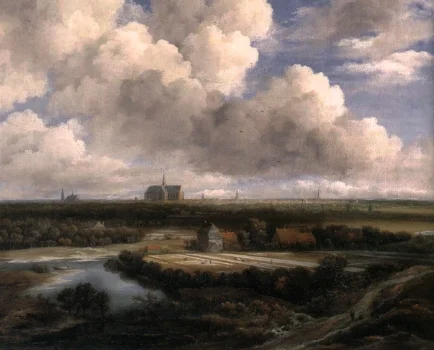
View of Haarlem with Bleaching Fields Landscape Painting
Jacob van Ruisdael’s View of Haarlem with Bleaching Fields stands among the most celebrated landscape paintings of the Dutch Golden Age. Known for its luminous skies, meticulous topographical detail, and profound symbolic resonance, the work captures not only a physical place but an entire cultural moment in 17th-century Holland. For art collectors, historians, and lovers of antique paintings, this masterpiece offers a fascinating combination of artistry, rarity, and historical significance.
This in-depth guide explores the history, controversies, symbolic meaning, what is happening in the scene, its actual location, and what the work could expect at auction today. Whether you’re researching for a collection, planning an acquisition, or simply admiring the genius of Ruisdael, this article offers everything you need to know.
Historical Background: Ruisdael, Haarlem, and the Birth of a Dutch Masterpiece
Jacob van Ruisdael (1628/29–1682) is widely considered the greatest landscape painter of the Dutch Golden Age. Working at a time when the Netherlands was experiencing unprecedented prosperity, Ruisdael transformed the landscape genre from decorative scenery into a deeply expressive and intellectually rich art form.
The Golden Age Context
During the mid-1600s, Holland’s booming textile industry, scientific innovations, and thriving merchant class created a new appetite for landscape paintings. These works were not commissioned by nobles but purchased by middle-class citizens who wanted scenes depicting their own land, industry, and national pride.
Haarlem, Ruisdael’s birthplace, was at the center of this cultural shift. The vast bleaching fields that surround the city were famous throughout Europe, producing some of the whitest linens of the era. By painting these fields repeatedly, Ruisdael was not merely depicting an agricultural scene but celebrating a cornerstone of Dutch economic identity.
Dating and Series of the Work
View of Haarlem with Bleaching Fields is part of a series of panoramic city views Ruisdael painted between 1660 and 1670. Several versions exist, all slightly different, and artworks from this series can be found in major museums including:
The Mauritshuis (The Hague)
The Louvre (Paris)
The Metropolitan Museum of Art (New York)
The Kunsthaus Zürich
Each version follows the same essential formula: a high, sweeping perspective over the flat Dutch landscape, dominated by an enormous cloud-filled sky.
What Is Happening in the Painting? A Scene of Dutch Industry and Daily Life
The painting presents a monumental panoramic view looking toward the city of Haarlem. Ruisdael achieved a remarkable sense of elevation, as if the viewer stands on a high dune, a vantage point that does exist north of Haarlem near the coastal dunes of Overveen and Bloemendaal.
The Bleaching Fields
The white rectangles scattered across the foreground represent linen bleaching fields, where newly woven cloth was spread out to be whitened by the sun. Workers tended to the cloth daily, sprinkling it with water to accelerate the chemical reaction between sunlight and natural bleaching agents.
Bleaching was a major industry in Haarlem, and Ruisdael’s inclusion of these fields can be interpreted as:
Documentary realism: capturing a recognizable economic activity
National pride: emphasizing Dutch craftsmanship and industry
Visual poetry: using bright linen to contrast with the darker earth tones
The Windmills
Scattered windmills appear in the middle ground. They were essential for pumping water out of the low-lying polders and maintaining the reclaimed land. Windmills were iconic symbols of Dutch ingenuity and engineering.
The City Silhouette
Far in the background, the spires of Haarlem rise delicately above the horizon. The most recognizable structure is St. Bavo’s Church, its monumental Gothic tower anchoring the composition.
The Luminous Sky
Perhaps the most striking element is the vast, billowing sky, consuming nearly three-quarters of the canvas. Ruisdael masterfully captured the fleeting play of Dutch light, with clouds casting shifting shadows across the land.
The interplay of light and shadow reflects:
The unpredictability of nature
A spiritual atmosphere
The Dutch fascination with meteorology
This sky transforms a simple view into a poetic meditation on the Dutch relationship with land, weather, and work.
Symbolism and Deeper Meaning
Although the painting looks straightforwardly realistic, Ruisdael infused it with symbolic undertones, reflecting religious, economic, and philosophical ideas of his time.
Protestant Dutch Values
During the 17th century, the Netherlands was a Protestant nation emphasizing modesty, labor, and piety. The carefully tended linen fields symbolize:
The reward of honest work
Purity and moral discipline
The prosperity of a hardworking society
The Transience of Light and Life
Ruisdael’s skies often carry religious symbolism. The contrast between the sunlit fields and encroaching clouds suggests:
The fleeting nature of human endeavors
The omnipresence of divine power
A meditation on spiritual reflection
While not overtly religious, the work evokes a sense of contemplation.
Mastery of Dutch Land Reclamation
The windmills and polders highlight Dutch achievements in reclaiming land from the sea. For 17th-century viewers, this was a point of immense national pride.
Ruisdael subtly communicates:
Human ingenuity over nature
Collective effort
Modern identity for the young Dutch Republic
Controversies and Debates: What Scholars Still Discuss
While the painting is widely admired, it is not without scholarly debate.
The Exact Vantage Point
For decades, historians debated whether Ruisdael painted the scene from an imaginary elevated view, since the Haarlem region is famously flat. However, recent research suggests he likely sketched the scene from the high dunes of Overveen, which provide a natural elevated viewpoint.
Still, the height depicted is somewhat exaggerated, Ruisdael likely enhanced the elevation for dramatic effect.
How Many Versions Did Ruisdael Paint?
There is disagreement about how many authentic View of Haarlem paintings exist. Most scholars identify:
Around 10–12 attributed versions
With 4–6 generally accepted as autograph masterpieces
Some versions appear to involve studio assistance, leading to ongoing attribution debates.
Was There a Political Message?
Some experts believe the painting subtly celebrates Dutch independence and innovation following the Eighty Years’ War. Others argue the painting is purely observational. Ruisdael left no writings clarifying his intent.
The Actual Location: Where the Scene Really Is
The setting can be traced to the sandy coastal dunes west of Haarlem, near:
Overveen
Bloemendaal
The Kennemerduinen nature reserve
From these dunes, one can still see:
The skyline of Haarlem
Open flatlands where bleaching fields once existed
Characteristic Dutch cloud formations driven by the North Sea
Although the bleaching fields have disappeared, modern visitors report that the sense of space and wind remains remarkably similar to Ruisdael’s depiction.
Artistic Techniques: Why Collectors Prize This Work
Collectors and museums value View of Haarlem with Bleaching Fields for many reasons:
Atmospheric Perspective
Ruisdael used sophisticated color modulation to create depth:
Warm tones in the foreground
Cooler blues and grays toward the horizon
Gradual loss of detail as the eye recedes
This gives the painting a sense of infinite distance.
Masterful Sky Painting
The clouds are painted with extraordinary precision and softness. Ruisdael used:
Thin glazes for transparency
Thick impasto for illuminated cloud edges
Subtle tonal transitions
His skies influenced later artists such as Constable and Turner.
Documentary Accuracy
Collectors admire the painting’s blend of realism and artistry. The buildings, fields, and windmills match historical Haarlem features.
Rarity of Large Panoramas
These panoramic works are among Ruisdael’s scarcest. Their rarity significantly enhances their market value.
Collector’s Insight: Rarity, Provenance, and Museum Holdings
Why This Theme Is Desirable
Ruisdael’s Haarlem views represent the pinnacle of Dutch topographical landscape painting. They rarely appear on the market because:
Most are in major museums
Those in private hands are tightly held
Their cultural significance makes them national treasures
Provenance Considerations
Because multiple versions exist, authentication is crucial. Scholars look for:
Signature and workshop clues
Consistency of brushwork
Dendrochronological analysis (for wood panels)
Early sales records
Condition reports and conservation history
Auction Value and Possible Price Today
Market Precedent
Ruisdael’s major paintings have achieved strong prices at auction:
Works of similar scale have sold for $5 million to $15 million
Smaller or less iconic works typically sell for $500,000–$3 million
However, a Haarlem panorama is significantly more important than the average landscape.
Why This Series Could Break Records
A fully autograph View of Haarlem with Bleaching Fields with excellent provenance could potentially achieve:
$20 million–$40 million at a major auction
Potentially even higher, due to rarity and museum-level quality
Given collector demand for Dutch Golden Age masterpieces and the scarcity of comparable works, some experts speculate that a pristine version could approach $50 million if two major institutions or collectors competed.
Practical Considerations for Collectors
Anyone considering acquisition should plan for:
Expert authentication
Conservation evaluation
Climate-controlled storage
Insurance for high-value artwork
Possible export restrictions (if in Europe)
Why This Painting Matters for Art History
Reinventing the Landscape Genre
Before Ruisdael, landscapes were often idealized or decorative. He transformed them into emotionally resonant, intellectually layered artworks.
A Symbol of Dutch Identity
The painting captures:
National pride
Technological progress
Harmony between humans and nature
Influence on Later Artists
Ruisdael’s landscapes inspired:
John Constable
J.M.W. Turner
German Romanticists
19th-century American landscapists
His use of sky, atmosphere, and spatial depth became foundational.
Tips For Antique Painting Lovers: How to Appreciate the Work More Deeply
Look at the Light
Observe how the clouds cast shadows across the bleaching fields. This interplay is the emotional heart of the painting.
Notice the Orderliness
The perfectly straight linen strips reflect Dutch order, industriousness, and civic pride.
Observe the Harmony
The painting balances:
Human labor
Natural beauty
Architectural presence
The immensity of the sky
Appreciate Its Stillness
Though workers and windmills imply activity, the overall impression is one of meditative calm, a hallmark of Ruisdael’s mature style.
The Lasting Legacy of Ruisdael’s Haarlem Masterpiece
View of Haarlem with Bleaching Fields is far more than a landscape. It is a profound cultural document, capturing Dutch industry, sky, land, and identity at a moment of extraordinary national pride. For art collectors and antique painting enthusiasts, it represents the pinnacle of Dutch Golden Age mastery: technically brilliant, historically rich, exceedingly rare, and emotionally resonant.
Whether viewed in a museum or considered for a private collection, it remains one of the most poetic and intellectually complex landscapes ever painted. Its blend of majestic skies, human labor, and quiet symbolism ensures that Jacob van Ruisdael’s vision of Haarlem will continue to inspire and captivate for generations.