The Laughing Fool: A Master of Mockery
Reflecting its joys, sorrows, and ironies, Art has long served as a mirror to society. One such artwork that has captivated historians, art lovers, and scholars alike is Laughing Fool, a painting that emanates a sense of intrigue and amusement. With its expressive portrayal of a laughing jester caught in a moment of raucous laughter, this portrait raises questions about its meaning, its artist, and the identity of its subject. In this comprehensive exploration, we delve into the essence of Laughing Fool, unravel its hidden symbolism, and reveal the secrets behind its painter and current location.
The Laughing Fool is a striking early sixteenth-century painting attributed to Jacob Cornelisz van Oostsanen, one of the most important Dutch painters active during the transition from the late Gothic tradition to the Northern Renaissance. At first glance, the work appears deceptively simple: a grinning figure dressed as a fool, gazing directly at the viewer. Yet beneath its playful exterior lies a complex visual language shaped by humanist thought, moral satire, and the evolving social role of art in the Netherlands. The painting reflects both van Oostsanen’s artistic milieu and broader cultural attitudes toward folly, wisdom, and human behavior in the early modern period.
Jacob Cornelisz van Oostsanen and His Artistic Environment
Jacob Cornelisz van Oostsanen was born around 1470 and worked primarily in Amsterdam, a city that was rapidly growing as a commercial and cultural center. He is widely regarded as the earliest major painter of Amsterdam whose name is known today. Van Oostsanen’s career coincided with a pivotal moment in Netherlandish art, when artists began to move away from strictly religious commissions and toward secular subjects, portraits, and moralizing genre scenes.
Although van Oostsanen remained deeply rooted in late medieval traditions, his work shows increasing engagement with Renaissance ideas circulating through prints, books, and imported artworks. He was also a prolific printmaker, and his familiarity with graphic satire and popular imagery likely influenced the directness and clarity seen in The Laughing Fool. This context is essential for understanding the painting not merely as a portrait, but as a visual commentary shaped by contemporary intellectual and social currents.
Description and Visual Characteristics of The Laughing Fool
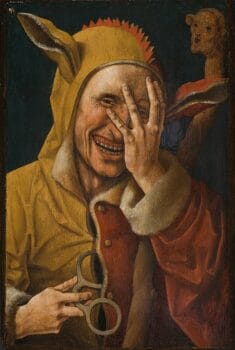
The Laughing Fool depicts a half-length figure dressed in traditional fool’s attire, including a cap that may allude to bells or exaggerated shapes associated with jesters. The subject’s wide grin, exposed teeth, and animated facial expression immediately capture attention. Unlike idealized portraits of the elite, this figure is intentionally exaggerated, almost caricature-like, emphasizing facial features to convey emotion and character rather than status.
The background is typically dark and neutral, a common device in early Netherlandish painting that isolates the figure and intensifies psychological presence. The fool’s direct gaze engages the viewer, creating an unsettling sense of confrontation. Rather than laughing at something within the scene, the figure seems to laugh at the viewer, implicating the audience in the joke or moral lesson embedded in the image.
The Figure of the Fool in Late Medieval and Renaissance Culture
To understand The Laughing Fool, one must consider the symbolic role of the fool in late medieval and Renaissance Europe. Fools were not merely entertainers; they were powerful cultural symbols. In literature, sermons, and visual art, the fool often represented moral blindness, spiritual ignorance, or the inversion of wisdom. At the same time, the fool could also function as a truth-teller, exposing hypocrisy through mockery and humor.
This duality is central to the painting’s interpretation. The fool’s laughter may signify joy and mockery, but it can also suggest moral emptiness or self-satisfaction. Viewers in van Oostsanen’s time, familiar with biblical passages such as “The fool hath said in his heart, There is no God,” would have recognized the image as a warning against arrogance, greed, or spiritual neglect.
Humanism, Satire, and Moral Commentary
The early sixteenth century saw the rise of humanist satire, particularly in Northern Europe. Writers such as Erasmus of Rotterdam, whose Praise of Folly was published in 1511, used irony and humor to critique social and religious corruption. The Laughing Fool aligns closely with this intellectual climate, translating literary satire into visual form.
Rather than presenting a narrative scene, van Oostsanen offers a single, emblematic figure that invites reflection. The fool’s exaggerated expression functions as a mirror, encouraging viewers to examine their own behavior. Are they laughing with the fool, or being laughed at? This ambiguity is a hallmark of humanist moral imagery, which sought to provoke self-awareness rather than deliver straightforward moral judgments.
Artistic Technique and Stylistic Influences
Stylistically, The Laughing Fool reflects van Oostsanen’s grounding in Netherlandish realism. The careful modeling of flesh, attention to surface detail, and emphasis on facial expression demonstrate technical skill honed through both painting and printmaking. At the same time, the work retains elements of late Gothic expressiveness, particularly in its bold characterization and lack of classical idealization.
The painting also shows the influence of popular prints and broadsheets, which often featured grotesque or humorous figures designed to communicate moral lessons to a broad audience. By adopting this visual language in a painted format, van Oostsanen blurred the boundaries between elite art and popular culture, expanding the function of painting beyond devotional use.
Patronage and Intended Audience
Unlike religious altarpieces commissioned by churches or wealthy patrons, works such as The Laughing Fool were likely intended for private homes. The growing merchant class of the Netherlands sought art that reflected their values, anxieties, and intellectual interests. Moralizing images with secular themes were particularly appealing, as they combined entertainment with ethical reflection.
The painting’s modest scale and direct imagery suggest it was meant to spark conversation rather than inspire devotion. It may have been displayed in a domestic interior where guests could engage with its message, reinforcing social norms through humor and shared cultural references.
Legacy and Art Historical Significance
The Laughing Fool holds an important place in the history of Dutch art because it anticipates later developments in genre painting and character studies. Artists of the seventeenth-century Dutch Golden Age, such as Frans Hals and Adriaen Brouwer, would continue exploring expressive faces and scenes of everyday life infused with moral undertones.
Van Oostsanen’s work demonstrates how early Netherlandish artists laid the groundwork for these later achievements by experimenting with secular subjects and psychological depth. The painting also contributes to our understanding of how Renaissance humanism manifested outside Italy, adapting classical and intellectual ideas to local traditions and concerns.
The Meaning of Laughing Fool: More Than Just a Jest?
At first glance, Laughing Fool appears to be a simple depiction of a court jester or fool, grinning broadly as if caught mid-laugh. However, as with many great works of art, the painting’s true meaning runs deeper than its surface charm. Fools and jesters held a peculiar position in historical European courts. They were not merely entertainers but often had the liberty to speak truths disguised as jokes, acting as unofficial advisors, provocateurs, and social commentators.
The Laughing Fool could symbolize several themes:
The fleeting nature of joy: Laughter, much like life, is ephemeral. The fool’s exaggerated expression might serve as a reminder of the temporary nature of happiness and the unpredictability of fortune.
The mockery of authority: Jest was a tool for ridiculing the powerful. By capturing a fool in a moment of uncontrolled mirth, the artist may be critiquing authority or highlighting the paradox of wisdom in foolishness.
Self-reflection: The fool’s laughter could be aimed at the viewer, as if inviting us to reflect on our own actions and beliefs.
This layered interpretation suggests that Laughing Fool is not merely a whimsical piece but a profound commentary on the human condition.
The Hidden Meanings of the Laughing Fool
What, then, are the hidden meanings of the Laughing Fool? Beneath the jester’s contagious grin may lie an intricate tapestry of symbolism, each detail inviting closer inspection. The painting asks the viewer to question: is the fool truly laughing from joy, or is that laughter a mask for something darker? Is his amusement genuine, or does it hide melancholy, irony, or even rebellion?
Throughout art history, fools have served as paradoxical figures, wise through their foolishness, honest through their jest. Their laughter often carried a double edge, at once humorous and haunting. In Laughing Fool, the exaggerated smile could signify more than amusement; it might symbolize a deep understanding of the absurdity of human existence. The fool, standing at the margins of society, sees truths that others cannot. His laughter may echo not from happiness, but from recognition, the recognition that life itself is a kind of performance, and that everyone wears a mask.
If we look closer, the painting may even pose an unsettling question: who is truly the fool? The laughing jester on the canvas, or the viewer who assumes his laughter is mindless? In this way, the work becomes a mirror, reflecting back our assumptions about joy, intellect, and sincerity.
The Symbolism of the Laughing Fool
The symbolism of the Laughing Fool extends far beyond his grin. In many cultures, the fool represents a liminal figure, one who stands between reason and madness, wisdom and folly, tragedy and comedy. His motley costume, bright colors, and cap with bells were not merely decorative; they symbolized contradiction and chaos, the breaking of social order through humor.
In the context of this painting, the laughter could also embody defiance. The fool’s grin may conceal rebellion, a subtle mockery of the power structures that sought to silence truth. By laughing, he diminishes fear; by jesting, he disarms authority. His apparent joy thus becomes a weapon, a disguise for critique.
Art historians often note how the laughter of fools in Renaissance art carried undertones of existential awareness. Just as tragedy can evoke catharsis, so too can comedy reveal uncomfortable truths. The Laughing Fool may, therefore, function as a satirical self-portrait of society, where the fool’s expression exposes the absurdity of human pretension, greed, and self-deception.
The Fool as Question to Authority
To laugh in the face of power is itself an act of courage. In royal courts, jesters were among the few who could mock kings without immediate consequence. They held up a distorted mirror to rulers, reminding them, through humor, of their mortality and fallibility. In this light, The Laughing Fool can be seen as a visual embodiment of truth cloaked in absurdity.
By depicting a fool who laughs so boldly, the artist may have been questioning the authority of both political and social systems. Is the fool laughing at a corrupt court? At the artist himself? Or perhaps at us, the audience, who so often seek order in a chaotic world? The laughter becomes not merely an emotional reaction but a philosophical challenge: a question about who holds power, who defines truth, and who dares to laugh at it all.
The Fool as Mirror of the Human Condition
Perhaps the most profound reading of The Laughing Fool lies in its portrayal of humanity itself. The fool, though dressed in motley and burdened by ridicule, reflects the contradictions within every person. We are, at different moments, both wise and foolish, joyful and despairing, free and constrained. The fool’s laughter captures that fragile tension, the recognition that life’s greatest truths are often wrapped in comedy.
In this sense, The Laughing Fool functions as a mirror of the human condition. His smile, though seemingly carefree, may express the artist’s meditation on the nature of existence: how laughter can spring from both joy and sorrow, how truth and deception intertwine, and how wisdom often hides behind the mask of madness.
What appears to be jest may, in fact, be an act of understanding. The fool laughs not because he is ignorant, but because he knows too much, because he sees the contradictions that define life and yet chooses laughter as his rebellion against despair.
More Than a Jest
Ultimately, The Laughing Fool stands as more than a playful depiction of mirth. It is a work that invites the viewer to look beyond surface joy and to confront deeper, more unsettling truths. Whether the grin conceals critique, melancholy, or rebellion, the painting challenges us to see laughter not as escape, but as revelation.
The fool’s laughter, wild, unapologetic, and ambiguous, remains a timeless reminder that wisdom often wears the face of folly, and that in mocking the world, we may come closest to understanding it.
What Is the Laughing Fool Holding?
A crucial detail that adds to the painting’s mystery is what the fool is holding. Various versions and interpretations exist, but one of the most widely recognized depictions shows the fool clutching a bauble, a small, scepter-like staff adorned with a miniature version of his own head. This was a common prop among court jesters, often serving as both a comedic device and a satirical symbol of self-awareness.
The bauble in Laughing Fool could signify:
- A symbol of self-mockery: The fool holds a reflection of himself, reinforcing the idea of self-deprecating humor.
- A paradox of wisdom: Though seen as a simpleton, the fool, through jest, often revealed deeper truths. The bauble represents this duality, both wisdom and foolishness encapsulated in one.
- A tool for entertainment: Historically, fools used baubles to enhance their performances, making the painting an authentic depiction of their role in court life.
In some versions, the fool may also be holding a goblet or tankard, which could allude to indulgence, revelry, or even a critique of excess. The ambiguity surrounding the object he holds only adds to the intrigue of the painting.
Who Painted The Laughing Fool?
The painting is often attributed to Jacob Cornelisz van Oostsanen (c. 1472–1533), a Dutch artist from the Northern Renaissance. His detailed and expressive style captured the vibrancy of human emotion, making him an ideal candidate for this lively portrait. However, there is debate among art historians about whether he was the definitive creator of the piece.
Another significant attribution goes to Frans Hals (c. 1582–1666), a Dutch Golden Age painter renowned for his loose, expressive brushwork and ability to capture fleeting moments of human expression. Hals’ series of paintings featuring laughing, drinking, and merry subjects, such as The Laughing Cavalier, align closely with the style and theme of Laughing Fool.
Despite these attributions, the exact origin of the painting remains somewhat ambiguous. The piece could also be the work of an anonymous artist, inspired by the Renaissance and Baroque traditions of depicting jesters as complex, multifaceted figures.
Where Is The Laughing Fool Painting Today?
The most well-known version of Laughing Fool is housed in the Rijksmuseum in Amsterdam, Netherlands. The museum, famous for its extensive collection of Dutch masterpieces, provides a fitting home for a painting steeped in Dutch artistic heritage.
There are also similar versions and derivatives of the painting in private collections and other European museums, reinforcing its popularity and widespread influence. Some variants have slight differences in the fool’s facial expression, attire, or the object he holds, suggesting multiple renditions by either the same artist or different painters influenced by the original.
The Enduring Legacy of Laughing Fool
The Laughing Fool continues to be a source of fascination for art enthusiasts and historians. Its expressive nature, symbolic richness, and the lingering mysteries surrounding its creator and subject make it a timeless piece. Beyond its artistic appeal, the painting serves as a cultural artifact that reflects societal attitudes toward humor, power, and human emotion.
Ultimately, Laughing Fool challenges us to consider the role of jest in both history and our own lives. Are we, like the fool, laughing at the absurdity of existence? Or is the fool laughing at us, knowing something we have yet to understand?
The Laughing Fool by Jacob Cornelisz van Oostsanen is far more than a humorous depiction of a jester. It is a carefully constructed moral image rooted in the cultural, intellectual, and artistic transformations of the early sixteenth-century Netherlands. Through its expressive realism, symbolic ambiguity, and engagement with humanist satire, the painting invites viewers to confront the thin line between wisdom and folly.
As both a product of its time and a precursor to later Dutch artistic traditions, The Laughing Fool remains a compelling example of how art can entertain, critique, and challenge its audience simultaneously. Its enduring power lies in its ability to turn laughter into reflection, reminding viewers that folly is not merely something to observe, but something to recognize within oneself.
Whatever the case, the painting remains a masterstroke of artistic wit, a reminder that sometimes, the wisest words are spoken through laughter.