Flora Painting, Titian: A Masterpiece of Allegory and Myth
Among the greatest treasures of Renaissance art, Flora by Titian stands as an emblem of sensual beauty and allegorical mystery. Painted in the early 16th century by the Venetian master Tiziano Vecellio, better known as Titian, this work has captivated audiences for centuries with its enigmatic subject and the emotional depth captured in a single glance.
But what does Flora truly represent? Who was Flora, and why would Titian choose to immortalize her in paint? To answer these questions, we must travel not only into the rich layers of symbolism embedded in the canvas, but also into the mythologies of antiquity, the culture of Renaissance Venice, and the life of the painter himself.
The Painting: A Description of Flora
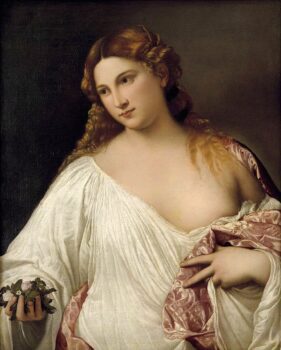
Flora is a half-length oil painting of a young woman, traditionally identified as the Roman goddess of flowers and spring. She is portrayed in a three-quarter view, turning gently toward the viewer. Her expression is serene, contemplative, and slightly melancholic, as if caught in a moment of introspection. Her auburn hair cascades down over her shoulder in soft curls, and her luminous skin glows with lifelike radiance.
Flora depicts a young woman turned slightly toward the viewer, wrapped in a soft, white chemise and a luxurious golden mantle. She holds a cluster of flowers delicately in her right hand, while her left gathers her drapery in a gesture that is both modest and alluring. Her expression is calm, introspective, and subtly sensual, an effect intensified by the warm, diffused lighting characteristic of early Titian. The painting’s rich colors, impeccable textures, and almost breathing lifelikeness demonstrate why Titian became the preeminent master of Venetian painting.
The central question that has long surrounded Flora concerns the true identity of the model and what she represents. Traditionally, she has been associated with Flora, the Roman goddess of spring and fertility. The flowers she carries, combined with her gentle sensuality, support this mythological reading. However, Renaissance artists often used classical symbols while still depicting real individuals. Some scholars argue the woman may have been a Venetian courtesan, perhaps even the famous courtesan Angela del Moro, whose portrait was idealized and given mythic overtones. Others believe she represents the Renaissance concept of the “bella donna,” a type of ideal beauty rather than a specific person. Because Titian repeated similar facial features in several works from this period, some propose the painting was meant as an allegory of beauty, purity, or even marital virtue.
The controversy intensifies when considering the sitter’s clothing and pose. The chemise slipping off her shoulder and her partially exposed body have led some critics to view the image as erotic or even commercial in nature. Renaissance Venice had a complex culture surrounding beauty, display, and social status, and courtesans often occupied a paradoxical position: socially marginal yet culturally celebrated. In this context, Flora may reflect both admiration and anxiety about female sexuality. On the other hand, the serene expression and gentle handling of light suggest a more poetic, elevated intention. Scholars who reject the courtesan theory argue that Titian’s aim was not provocation but idealization, using the language of antiquity to explore themes of nature, beauty, and renewal.
Reception of Flora has shifted significantly across the centuries. In the seventeenth century, the painting was admired for its softness and color but seen as somewhat ambiguous in theme. By the nineteenth century, Romantic and Victorian viewers embraced it as an image of pure, natural beauty, celebrating Titian’s ability to elevate feminine grace. In modern scholarship, the painting has become a key case study in discussions of gender, representation, and the male gaze. Contemporary viewers remain captivated by the sitter’s humanity and the painting’s atmospheric richness. Exhibitions featuring Flora routinely draw significant international attention.
When critics analyze Flora, they frequently highlight the balance between sensuality and restraint. The painting demonstrates Titian’s mastery of “colorito,” the Venetian technique emphasizing rich color and subtle tonal transitions. Its delicate textures, especially in the fabrics and hair, are often praised as some of the most refined in Titian’s early career. Many critics describe the work as a turning point in the evolution of Venetian portraiture, helping shift emphasis from rigid formality toward emotional presence and psychological depth.
As for monetary value, Flora is considered priceless and is unlikely ever to appear on the market due to its importance to the Uffizi’s collection and its status as a cultural treasure. However, comparable Titian works have sold for tens of millions of dollars, and experts estimate that if Flora were hypothetically auctioned, its value could exceed $100 million. Beyond financial worth, its historical, cultural, and artistic significance makes it one of the most invaluable paintings of the Renaissance.
Titian: The Painter and His World
Titian painted Flora around 1515, during his early maturity. At this point, he was already emerging as the most important painter in Venice. His style combined the coloristic brilliance of his mentor, Giovanni Bellini, with the innovative dynamism of Giorgione, his peer and early collaborator.
Venice in the early 16th century was a hub of trade, culture, and sensuality. It was a city of rich merchants, powerful nobility, and a unique fusion of Eastern and Western influences. The Renaissance ideals of humanism, mythology, and classical beauty flourished in this environment, and artists were often commissioned to create works that celebrated not only religious themes but also secular pleasures and allegories.
It is in this world that Titian’s Flora was born, a painting that merges myth, allegory, and an idealized form of feminine beauty.
Who Is Flora? The Myth Behind the Muse
In Roman mythology, Flora is the goddess of flowers, fertility, and spring. She is one of the lesser-known deities in the Roman pantheon, but her domain is vital: she governs the blooming of plants and the renewal of life after the dead of winter.
Flora’s myth finds its most famous source in Ovid’s Fasti, a poetic calendar of Roman festivals. According to Ovid, Flora was originally a nymph named Chloris. One day, as she wandered through the fields, she was pursued by Zephyrus, the god of the West Wind. Though the myth contains darker undertones, Zephyrus forces himself upon her, he later regrets his violence and transforms her into Flora, making her a goddess and bestowing upon her a garden of eternal spring.
As Flora, she becomes a giver of life and a symbol of the perpetual rebirth of nature. Ovid describes her as scattering seeds and blossoms with every step, adorned with garlands and surrounded by the vibrant flora of the earth. Her festival, the Floralia, was celebrated in late April and early May with games, theatrical performances, and the wearing of colorful garments and flowers.
Flora, then, is not only a goddess of natural beauty but also a symbol of fertility, erotic energy, and the cyclical nature of life and love.
What Does Flora Represent in Titian’s Painting
The identification of Titian’s figure as Flora is not based on any inscription by the artist but rather on the clues embedded in the painting itself. The flowers she holds are not random, they are carefully chosen symbols. Myrtle is associated with Venus, the goddess of love. Roses also connect to Venus and to love more broadly. Jasmine, with its sweet scent, is a traditional emblem of sensuality.
Her bare shoulder and the suggestive draping of her garments hint at eroticism, but her gaze and demeanor are not overtly seductive. She seems pensive, gentle, and dignified, a woman aware of her beauty, yet imbued with an inner depth. This balance between sensuality and serenity is a hallmark of Titian’s portrayal of the feminine ideal.
But beyond the surface, Flora can be read as an allegory. Renaissance viewers would have been well-versed in decoding the visual language of myth and symbol. To them, Flora might have represented:
Fertility and Marriage: The flowers and the modest (yet erotic) presentation might signal the virtues and expectations of a bride.
Ideal Beauty: Flora could be a personification of bellezza, the Renaissance concept of idealized feminine beauty.
Love and Transience: Her youth and beauty might also be seen as fleeting, a moment of perfection destined to fade, an idea echoed in the stillness and contemplative tone of the painting.
Venetian Courtesans: Some art historians have suggested that Flora might represent a cortigiana onesta, a high-class courtesan in Renaissance Venice known not only for her beauty but also for her education and refinement. Such women were often muses and patrons of the arts, and their ambiguous social status made them complex symbols of both virtue and desire.
A Portrait or an Allegory
There has been much debate about whether Flora is a portrait of a real woman or a purely allegorical figure. Some have speculated that she might have been one of Titian’s lovers or muses, given the intimate and personal atmosphere of the painting. Others argue that she is an idealized amalgam of feminine beauty, designed to convey universal themes rather than individual identity.
In truth, the genius of Flora lies in this very ambiguity. She is both a person and a symbol, both timeless and momentary. Like the mythological goddess herself, she is caught between the real and the divine, the carnal and the sacred.
Influence and Legacy
Titian’s Flora was immensely influential in the centuries that followed. The painting inspired generations of artists, especially in the Baroque period, who sought to emulate the Venetian master’s ability to render skin, fabric, and light with such astonishing vitality.
Moreover, Flora became a model for the portrayal of mythological and allegorical female figures in European art. The soft, glowing flesh, the lush textures, the inward gaze, all became hallmarks of idealized beauty in Western painting.
Even in literature and music, the figure of Flora endured. She became a symbol of youth, springtime, and fleeting beauty, a muse for poets and composers alike.
Where Is Flora Oil Painting Today
Titian’s Flora is currently housed in the Hermitage Museum in St. Petersburg, Russia. It is one of the highlights of the museum’s vast collection of Renaissance art, which includes works by Leonardo da Vinci, Raphael, Caravaggio, and many others.
The painting made its way to the Hermitage through a winding path of ownership. It was once in the collection of Christina of Sweden, who abdicated her throne and settled in Rome. From there, it passed through the hands of various collectors, including Philippe II, Duke of Orléans, before eventually arriving in Russia in the 18th century as part of Catherine the Great’s ambitious efforts to build one of the world’s greatest art collections.
Today, Flora remains a beloved masterpiece in the Hermitage, admired by thousands of visitors each year who marvel at its delicate beauty and enduring mystery.
The Enduring Allure of Flora
More than five centuries after its creation, Flora continues to enchant and intrigue. Its subject, drawn from the myths of ancient Rome, speaks to eternal themes: the renewal of life, the passage of time, the nature of beauty, and the complexities of love and desire.
Titian, with his unmatched ability to capture the soul through paint, gives us a figure who is at once goddess and woman, symbol and self. She holds her flowers as if caught between offering and withholding, between blossoming and fading. She looks out at us, yet seems lost in her own thoughts.
And perhaps that is the true magic of Flora, not just in what she represents, but in what she leaves unsaid. In her gaze, we find not only the elegance of Renaissance artistry, but a mirror reflecting our own questions about beauty, identity, and the meaning of myth in our lives.