Napoleon Crossing the Alps
Jacques-Louis David’s Napoleon Crossing the Alps (1801–1805) is one of the most iconic images of political power and propaganda in Western art. The painting commemorates Napoleon Bonaparte’s daring crossing of the Alps in 1800, when he led his army through the Great St. Bernard Pass to surprise Austrian forces in Italy. Rather than offering a literal or documentary account of the event, David presents an idealized and symbolic portrayal that elevates Napoleon from military leader to heroic legend. Through composition, symbolism, and stylistic choices rooted in Neoclassicism, the painting constructs a powerful image of authority, control, and destiny.
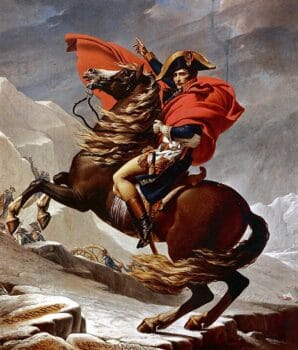
At first glance, the painting depicts Napoleon mounted on a rearing horse, pointing decisively upward as if commanding both his troops and nature itself. His posture is calm and assured despite the horse’s dynamic movement and the harsh alpine environment. This contrast immediately establishes Napoleon as a figure of composure and mastery. Historically, Napoleon crossed the Alps on a mule, wearing a practical uniform, and under difficult conditions. David deliberately rejects these realities in favor of a more dramatic and glorifying image. The goal was not historical accuracy but the creation of a political myth that reinforced Napoleon’s legitimacy and greatness.
The composition of the painting is highly dynamic. Diagonal lines dominate the scene, from the horse’s raised forelegs to the billowing cloak and the steep mountain slopes in the background. These diagonals create a sense of movement and energy, suggesting forward momentum and inevitable progress. Napoleon’s outstretched arm directs the viewer’s eye upward and forward, symbolizing leadership and vision. The turbulent sky and rocky terrain emphasize the danger of the journey, which in turn magnifies Napoleon’s courage and determination. Nature appears powerful and chaotic, yet Napoleon remains in control, reinforcing the idea that he is a leader capable of overcoming any obstacle.
Symbolism plays a central role in the painting’s message. Inscribed on the rocks in the foreground are the names “BONAPARTE,” “HANNIBAL,” and “KAROLUS MAGNUS” (Charlemagne). By placing his name alongside those of two legendary military commanders who also crossed the Alps, David situates Napoleon within a historical lineage of great conquerors. This visual association suggests that Napoleon is not merely a contemporary general but a figure of enduring historical significance. It also implies continuity between classical antiquity, the medieval empire, and modern France, aligning Napoleon with timeless ideals of leadership and empire.
The painting’s style reflects the principles of Neoclassicism, an artistic movement that emphasized clarity, order, and references to classical antiquity. David was a leading figure of this movement, and his approach is evident in the painting’s clean lines, idealized anatomy, and controlled composition. Napoleon’s face is youthful and serene, lacking signs of strain or fatigue. His uniform is pristine, and his posture resembles that of classical equestrian statues, particularly those of Roman emperors. These stylistic choices reinforce the image of Napoleon as a rational, heroic, and almost timeless leader, consistent with Enlightenment ideals of reason and virtue.
Color also contributes to the painting’s impact. The contrast between Napoleon’s bright uniform and cloak and the muted, earthy tones of the mountains draws attention to him as the focal point. The red cloak, in particular, symbolizes power, authority, and sacrifice, while also enhancing the dramatic effect of the scene. Light is used strategically to illuminate Napoleon, further separating him from the darker, more chaotic background and emphasizing his prominence.
Ultimately, Napoleon Crossing the Alps functions as a work of political propaganda as much as a piece of fine art. Commissioned at a time when Napoleon was consolidating power, the painting was intended to shape public perception and project an image of heroic leadership. It transforms a difficult military maneuver into a grand, almost mythological event and presents Napoleon as a ruler destined for greatness. By blending historical reference, symbolic imagery, and Neoclassical style, David created an enduring visual statement that continues to influence how Napoleon is remembered. The painting demonstrates how art can be used to construct political identity and immortalize power, making it a defining example of the relationship between art, history, and authority.
Where is Napoleon Crossing the Alps Painting Located
One of the most famous and dramatic depictions of Napoleon Bonaparte, Napoleon Crossing the Alps ,also known as Napoleon at the Saint-Bernard Pass, is an iconic oil painting created by the French artist Jacques-Louis David. This striking neoclassical masterpiece was commissioned in 1801 and has since become synonymous with Napoleon’s ambition and military prowess.
There are actually five known versions of Napoleon Crossing the Alps, each housed in different locations around the world:
- Château de Malmaison, France – The original version, completed in 1801, resides in Château de Malmaison, the former residence of Napoleon and his wife Josephine. This version was commissioned by King Charles IV of Spain.
- Belvedere, Vienna, Austria – Another version of the painting can be found in the Belvedere Museum in Vienna, Austria. This copy was commissioned in 1801.
- Palace of Versailles, France – A third copy is held in the Palace of Versailles, which remains a historic site dedicated to French monarchy and political power.
- Musée National du Château de Fontainebleau, France – Fontainebleau also houses a version of the painting, adding to the collection of Napoleonic relics.
- Kunsthistorisches Museum, Vienna, Austria – The final version is displayed in the Kunsthistorisches Museum, one of the most prestigious art museums in Austria.
Thus, while there is no single location for Napoleon Crossing the Alps, these five copies ensure that the image of Napoleon as a bold and fearless leader continues to be admired across Europe.
Despite being one of Jacques-Louis David’s most renowned paintings, Napoleon Crossing the Alps is not displayed in the Louvre Museum in Paris. Instead, the Louvre houses other significant works by David, including The Coronation of Napoleon, a grand and detailed depiction of Napoleon’s self-coronation as Emperor in 1804. However, the Louvre does feature numerous Napoleonic artworks, sculptures, and historical artifacts.
If you are visiting the Louvre to admire Napoleon’s imagery, you will find The Coronation of Napoleon in the museum’s Denon Wing, where it takes a place of prominence due to its massive size and historical importance. But for Napoleon Crossing the Alps, you will need to visit the Château de Malmaison or the Palace of Versailles in France.
Why is Napoleon Crossing the Alps Important?
Napoleon Crossing the Alps is an essential piece of art history, not just for its aesthetic brilliance but also for its deeper historical and political implications. It represents several key themes:
1. Political Propaganda
At the time of the painting’s creation, Napoleon was at the height of his power and wanted to craft an image of himself as a heroic and visionary leader. The painting was designed to solidify his status as a strong and decisive ruler, depicting him as a fearless commander leading his army through treacherous conditions.
2. Neoclassical Art Movement
David was a master of neoclassical art, and Napoleon Crossing the Alps is a prime example of this style. The painting emphasizes grandeur, idealism, and order, characteristics that align with Napoleon’s political ambitions. The detailed rendering of Napoleon’s red cape, his determined gaze, and the muscular, powerful horse all contribute to the myth-making of Napoleon as a larger-than-life figure.
3. Historical Symbolism
The painting commemorates Napoleon’s daring decision to cross the Saint Bernard Pass in 1800 during the War of the Second Coalition against Austria. This strategic maneuver led to a crucial French victory at the Battle of Marengo. Though in reality, Napoleon likely crossed the Alps on a mule rather than a majestic stallion, the painting elevates the moment into a legendary feat of courage and strategy.
Why is Napoleon Crossing the Alps Famous?
Several factors contribute to the lasting fame of Napoleon Crossing the Alps:
1. Powerful Imagery and Symbolism
The painting is filled with striking visual elements that make it instantly recognizable. Napoleon’s outstretched arm, pointing towards destiny, is a classic symbol of leadership and ambition. The flowing red cape adds dynamism, while the stormy sky and mountainous terrain evoke drama and grandeur. These elements create a captivating, almost cinematic quality that has fascinated viewers for centuries.
2. Artistic Mastery
Jacques-Louis David was one of the most skilled painters of his time, and this piece showcases his expertise in composition, light, and movement. The contrast between Napoleon’s composed expression and the wild energy of the horse highlights the painter’s ability to convey both human emotion and natural forces in a single frame.
3. Enduring Influence
Napoleon Crossing the Alps has been widely reproduced, parodied, and referenced in popular culture, from political cartoons to modern advertising. It has inspired countless reinterpretations, solidifying its status as one of the most famous portraits of military leadership.
4. Napoleon’s Legendary Status
Napoleon Bonaparte remains one of the most studied and controversial figures in history. His military genius, political reforms, and dramatic rise and fall continue to capture the imagination of scholars and the public alike. This painting serves as an enduring testament to his legacy, ensuring that his image remains etched in history.
Napoleon Crossing the Alps is more than just a portrait; it is a powerful piece of historical propaganda, a masterpiece of neoclassical art, and an enduring symbol of ambition and leadership. While it is not housed in the Louvre, its five versions can be found in locations such as Château de Malmaison, the Palace of Versailles, and museums in Austria. Its importance lies in its role as a political tool, its artistic brilliance, and its contribution to Napoleon’s larger-than-life mythos. Today, it remains one of the most recognizable images in Western art, capturing the essence of one of history’s most influential figures.