The Story Behind the Arnolfini Portrait (ca. 1434)
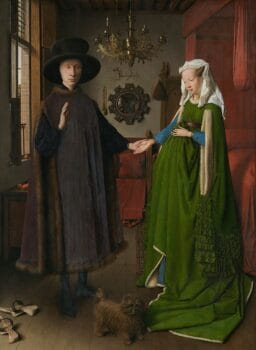
Jan van Eyck’s Arnolfini Portrait is one of the most enigmatic and closely studied paintings of the Northern Renaissance. Created in 1434, it depicts a richly dressed man and woman standing in a domestic interior, their hands loosely linked, surrounded by objects rendered with astonishing detail. Although often described as a wedding or betrothal scene, the painting’s true meaning has long been debated, and its mystery is part of what has made it so iconic.
At the center of the painting stand Giovanni di Nicolao Arnolfini, an Italian merchant living in Bruges, and a woman traditionally identified as his wife, Giovanna Cenami. However, historical records complicate this identification: Giovanni Arnolfini and Giovanna Cenami appear not to have married until 1447, thirteen years after the painting was completed. This discrepancy has led scholars to propose that the woman may be Arnolfini’s first wife, Constanza Trenta, who had died by 1433. If so, the portrait may serve as a memorial or a solemn tribute rather than a wedding picture. Others argue that it is neither a wedding nor a memorial but instead a formal record of a couple within their home, expressing status, piety, and cultural identity.
Objects placed throughout the scene enrich the painting’s narrative through symbolism. The solitary lit candle in the chandelier, for instance, has been interpreted as representing the presence of God or a symbol of marriage. The faithful little dog at the couple’s feet traditionally symbolizes loyalty or fidelity. The oranges on the chest and windowsill evoke luxury, these were costly imports in the Low Countries, and may also reference fertility or the couple’s prosperous status. Van Eyck’s meticulous attention to textures, fur, wood, glass, metal, reinforces the couple’s wealth and the painter’s technical mastery.
One of the most intriguing elements is the convex mirror on the rear wall. Its curved surface reflects not only the backs of the couple but also two additional figures standing in the doorway, one of whom may be van Eyck himself. Above the mirror, written in elaborate script, are the words Johannes de eyck fuit hic (“Jan van Eyck was here”). This unusual inscription has fueled speculation that the painting served a legal or documentary purpose. In the 15th century, artists sometimes served as witnesses in legal attestations; thus, some historians believe van Eyck may have been formally recording an event, perhaps a private contract or oath between the couple.
The portrait is also notable for its naturalism. Van Eyck’s use of oil paint, then still a relatively new medium, allowed him to create vibrant colors and subtle variations of light. The tiny highlights on the beads of the rosary, the reflections in the mirror, and even the woven patterns of the carpet all exemplify van Eyck’s astonishing optical precision. His mastery helped establish oil painting as the dominant medium of Northern European art.
Overall, the Arnolfini Portrait remains captivating precisely because it resists a single, definitive interpretation. Whether read as a document of marriage, a memorial, a display of wealth, or a symbolic meditation on fidelity and domestic life, it stands as one of the most technically brilliant and narratively rich paintings of the Renaissance.
Exploring Marriage and Gender Through the Arnolfini Portrait
Marriage as a Legal Contract
In the fifteenth century, marriage was fundamentally a legal and economic agreement rather than a purely romantic union. A couple could legally marry through verbum de praesenti, a mutual declaration of consent spoken in the present tense, even without clergy. This is one reason some scholars interpret the painting as a visual record of such a contract. The inscription above the convex mirror, “Johannes de eyck fuit hic” (“Jan van Eyck was here”), is unusual in portraiture and has been interpreted as a witness statement. If the painting is indeed documenting a legal act, it suggests that van Eyck was present as a witness to an oath or agreement, which aligns with the legal customs of the time.
The Role of Dowries and Material Wealth
Marriage arrangements typically involved negotiations over property transfers, dowries, and financial obligations between families. Several objects in the painting hint at wealth and the domestic prosperity that would accompany a substantial dowry. The oranges on the windowsill and chest, costly imports in Bruges, signal affluence. The ornate carpet, brass chandelier, and finely carved bedpost likewise reflect the economic status needed to sustain a household. These details, meticulously rendered, help modern viewers understand how displays of wealth functioned within marriage contracts: possessions were not merely decorative but communicated the financial security that underpinned a union.
Gender Roles and Domestic Authority
The composition subtly expresses the expectations placed on men and women within marriage. Giovanni Arnolfini stands closer to the window, a traditional symbol of his engagement with the public world of business and law. The woman stands nearer the bed, evoking associations with household management, fertility, and domestic responsibility. Her voluminous gown and high-waisted silhouette, once thought to suggest pregnancy but now understood as fashionable attire, still emphasize her role in lineage and family continuity. Meanwhile, Giovanni’s raised hand can be read as a gesture of oath-taking or authority, reinforcing the patriarchal structure of marital life.
Legal Customs Embedded in Symbolism
Objects throughout the room reflect legal and moral expectations for married couples. The single lit candle in the chandelier may symbolize divine presence overseeing the contract. The small dog at the couple’s feet represents fidelity, a moral and legal expectation within marriage. Even the convex mirror, showing scenes from Christ’s Passion in its decorative frame, acts as a reminder that Christian doctrine permeated marital law and ethical obligations.
Ultimately, the Arnolfini Portrait is a visual tapestry of the legal, economic, and gendered frameworks that defined marriage in the 15th century. Whether it records an actual contract or constructs an idealized image of Renaissance domesticity, the painting encodes the customs, hierarchies, and values that shaped married life in the world van Eyck so meticulously observed.
The Meaning of The Arnolfini Portrait
The Enigma of Jan van Eyck’s Arnolfini Portrait: A Masterpiece Shrouded in Mystery
Jan van Eyck’s Arnolfini Portrait (1434) is one of the most intriguing and masterfully detailed paintings in Western art. This small yet profoundly complex oil painting has fascinated scholars, historians, and art lovers for centuries. From its groundbreaking use of oil paint to its symbolic depth, this portrait is a visual riddle that continues to spark debate. But what makes it so significant? Why is it controversial? And what mysteries surround it? Let’s explore the fascinating world of The Arnolfini Portrait and attempt to unravel the secrets hidden within its frame.
Painted in 1434, The Arnolfini Portrait is often considered one of the greatest early Netherlandish paintings. Its significance lies in several key aspects:
1. A Pioneering Use of Oil Paint
Van Eyck was one of the earliest artists to fully exploit the capabilities of oil paint. Unlike tempera, which dries quickly and lacks depth, oil paint allows for meticulous detail, rich colors, and stunning light reflections. The Arnolfini Portrait showcases this technique masterfully, with luxurious textures in fabrics, the shimmer of glass, and the softness of human skin.
2. A New Approach to Portraiture
Prior to van Eyck, most portraiture was stiff and formal. However, this painting captures a moment of everyday life, filled with naturalism and personal presence. The couple depicted, Giovanni di Nicolao di Arnolfini and his wife, possibly Giovanna Cenami, stand in a richly decorated room, creating an intimate scene that feels alive and real.
3. A Complex Symbolic Language
Every detail in the painting carries meaning. From the chandelier with a single lit candle (possibly symbolizing divine presence or a wedding night) to the convex mirror that reflects unseen figures, the artwork is layered with hidden messages about wealth, status, marriage, and faith.
4. An Early Example of a Signed Painting
Van Eyck boldly inscribed his name above the mirror: “Johannes de Eyck fuit hic” (Jan van Eyck was here). This not only asserts his authorship but may also suggest that he served as a witness to whatever event is being depicted.
Why Is The Arnolfini Portrait Controversial?
Despite its artistic brilliance, The Arnolfini Portrait has been the subject of numerous controversies. Scholars have debated its meaning for centuries, leading to different interpretations and even historical disputes.
1. Is It a Wedding Portrait?
For a long time, art historians believed the painting depicted the wedding of Giovanni di Nicolao di Arnolfini and Giovanna Cenami. However, records suggest that the couple was married long after the painting was created, throwing this interpretation into question. Was this then a betrothal ceremony? A legal agreement? A mere representation of an idealized couple? The uncertainty continues to fuel academic debates.
2. The Role of the Mirror
The convex mirror at the center of the composition is more than just a reflection, it reveals two additional figures entering the room, one of whom could be the artist himself. Some believe this suggests that the painting was a legal document, witnessing a marriage contract. Others argue that it represents the presence of God or the viewer themselves.
3. The Question of Gender and Power
Some interpretations argue that the painting reflects the patriarchal structure of 15th-century Europe. The placement of Giovanni on the left, closer to the window, suggests his connection to the external world and commerce, while his wife stands near the bed, emphasizing her role in domestic life. Feminist readings have questioned whether the painting celebrates or critiques these gender roles.
4. Forgery and Ownership Disputes
The painting has also been embroiled in ownership controversies. It was once part of the Spanish royal collection before being taken by the British after the Napoleonic Wars. Today, it resides in the National Gallery in London, where debates about its rightful ownership occasionally arise.
The Mystery of The Arnolfini Portrait
Many mysteries surround The Arnolfini Portrait, adding to its allure. Some of the most puzzling elements include:
1. Who Are the Figures in the Mirror?
As mentioned, the convex mirror in the background reflects two figures entering the room. Some believe one of them is Jan van Eyck himself, subtly inserting his presence into the scene. Others suggest that they are wedding witnesses or legal officials.
2. The Meaning of the Hand Gesture
Giovanni’s raised hand appears to be an oath-taking gesture, reinforcing the idea of a legal contract or sacred vow. However, some scholars argue that it is simply a polite greeting, leaving its true intent uncertain.
3. Is the Woman Pregnant?
One of the most common misunderstandings about the painting is the belief that the woman is pregnant due to her swollen-looking belly. However, experts suggest that this was simply the fashion of the time, as women wore gowns with voluminous fabric that gave the illusion of pregnancy.
4. The Cryptic Signature
The Latin inscription “Jan van Eyck was here” raises questions. Was van Eyck a literal witness to the event depicted, or was this merely a stylistic flourish? Some even suggest that the painting may have been a memorial portrait, possibly created after the woman’s death.
Why Is There a Small Dog in The Arnolfini Portrait?
At the couple’s feet stands a small, fluffy dog, which seems to gaze directly at the viewer. This seemingly minor detail carries multiple layers of symbolism:
1. A Symbol of Fidelity
Dogs were commonly associated with loyalty and marital fidelity in Renaissance art. This would align with the painting’s possible theme of marriage and commitment.
2. A Status Symbol
Small dogs were luxury pets, often owned by the wealthy. The inclusion of the dog could signify the couple’s social status and wealth.
3. A Representation of Love or Carnal Desire?
Some interpretations suggest that the dog’s presence might allude to sensual love or earthly pleasures, adding another layer to the painting’s meaning.
How Much Is The Arnolfini Portrait Worth Today?
While The Arnolfini Portrait is considered priceless due to its historical and artistic significance, experts estimate that if it were ever sold (which is highly unlikely), it could fetch anywhere between $500 million and $1 billion. Given its influence on Western art and its importance in the history of oil painting, its value far exceeds any monetary sum.
Where Is The Arnolfini Portrait Today?
Today, The Arnolfini Portrait is housed in the National Gallery in London, United Kingdom. It was acquired by the gallery in 1842 for a modest sum but has since become one of its most treasured masterpieces. Millions of visitors each year stand before this enigmatic painting, drawn in by its exquisite detail and unresolved mysteries.
Jan van Eyck’s Arnolfini Portrait is more than just a beautifully painted image, it is a historical enigma filled with layers of meaning, symbols, and controversy. From its groundbreaking artistic techniques to its mysterious figures and debated symbolism, it continues to captivate audiences nearly 600 years after its creation. Whether it depicts a marriage, a legal contract, or something more elusive, its true meaning remains open to interpretation, ensuring its place as one of the most fascinating works of art in history.